


Within the burgeoning realm of tools aimed at enhancing child development, large busy boards stand out as pivotal in fostering interactive learning and sensory discovery. These complex panels are crafted not merely as playthings but as comprehensive educational environments. They are equipped with an array of elements such as levers to manipulate, dials to turn, and varied textures to investigate, thus introducing a new level of engaging developmental activities. Through a hands-on learning experience that surpasses what traditional toys offer, busy boards present an innovative approach to nurturing young minds. This detailed guide is designed to assist parents, educators, and caregivers in navigating the vast landscape of large busy boards. It highlights their benefits for developmental progress, offers advice on selecting the most suitable option, and suggests creative ways to fully leverage their educational value. We invite you to join us in delving into the world of these enthralling educational instruments, which are meticulously devised to encourage growth, ignite curiosity, and improve fine motor skills in children, thereby laying a foundation for a lifelong passion for learning.
Exploring the Basics: What Are Big Busy Boards?
Within the innovative realm of tools designed for child development, the large busy board stands as a pivotal instrument, acting as a vibrant sensory playground aimed at nurturing growth and facilitating learning in children. These extensive boards, often crafted through DIY efforts, are adorned with a variety of engaging elements such as latches, locks, knobs, and any item likely to spark a child's curiosity. Far beyond mere playthings, these boards serve as robust educational devices, drawing toddlers into meaningful interactions that bolster both their cognitive and motor abilities.
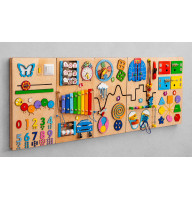
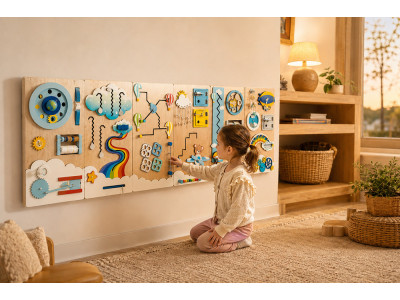
The trend of creating DIY Busy Boards for Toddlers has gained momentum among both parents and educators, driven by the desire to offer bespoke sensory experiences. Through the integration of diverse textures, colors, and practical items, these boards encourage youngsters to embark on exploratory and problem-solving adventures. The concept is expanded upon with large sensory boards or sensory wall panels, which cover broader interaction areas, making them perfectly suited for environments such as classrooms and pediatric therapy spaces.

The appeal of busy boards, especially for DIY aficionados, resides in their adaptability and the opportunity to customize them according to a child's particular interests and developmental phases. From straightforward designs that hone basic motor skills to intricate arrangements featuring sensory wall panels for complex problem-solving challenges, the scope for creativity is boundless. Regardless of whether they are purchased or handmade, these stimulating panels provide a tactile learning experience that surpasses the capabilities of conventional toys, establishing them as indispensable components of contemporary child development strategies.
The Developmental Benefits of Busy Boards
Busy boards transcend mere playthings, evolving into pivotal instruments for nurturing a child's developmental arc. These tactile interfaces, tailored as busy boards for infants or educational panels for toddlers, amalgamate a suite of activities that markedly bolster a child's developmental milestones.
Central to their utility is the enhancement of fine motor skills. The manipulation of various components—twisting, pulling, and grasping—fortifies the musculature of a child's hands and digits, laying foundational skills for writing and tasks demanding precision. Sensory wall panels further broaden this developmental spectrum by acquainting children with a medley of textures and stimuli, thus cultivating sensory processing capabilities vital for absorbing knowledge and interacting with their surroundings.
Cognitive growth is spurred as toddlers navigate the challenges posed by these boards, transitioning from mere play to engaging in problem-solving. Each task, from slotting shapes accurately to unlatching compartments, sharpens critical thinking and focus.
Moreover, linguistic abilities flourish through interactive play. These boards serve as conduits for enriching vocabulary as children articulate their actions or inquire about the various elements they engage with.
Social and emotional faculties are also honed. In communal settings, these boards become tools for fostering sharing and collaboration, guiding children in understanding and navigating the nuances of social exchanges.
In summation, busy boards are comprehensive educational apparatuses, bolstering a broad spectrum of developmental domains from the physical to the cognitive, thereby constituting essential components within any educational framework.
DIY vs. Store-Bought: Choosing the Right Busy Board for Your Child
When it comes to enriching your child's playtime and learning experience, deciding between a DIY busy board and a store-bought one is a pivotal choice. Both options offer unique benefits, and the best choice depends on various factors including personal preference, time, skills, and budget.
DIY busy boards are a popular choice for many parents and caregivers who wish to create a personalized learning tool tailored specifically to their child's interests and developmental stage. The process of making a busy board can be incredibly rewarding, offering a creative outlet and a meaningful bonding experience. It allows for complete customization, from selecting specific sensory wall toys to including favorite colors or themes. Additionally, crafting a DIY busy board can be cost-effective, especially if you're able to repurpose items you already have at home. However, it requires a significant time investment and a certain level of craftiness to ensure that the board is safe and durable.

On the other hand, store-bought busy boards provide convenience and professional design. These boards are typically crafted with safety standards in mind, using durable, child-safe materials that withstand rough play. Purchasing a busy board for your baby from a store or a trusted online retailer can save time and effort, especially for those who might not feel confident in their crafting abilities. Moreover, many commercially available boards come with innovative features that might be challenging to replicate at home, such as electronic components or themed play walls. The downside is that these boards can be more expensive and less customizable than their DIY counterparts.
Ultimately, whether you opt for a DIY approach or a store-bought busy board, the key is to focus on the developmental benefits it offers. Consider your child's age, interests, and what skills you'd like to develop or enhance through the board. Whether it's a learning wall filled with sensory wall toys or a custom-made busy board with family photos and household items, the goal is to provide a stimulating and educational experience that sparks joy and curiosity in your little one.
Innovative Ideas and Activities for Big Busy Boards
Big busy boards offer a world of developmental fun and endless learning possibilities for young minds. To maximize their potential, incorporating innovative ideas and activities can turn any big busy board into an adventure playground that stimulates, educates, and entertains. Here are some creative ways to enhance your big busy board experience:
- Transform your busy board into a landscape of themed sectors, each crafted to target distinct educational goals or sensory adventures. Consider setting up a 'nature' sector, outfitted with sensory panels that mimic the feel of the outdoors with elements like synthetic grass, polished pebbles, and textured bark, to spark a hands-on nature exploration.
- Spin tales using your busy board's features to weave engaging narratives. Imagine a scenario where a locked door on the board becomes the gateway to an enchanted garden, challenging the child to solve puzzles to gain entry. This method not only enriches the imagination but also serves as a practical lesson in cause and effect.
- Introduce color coordination activities by integrating parts of the learning wall that encourage color matching. This could be as straightforward as coloring distinct board sections and supplying corresponding colored items for matching, enhancing both color recognition and coordination skills.
- Dedicate a zone on your board for musical exploration, incorporating instruments or sound-producing items like bells and xylophones, or craft your own sound-making objects. This musical corner can serve as an introduction to the world of music and sounds, nurturing a foundational appreciation for the auditory arts.
After exploring these activities, if you're looking to expand your busy board's horizon with quality sensory wall panels, consider exploring our store at Bumblebee Smart. Our selection of sensory wall panels is designed to enrich your child's learning environment by providing them with an engaging tactile experience that supports their developmental growth. Visit us to find the perfect addition to your educational toolkit.




Write a comment