







-300x300.jpg)
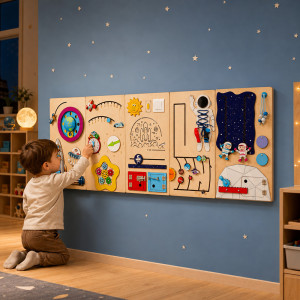
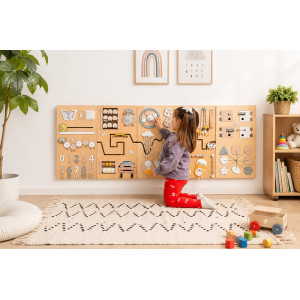
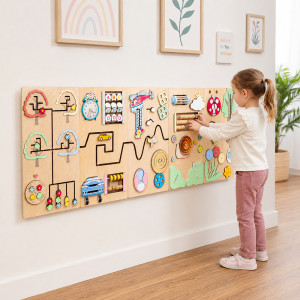
Sensory wall panels for schools turn ordinary classroom walls into structured, hands-on learning stations. Students of every age and ability can use them throughout the day. K-12 buildings, preschool rooms, special education classrooms, and sensory break spaces all need the same thing - a durable, always-available tool for regulation, fine motor practice, and quiet transitions. Wall-mounted panels give teachers that tool, without adding floor clutter or single-student toys that need constant supervision.
BumbleBeeSmart builds sensory wall panels used in public schools, private academies, Montessori programs, SPED classrooms and preschools across North America and Europe. Each panel is made from natural birch plywood and finished with non-toxic, water-based coatings. Panels mount directly to the wall, so they stay exactly where teachers need them.
Not sure where to start? See our school sensory room planning guide.
Why sensory wall panels belong in schools
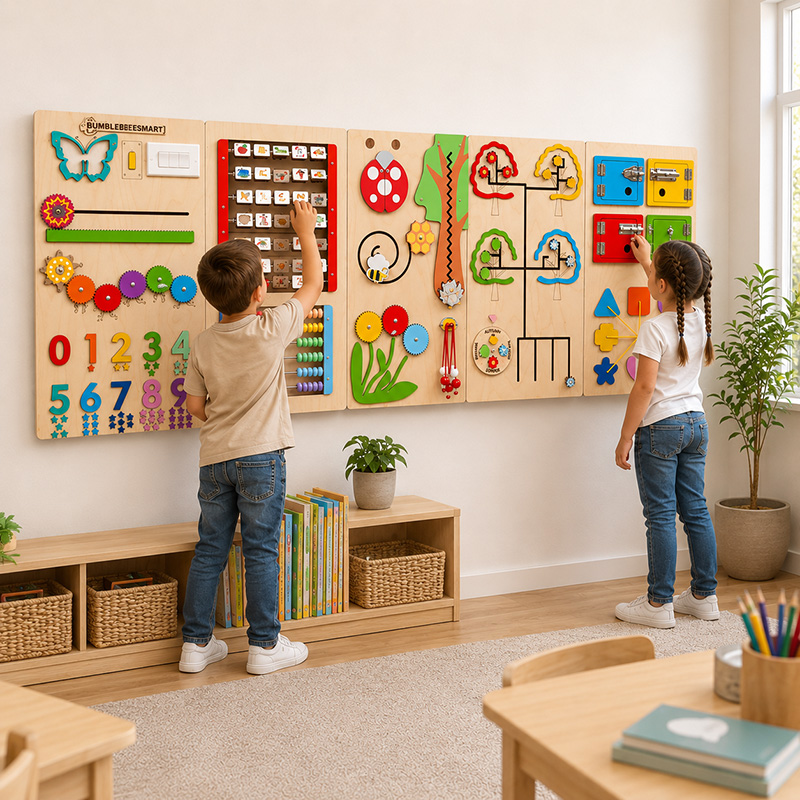
Sensory walls in schools do three things a shelf of loose toys cannot. They stay in place, they invite parallel play by several students at once, and they give kids something to do with their hands when their bodies need input and their minds need a break.
Self-regulation and sensory diet support
A wall-mounted busy board gives students a defined, teacher-visible spot to seek proprioceptive and tactile input. Sensory diet plans are common in SPED and inclusive general-ed rooms, and a sensory wall removes the need to hand out fidgets one by one. Students walk to the wall, use it, and return to their seat.
Fine motor development in pre-K and early elementary
Latches, knobs, gears, zippers and rotating elements build the same finger strength and bilateral coordination that early writing depends on. Preschool busy boards mounted at child height turn the wall itself into a motor skills station.
Calm corners, hallways and transition spaces
A single panel in a hallway or reading nook works as a quiet self-regulation stop between activities. Many districts have added calm corners as part of trauma-informed teaching frameworks. Sensory wall panels fit that role well - they're silent, screen-free, and need no adult setup.
Shared use without shared germs
All wooden surfaces wipe down with standard classroom disinfectant. There are no fabric elements, no small removable parts to lose, and no batteries to replace on base models. That matters most in high-turnover shared spaces - daycare rooms, media centers, before-and-after-care programs.
What to look for when buying sensory wall panels for a school
Age range and mounting height
A panel for a preschool room should sit lower than a panel for a middle school calm corner. We recommend mounting so the vertical center of the panel sits at eye level for the primary user group. Ask us for a mounting diagram - we send one with every order.
Safety and materials
Our panels are built with children's safety in mind: natural birch plywood, non-toxic water-based finishes, mechanically fastened elements, and rounded edges on preschool sets. For the full walkthrough of materials, finishes and safety choices behind every panel, see our sensory wall safety guide.
Durability under shared use
School panels get used harder than home panels. Birch plywood outlasts softwoods, and moving elements - hinges, gears, sliding parts - should be through-bolted rather than glued. Every element on our panels is mechanically fastened.
Customization for your program
Schools often ask for specific color palettes, dimensions to fit an existing wall bay, or a specific mix of elements aligned to an IEP goal set. Custom sizing, color matching and element selection are all available - contact us with your requirements and we'll come back with a spec.
Installation
Panels ship pre-assembled with mounting hardware and a printed guide. One maintenance person can install a standard panel in under 30 minutes. Larger multi-panel walls take a couple of hours for a two-person team.
Planning a school installation?
Send us your wall dimensions and student age range, and we'll come back with a panel selection, a mounting layout, and a quote for your purchasing office.
Sensory wall panels by school setting
Preschool and pre-K rooms
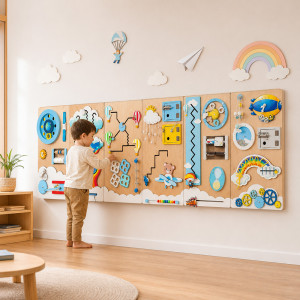
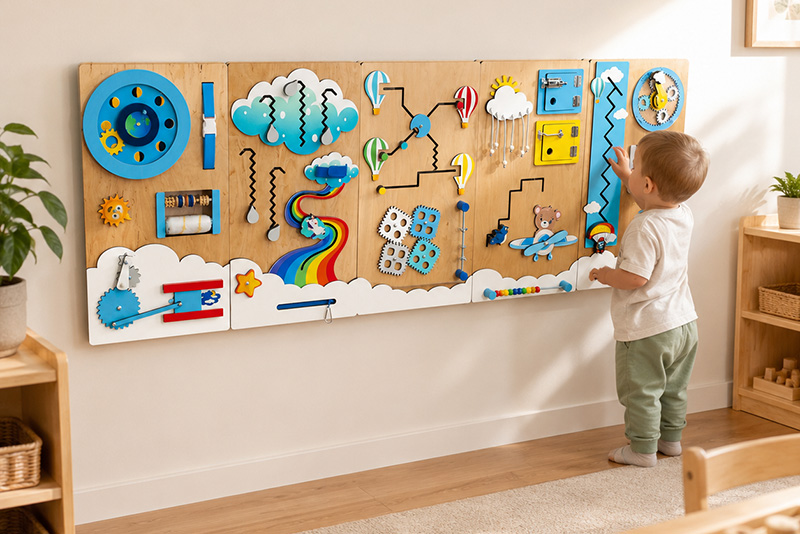
For preschool rooms, we usually recommend a set of 5 to 9 rounded-corner panels installed 24 to 36 inches above the floor. Preschool busy boards work best when children can rotate between three or four tactile experiences without waiting. Themed panels - mountains, sea, sky, safari - hold attention longer than abstract element grids at this age.
Elementary classrooms and calm corners
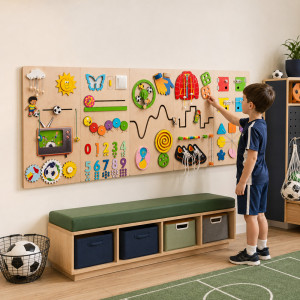
A single large panel or a set of 3 to 5 medium panels serves an elementary calm corner well. Neutral or Scandinavian palettes blend into most classroom decor without pulling attention away from instruction.
SPED and self-contained classrooms
Self-contained special education rooms benefit from larger multi-panel walls with a wider mix of tactile, visual and cause-and-effect elements. For students on the autism spectrum, we also build panels with interactive LED elements that respond to touch, useful for building attention and cause-and-effect understanding. See our dedicated sensory wall panels for autism collection.
Middle and high school break spaces
Older students respond to more sophisticated finishes. Natural birch, monochrome white, or Scandinavian palettes suit middle and high school break rooms and counseling offices. Element selection here leans toward fine motor tasks - peg mazes, geometric puzzles, patterned latches - rather than early-childhood themes.
Hallways, media centers and shared spaces
Wall-mounted panels are the sensory tool most likely to survive an unsupervised hallway. Mount at least 12 inches from the nearest doorframe, and confirm the wall is drywall over stud or CMU with the correct anchor.
Frequently asked questions about sensory wall panels for schools
What is a sensory wall for a classroom?
A sensory wall for a classroom is a wall-mounted panel, or set of panels, with interactive tactile elements - latches, gears, knobs, rotating pieces, textured surfaces - that students touch and manipulate while standing at the wall. Unlike loose toys, it stays fixed in place, several students can use it at once, and it provides sensory input without pulling anyone out of the classroom.
Are sensory walls good for special education classrooms?
Yes. Sensory walls are widely used in SPED and self-contained classrooms. They support sensory diet plans, offer non-verbal engagement options, and can be tailored to IEP goals such as bilateral coordination, cause-and-effect understanding, tactile discrimination and self-regulation.
What age is a preschool busy board for?
Preschool busy boards suit children roughly 2 to 6 years old. Elements are sized for smaller hands and mounted at a height that allows independent standing use. Younger toddlers can use the same panels with supervision, and older elementary students often return to them for calming and fine motor practice.
How do you install a sensory wall panel in a classroom?
Standard panels install with wood screws into drywall studs, or masonry anchors into CMU walls. Each order ships with mounting hardware and a printed installation guide. Most single-panel installs take a maintenance person under 30 minutes; larger multi-panel walls come with a spacing template.
Can we customize a sensory wall for our school colors or curriculum?
Yes. We regularly build custom panels for schools that want to match brand colors, coordinate with a classroom palette, or include a specific mix of elements tied to a program's goals. Contact us with your dimensions, color reference and element preferences.
Are these panels safe for school use?
Yes. All panels are built from natural birch plywood with non-toxic water-based finishes and mechanically fastened elements, and preschool sets have rounded corners. Our sensory wall safety guide covers materials, finishes and installation guidance in detail.
How many panels do we need for a classroom?
For a single calm corner, one large panel or a set of 3 works well. For an active preschool room with several children using the wall at once, use 5 to 9 panels. For a shared sensory hallway serving multiple classrooms, plan for 6 to 12 panels spaced 12 to 18 inches apart. Send us your wall dimensions and we'll recommend a specific layout.