


BumbleBeeSmart · Safety guide · 11-minute read
Safety is one of the first questions parents, therapists and educators ask before purchasing a sensory wall. This guide covers what to look for in materials, construction, mounting hardware and ongoing maintenance. It draws on U.S. federal safety standards and pediatric guidance rather than marketing claims. It's written as a buying and installation reference. It is not a substitute for a manufacturer's own safety documentation or a facility's licensing requirements. This guide focuses specifically on safety, materials, mounting and ongoing inspection - for sizes, configurations and the full product collection, explore our complete sensory wall panels collection below. If you're planning a room that combines wall panels with light or water equipment, our wider sensory room equipment category covers both.
Explore BumbleBeeSmart Sensory Wall Panels
See materials, construction, mounting and activity configurations for our wall-mounted sensory panels.
Are Sensory Wall Panels Safe? A Sensory Wall Panel Safety Overview
Sensory wall panels aren't specifically regulated as their own product category. Depending on a product's intended use, age grading and construction, requirements applicable to children's products or toys may be relevant. These include the small parts and choking-hazard rules, sharp-point and sharp-edge limits, and lead-in-paint restrictions enforced by the U.S. Consumer Product Safety Commission (CPSC).[1] We don't claim BumbleBeeSmart panels are independently certified or lab-tested against these standards. What we can tell you is which standards exist, what they cover, and what to ask a manufacturer before you buy.
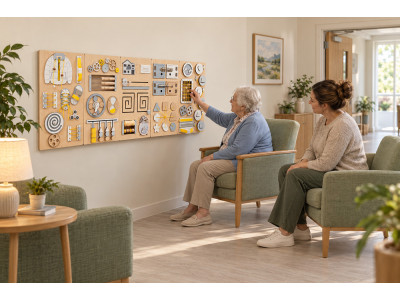
Unlike loose toys, wall-mounted panels stay fixed in one location. They can't be misplaced, damaged underfoot, or left on the floor as a tripping hazard. Wall-mounted sensory panels are commonly used in homes and shared environments such as schools, clinics and waiting areas, where secure installation and routine inspection are especially important.
Small Parts and Choking Hazards
The single most-cited toy safety rule in the U.S. is the small parts ban. Under 16 CFR Part 1501, products intended for children under 3 must not contain any part that fits inside a standard small-parts test cylinder. They also must not release such a part under normal use and abuse. That cylinder approximates the fully expanded throat of a child under three.[2] This is a real, ongoing risk, not a theoretical one. The CPSC estimates roughly 15 choking deaths per year among children under 3 involving small toys, toy parts and similar household items.[3]
For a sensory wall panel, this means checking small manipulable pieces directly: spinner caps, bead ends, clasp hardware. As part of routine inspection, check for components that have become loose, damaged or unstable. This practical inspection is not a substitute for formal use-and-abuse testing against the CPSC's small-parts cylinder, which requires standardized equipment.[4] If a panel includes any genuinely small components, confirm the manufacturer's stated minimum age. Also check whether those parts carry the required choking-hazard warning language for children aged 3 to 8.[2]
Materials and Finishes
The materials used to manufacture a sensory wall directly affect its longevity and safety. Two federal rules matter most here.
First, lead in paint and similar surface coatings. Under 16 CFR Part 1303, paint and comparable surface coatings on children's products face a strict limit. They may not contain more than 0.009% lead by weight, or 90 parts per million.[5] This applies to painted, printed and any other coated finish, not just solid colors.
Second, sharp points and edges. Under 16 CFR 1500.48 and 1500.49, toys and articles intended for children under 8 are tested with a standardized probe. Testing happens both before and after simulated use and abuse. If the probe contacts an accessible sharp point or a sharp metal or glass edge, the product fails.[6] In practice, this is why reputable panels use sanded, rounded edges and smooth corners rather than raw-cut wood.
When evaluating any sensory wall panel, verify the following directly with the manufacturer rather than relying on general marketing language:
- Material specification (e.g., plywood grade, hardwood species)
- Coating specification (paint or finish type, and whether it's water-based)
- Whether edges and corners are sanded and rounded
- Whether interactive hardware is recessed or otherwise limits accessibility to small children
- Current surface condition on the specific unit you're purchasing, especially for floor models or refurbished stock
- Cleaning and disinfectant compatibility for the specific finish
- Any manufacturer documentation on testing, materials sourcing or compliance
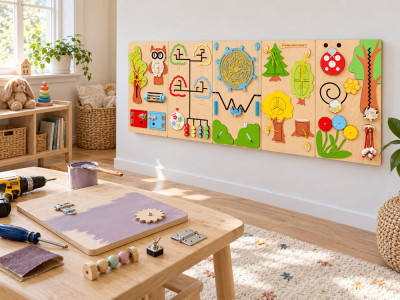
BumbleBeeSmart panels use birch plywood construction with a water-based lacquer topcoat across our painted, printed and unpainted finishes. The choice between finishes is a matter of appearance; the underlying coating system is the same across all three.
Securely Attached Components
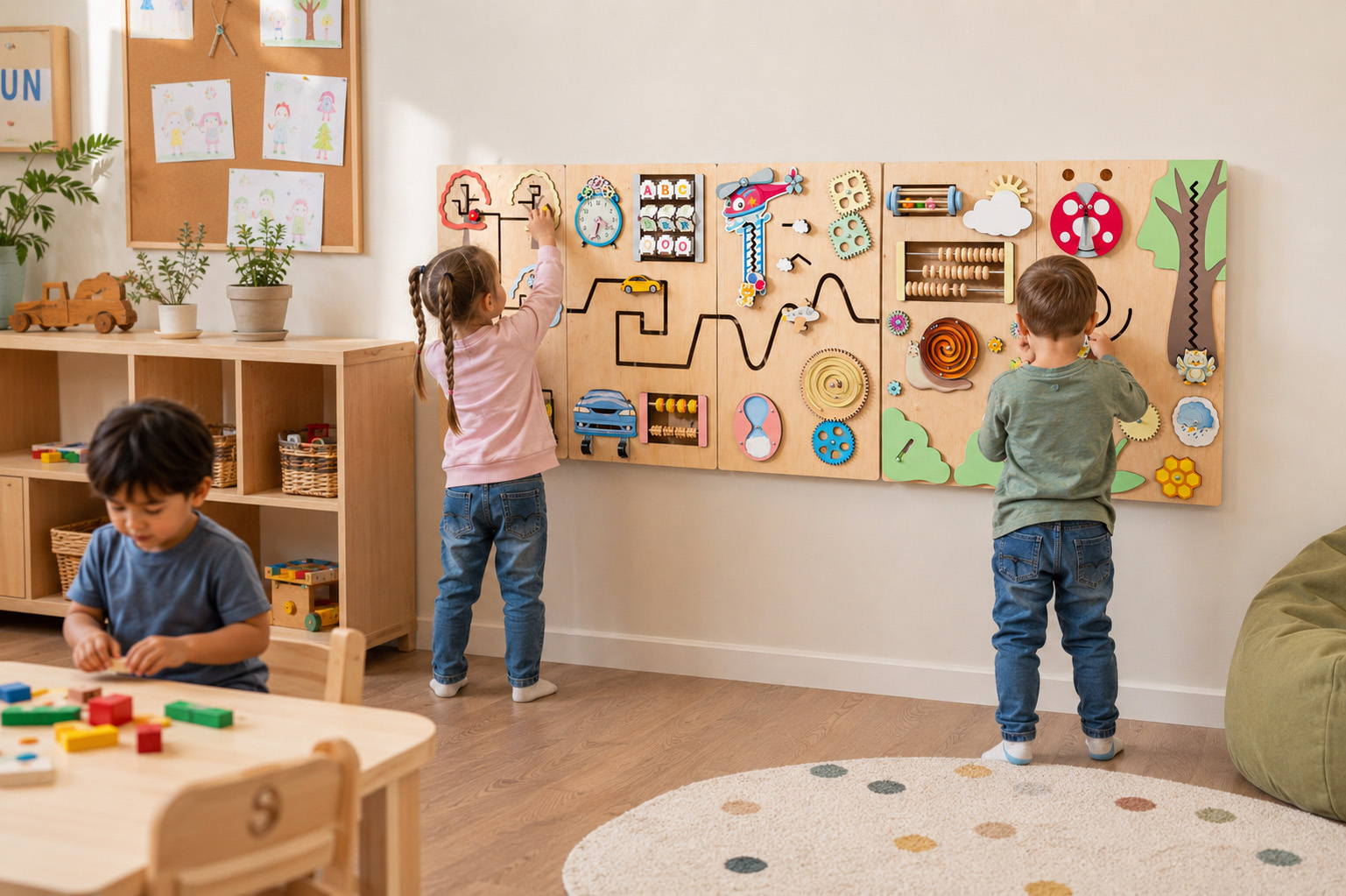
Locks, gears, switches, spinners and other moving elements should be firmly fastened and built to withstand repeated daily use. As part of routine inspection, check for components that have become loose, damaged or unstable. This practical inspection is not a substitute for formal use-and-abuse testing, which requires standardized equipment and procedures under the CPSC's rules for children's products.[2] A loose part is a potential small-parts hazard on its own, separate from whether the product passed formal testing when new.
Age-Appropriate Activities
The American Academy of Pediatrics notes that most toys on the market are safe when used as intended for their recommended age and stage. A product being for sale doesn't by itself guarantee it's a safe fit for a specific child.[7] The AAP recommends matching activities to a child's actual developmental stage rather than defaulting to a general age range. It specifically calls out manipulable toys, shape sorters, stacking pieces and simple puzzles as strong choices for building fine motor, cognitive and perceptual skills in young children.[8]
For a sensory wall, that means matching activity complexity to your setting. Younger children benefit from simple tactile activities, while older preschoolers engage more with puzzles, latches and multi-step fine motor challenges. Mixed-age spaces, such as family waiting rooms, often do best with a panel that combines both simple and more complex elements.
Wall Mounting and Installation Hardware
A properly mounted sensory wall is more stable than a free-standing toy because it can't tip over or slide across the floor. The core principle is straightforward: follow the manufacturer's installation instructions and use fasteners appropriate for the wall construction, mounting system and product weight. Requirements can differ for drywall, wood framing, masonry and other wall types. A manufacturer's own instructions should take precedence over general guidance whenever the two differ.
Where a wall panel doesn't come with detailed installation instructions, the same general anchoring principles the CPSC promotes for furniture and TV tip-over prevention are a reasonable reference point. Use hardware rated for the item's actual weight. Avoid plastic anchors or zip-tie style fasteners alone, since those can become brittle and fail over time.[9] Fastening into wall studs, where the wall construction allows it, is one common way to meet that weight-rating principle. This general anchoring guidance is not a claim that sensory wall panels fall under CPSC's specific furniture tip-over rule for clothing storage units. That rule is a distinct, narrower regulation. It's the same underlying engineering principle applied to a different product.
For maximum stability:
- Follow the manufacturer's installation instructions for your specific panel and wall type.
- Use fasteners and anchors rated for the panel's weight and the wall construction, whether that's drywall, wood framing or masonry.
- Install panels at a height appropriate for the intended age group.
- Leave enough open space around the wall for comfortable play.
- Check that every mounting screw remains tight after installation.
In spaces that also serve wheelchair users or seated adults, mount lower or add a second panel at a lower height. Where ADA compliance applies, the U.S. Access Board's 2010 ADA Standards set an unobstructed forward reach range of 15 to 48 inches from the floor for operable elements.[10] Facilities outside the scope of that requirement may still choose to reference the same range when planning mounting height. That's a design decision for the facility to make, not a compliance obligation this guide is asserting.
Wall-mounted installations also help maximize usable floor space. This makes them a practical solution for waiting rooms, classrooms and therapy centers, where every square foot matters.
Cleaning and Disinfection
Routine cleaning keeps sensory walls both hygienic and safe, and the right approach depends on the setting.
For home and everyday care:
- Wipe wooden surfaces with a soft, damp cloth.
- Use a child-safe disinfectant when needed.
- Avoid soaking wooden components.
- Dry all moving parts after cleaning.
- Clear dust from gears, tracks and sliders regularly.
For schools, clinics and daycare settings, follow the same cleaning hierarchy public health agencies recommend for shared toys and equipment. Clean visible dirt with soap and water first. Then sanitize or disinfect as needed, using a product registered with the U.S. Environmental Protection Agency.[11] Only products with an EPA registration number on the label are permitted to claim effectiveness against specific germs. Disinfectants are themselves regulated as pesticides, so they should never be applied while children are present or handled by children directly.[12] The American Academy of Pediatrics and American Public Health Association's shared childcare health standards address this directly. They call for surfaces and toys that contact hands or mouths to be sanitized on a regular schedule, not just wiped down visually.[13]
Practically, this means a smooth, sealed wooden surface is easier to bring into compliance with a facility's infection-control policy than fabric or plush materials. Fabric and plush typically require laundering rather than surface disinfection. Clinics with stricter requirements should confirm any specific disinfectant product against the panel's finish. Check that product's EPA registration before adopting it as a standard.
Inspection Schedule
Regular inspection is what actually keeps a sensory wall safe over years of use. Inspect regularly, with frequency based on usage intensity and the manufacturer's maintenance guidance. Check for:
- Loose screws or hardware
- Moving elements that need tightening
- Signs of excessive wear
- Damaged finishes
- Wall mounting stability
Commercial facilities with heavy daily use generally warrant more frequent inspection than a single home installation sees. Replacing worn hardware early extends the lifespan of the entire installation and keeps every activity element within the safety margin it was built for. If your panel's manufacturer publishes a specific maintenance schedule, follow that guidance directly rather than a generic interval.
Supervision
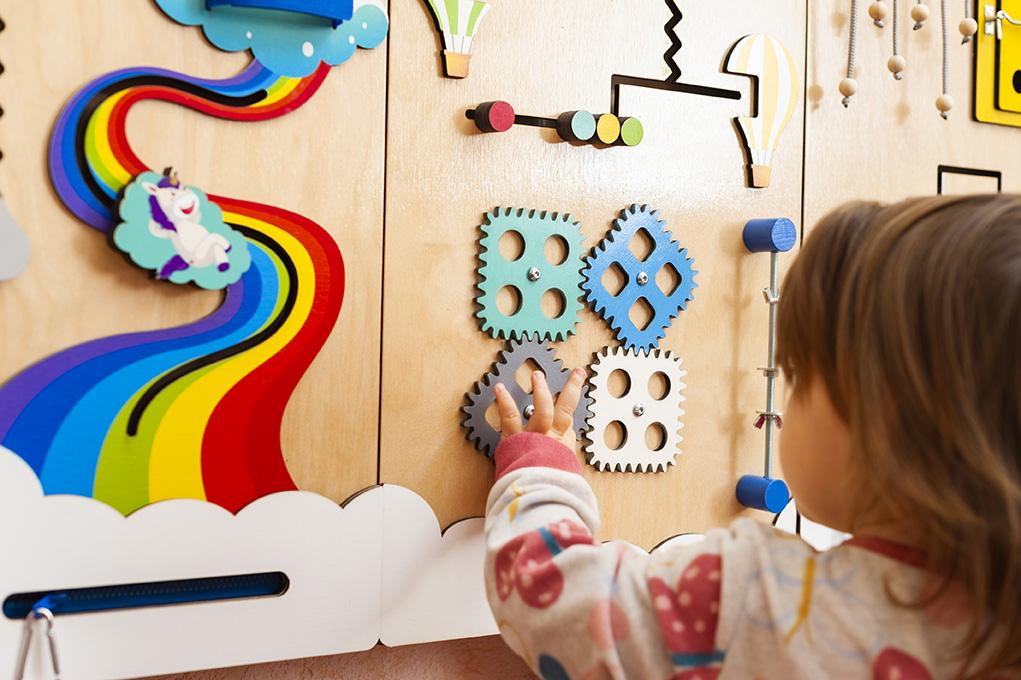
No safety standard replaces active supervision. The AAP's guidance on toy safety is consistent on this point. Age labels and construction standards reduce risk, but they don't eliminate the need for a caregiver, teacher or therapist to be present. This matters especially for younger children, or in group settings where a child might use an activity in an unexpected way.[7] It's particularly relevant in institutional settings. A sensory wall is often used by many different children across a single day, without one dedicated adult watching a single child continuously.
Installation Settings and Safety Considerations
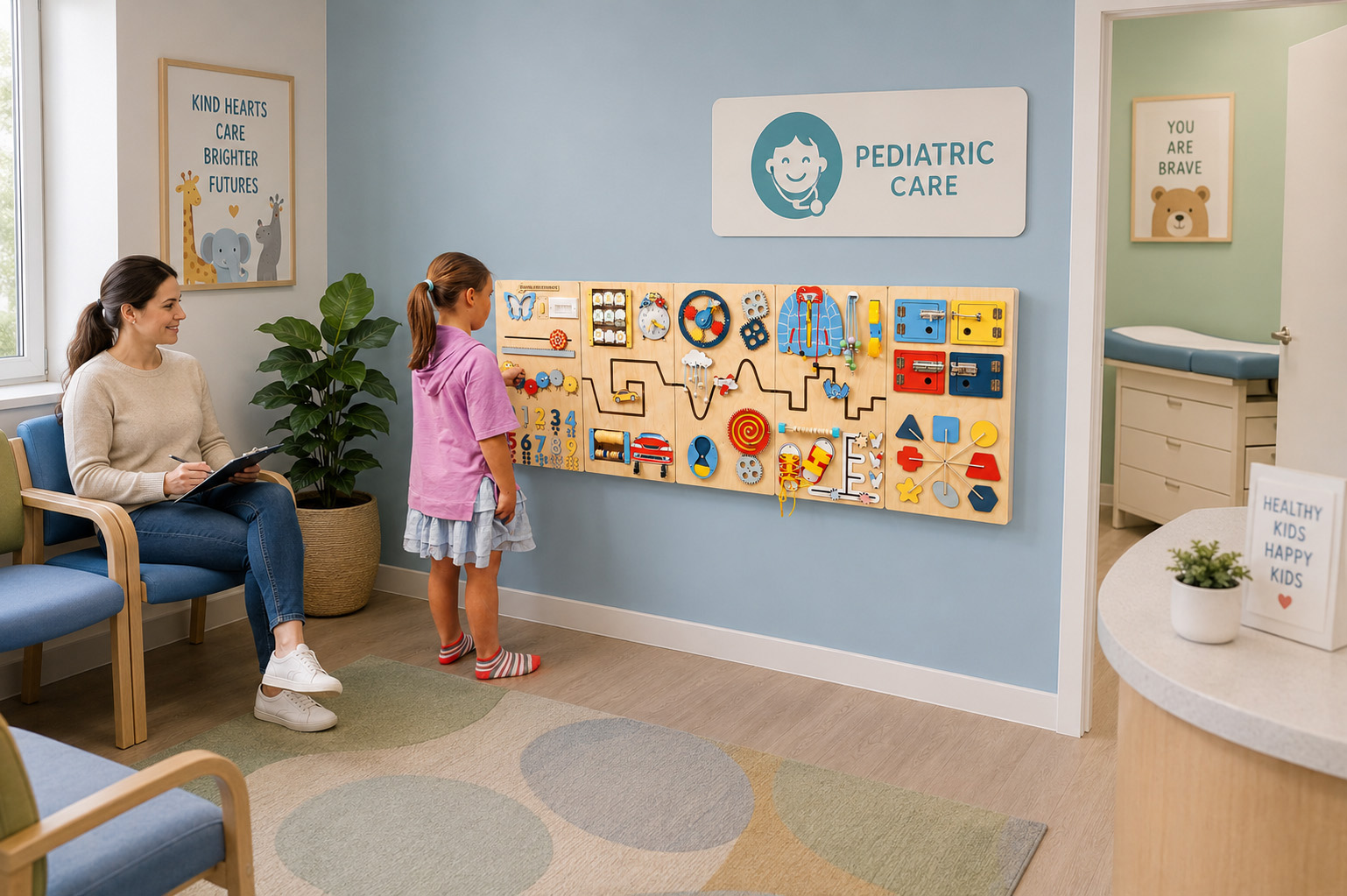
Wall-mounted sensory panels turn up across many high-traffic settings - preschools, pediatric clinics, dental offices, therapy centers, waiting rooms and family cafes among them. For the full list of settings and product options by audience, see our sensory wall panels collection above.
What actually changes from one setting to another is less the panel itself and more the safety context around it. Shared, institutional spaces typically see far more daily use per panel than a single home installation, which is why shorter inspection intervals and sturdier mounting hardware (see Wall Mounting and Installation Hardware above) matter more in a classroom or waiting room than in a bedroom.
For a closer look at a specific institutional setting, see our guides to sensory walls for dental clinics and sensory wall panels for pediatric practices. If you're still deciding on a theme or layout, our guide to choosing a themed sensory wall panel covers that decision in more depth. Once you've chosen a panel, our installation and care manual walks through setup step by step.
Frequently asked questions about sensory wall panel safety
Are sensory wall panels safe for toddlers?
They can be, when built with rounded edges, securely attached components and child-safe, low-lead finishes consistent with CPSC's toy safety rules. Always choose age-appropriate activities and supervise young children during play. No product is automatically safe just because it's marketed for children. Check construction quality directly.
How often should a sensory wall be inspected?
There's no single federal standard dictating an inspection interval for sensory wall panels. Inspect regularly, with frequency based on usage intensity and the manufacturer's maintenance guidance. Schools, clinics and other high-traffic environments generally warrant more frequent inspection than a single home installation sees, since far more children use the panel each day.
How do you clean a sensory wall in a clinic or daycare?
Clean visible dirt with soap and water first. Then sanitize or disinfect with an EPA-registered product suited to the surface. Wooden panels should not be soaked. Check your specific disinfectant's label against the panel's finish, and confirm it carries an EPA registration number before making it a standard part of your routine.
Is a sensory wall panel certified or tested to a specific safety standard?
We don't claim independent certification or third-party lab testing for BumbleBeeSmart panels. What we can tell you is which federal rules exist for children's products generally: small parts, sharp points and edges, and lead in surface coatings. We can also explain how our materials and construction relate to them. If formal certification matters for your purchase, ask any manufacturer directly for documentation rather than relying on general marketing language.
Are wall-mounted sensory panels safer than loose sensory toys?
For many homes, schools and clinics, yes. Mainly because they can't be misplaced, become a tripping hazard, or migrate to a younger sibling's reach. That said, a poorly installed or poorly maintained wall panel isn't automatically safer than a well-made loose toy. Installation quality and ongoing inspection matter as much as the product itself.
Safe Sensory Play Starts with Quality Design
A well-designed sensory wall should invite curiosity while giving parents, teachers and therapists real confidence in its safety, not just marketing assurance of it. That's really what sensory wall panel safety comes down to in practice: durable, low-lead materials, correct installation, and simple routine maintenance. Those three things cover most of what the standards above actually ask for.
Whether you're creating a sensory room at home or equipping a busy educational facility, the same few principles apply at any scale. If you're still deciding between options, our guide to choosing the right sensory wall panel covers the practical side of that decision.
Related guides:
- What Should Be in a Sensory Room for Autism?
- Wall-Mounted Busy Boards: A Space-Saving Solution for Interactive Play
- Inclusive Sensory Walls for All Abilities
- How Are Busy Boards Produced?
Standards Referenced
- U.S. Consumer Product Safety Commission. Business Guidance FAQ: Toy Safety Standard (ASTM F963 / 16 CFR Part 1250).
- U.S. Consumer Product Safety Commission. Small Parts and Choking Hazard Labeling FAQs (16 CFR Part 1501).
- U.S. Consumer Product Safety Commission. CPSC Warns Parents About Choking Hazards to Young Children.
- U.S. Consumer Product Safety Commission. Regulatory Summary: Small Parts, 16 C.F.R. Part 1501.
- U.S. Consumer Product Safety Commission. Lead in Paint (16 CFR Part 1303).
- Electronic Code of Federal Regulations. 16 CFR 1500.49, Sharp Metal or Glass Edges.
- Gilboa, S. M., et al. American Academy of Pediatrics. Selecting Appropriate Toys for Young Children in the Digital Era. Pediatrics.
- American Academy of Pediatrics, HealthyChildren.org. How to Buy Safe Toys.
- U.S. Consumer Product Safety Commission. Anchor It! Furniture and TV Tip-Over Prevention Campaign.
- U.S. Department of Justice, ADA.gov. 2010 ADA Standards for Accessible Design.
- HeadStart.gov. Selecting and Using Cleaning, Sanitizing, or Disinfecting Products.
- Montana Department of Public Health and Human Services, citing CDC guidance. Safer Disinfecting in Child Care Facilities.
- National Resource Center for Health and Safety in Child Care and Early Education. Caring for Our Children: Selecting Appropriate Sanitizers and Disinfectants.
Educational guide from the BumbleBeeSmart blog, referencing publicly available U.S. federal safety standards and pediatric guidance. This article does not claim that any specific BumbleBeeSmart product is independently certified, lab-tested, or compliant with any standard referenced here unless stated explicitly. Always verify current requirements with the relevant agency and confirm specifics directly with a manufacturer before purchase. Not medical, legal or regulatory advice.
© BumbleBeeSmart, Sensory Wall Panels for Inclusive Learning








Write a comment