


If you're choosing themed sensory wall panels, the theme question comes up fast - and it's usually asked backwards. People start with the picture they like, then try to fit it to the room. The more useful order is the reverse: decide what the space needs to do, then let that choose the sensory wall theme. A dental waiting room and a STEM classroom want almost opposite things from a wall.
This guide gives you a decision framework, a side-by-side comparison of the six most common themed sensory wall panels, room-by-room recommendations, the mistakes that undermine an otherwise good choice, and a clear-eyed note on what research supports. Where a specific panel helps illustrate a point, we link to a real example.
A quick note on who this is for: whether you're a parent setting up a playroom, an occupational therapist outfitting a clinic, a purchasing manager comparing options for a school or daycare, or an interior designer specifying for a pediatric practice, the underlying logic is the same. The stakes just differ. In a home, the wrong theme is a minor miss. In a clinic or classroom, the right one can measurably change how children behave in the space - so it's worth a few minutes of deliberate thought before you choose.
A quick orientation. Throughout this guide, BumbleBeeSmart panels appear as one example of themed, wall-mounted sensory panels - used to show how a design principle translates into a real fixture, not as a sales pitch. The theme advice applies whether you buy, commission, or build.
How to choose the right theme
Before comparing themes, answer one question: is this room supposed to calm children down or to energize and engage them? Almost everything else follows from that. A calming space (waiting room, therapy corner, quiet classroom) wants low visual arousal - cooler colors, simpler imagery. An engaging space (daycare play area, STEM corner, family restaurant) can carry a livelier theme.
Use this as a starting map from goal to theme:
Treat these as sensible defaults, not rules. The activities on the panel matter more than the scene behind them, and any theme can be dialed calmer or livelier through its palette and complexity.
Calming vs. stimulating: the distinction that matters most
If you remember one idea from this guide, make it this one: every theme sits somewhere on a line between calming and stimulating, and matching that to the room's job is more important than the specific scene. It's the difference that quietly decides whether a wall helps or hurts.
Calming themes - sea, sky, forest, and muted natural palettes - use cooler colors and simpler imagery to keep visual arousal low. They're the right starting point anywhere the goal is to settle a child: a dental or medical waiting room, a therapy corner, a quiet classroom, or any space serving children who are easily overwhelmed. The wall becomes a soft focal point rather than another thing demanding attention.
Stimulating themes - safari, space, and brighter, story-rich scenes - trade some of that calm for engagement. They shine where the aim is to pull children in and sustain imaginative or exploratory play: a daycare activity zone, a discovery corner, a museum, a family restaurant. Here, visual energy is the point.
The common error is assuming "engaging" is always better. It isn't. The same lively safari wall that delights a daycare can push an anxious child in a waiting room toward overload. Neither register is superior - they simply answer different questions. So before you fall for a look, decide which register the room needs. Everything after that is easier.
Theme comparison table
A side-by-side view of the six themes on the factors that actually drive a good match. The energy rating is a design heuristic - how visually stimulating the theme tends to be - not a measured value. See the full range on the themed sensory wall panels hub.
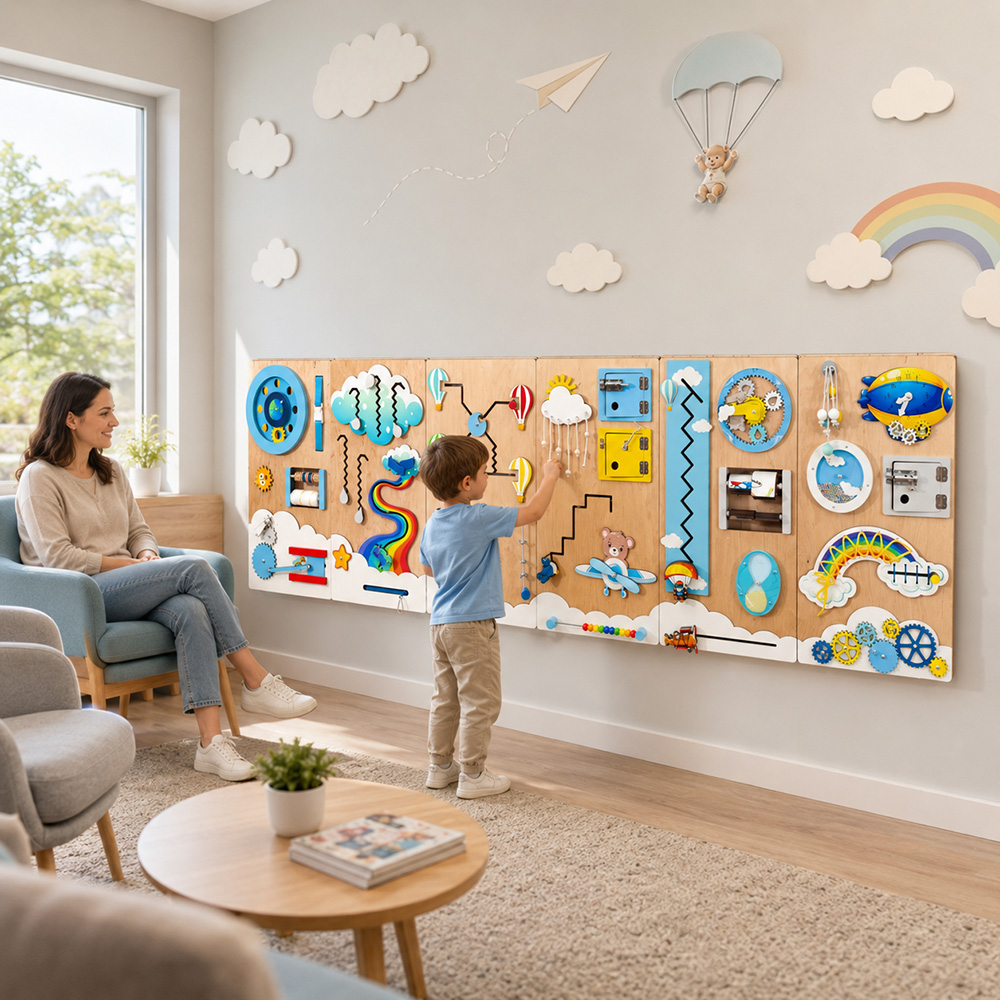
Where each theme works best
The same theme can succeed in one room and misfire in another. Here's how the six map onto common environments.
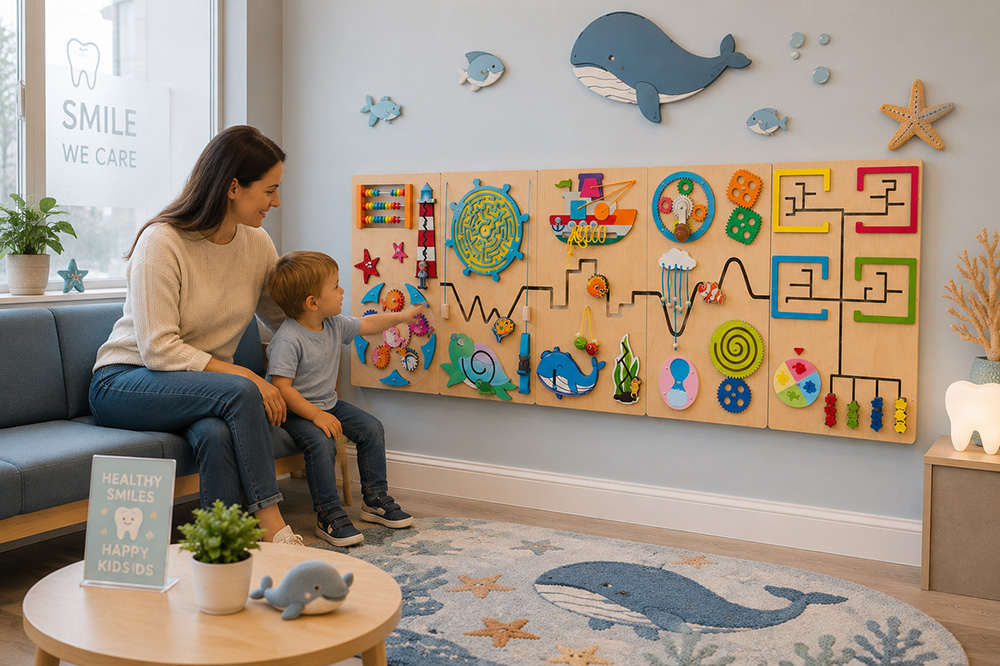
Dental clinics & pediatric waiting rooms
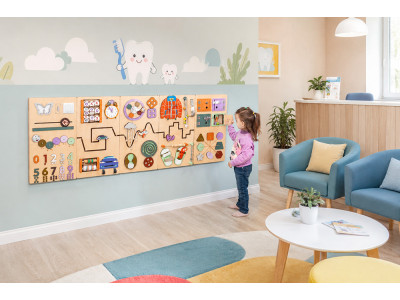
These rooms carry anxiety, so calm wins: sea, sky, or forest. The goal is a focal point that settles a child, not one that revs them up. A wall-mounted panel also keeps the floor clear - useful in tight reception areas - and gives an anxious child something to do with their hands. For a purpose-built option, there's also a five-panel set configured for dentist offices.
Occupational & speech therapy rooms
Therapy favors grounding, moderate-energy themes - mountains or a natural-palette panel - that stay visually calm while offering rich tactile work: latches, gears, sliders, textures. The picture should support focus, not distract from the task.
Schools, Montessori & libraries
Nature-led themes (forest, mountains, sky) suit Montessori and Reggio-inspired rooms and quiet library corners, because they lean on real-world, muted imagery rather than cartoonish visuals. For reading areas, keep the energy low.
Daycares, playrooms, museums & restaurants
These are engagement spaces, so livelier themes earn their place: safari for animals and storytelling, space for curiosity and older children. Here a bit of visual energy is a feature, not a bug.
Home playrooms
At home, the child's own interest is a perfectly good guide - the developmental value comes from the activities, so a theme they love will hold attention longest.
Explore the theme options
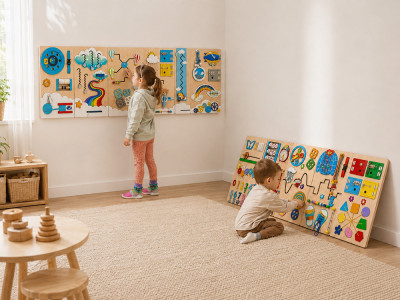
With the framework in mind, here's how the six themes tend to be used, each with a real example panel so you can see how the idea translates. Themes are made to order, so any of them can be adjusted in size, palette, and activities - browse the full range on the theme shaped panels collection.
Sea - calm blues for anxious and busy spaces
Cool, soothing, and low-arousal - the sea theme is a natural first choice where the job is to settle children. Its palette reads calm and pairs well with clinical and reception environments without competing with them.
Why it works: cool blues lower the visual temperature of a room, and underwater scenes tend to move slowly in a child's imagination, which suits spaces meant to decompress. Watch-out: pair it with genuinely rich tactile elements so a calm look doesn't become a boring one - the activities carry the engagement.
Ideal for: dental and pediatric waiting rooms, calming corners, sensory-sensitive children. See a sea-themed panel →
Forest - grounded, natural, and Montessori-friendly
Muted greens and real-world woodland imagery make the forest theme a strong fit for spaces that value calm focus and nature-led learning. It supports quiet engagement rather than high stimulation.
Why it works: natural greens and woodland imagery feel grounding and familiar, and they align with the muted, real-world aesthetic Montessori and Reggio rooms prefer over cartoon visuals. Watch-out: keep the scene uncluttered - a forest can easily tip into visually busy, which undercuts the calm you're after.
Ideal for: Montessori classrooms, reading nooks, clinic and lobby areas. See a forest-themed set →
Sky - soft and quiet, with gentle sound play
The sky theme keeps things light and low-contrast, and some versions add gentle sound elements for cause-and-effect play. It suits rooms that need calm engagement rather than energy.
Why it works: soft blues and open, airy imagery keep arousal low while still feeling cheerful, and gentle sound elements add cause-and-effect play without the visual noise of a busier theme. Watch-out: if the panel includes sound, keep it optional and quiet - in a library or clinic, loud feedback defeats the purpose.
Ideal for: quiet classrooms, libraries, waiting areas. See a sky-themed panel →
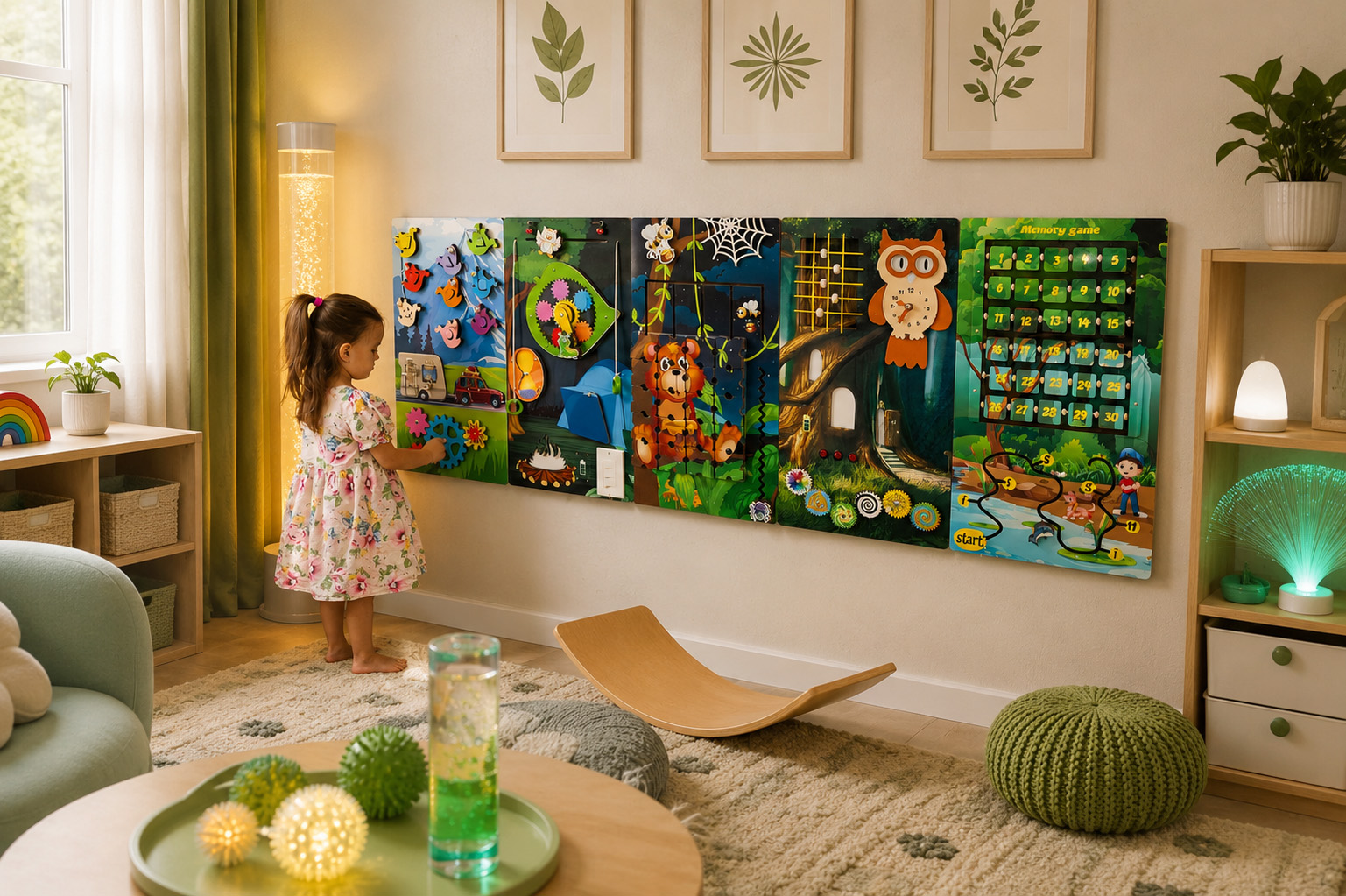
Mountains - grounding energy for therapy and sensory rooms
Earthy and calm but rich in manipulable elements - locks, latches, gears - the mountains theme is designed with a Montessori approach and works well in therapeutic settings, including for older users.
Why it works: earthy, moderate-energy imagery stays visually calm while offering the dense, manipulable elements - locks, latches, gears - that therapy and regulation work depend on. Its wide age appeal (it's even used with adults) makes it a strong default for mixed-age rooms. Watch-out: choose the tactile mix deliberately so it matches your therapeutic goals rather than defaulting to whatever comes standard.
Ideal for: occupational and speech therapy, sensory rooms, mixed-age spaces. See a 9-panel mountains-themed set →
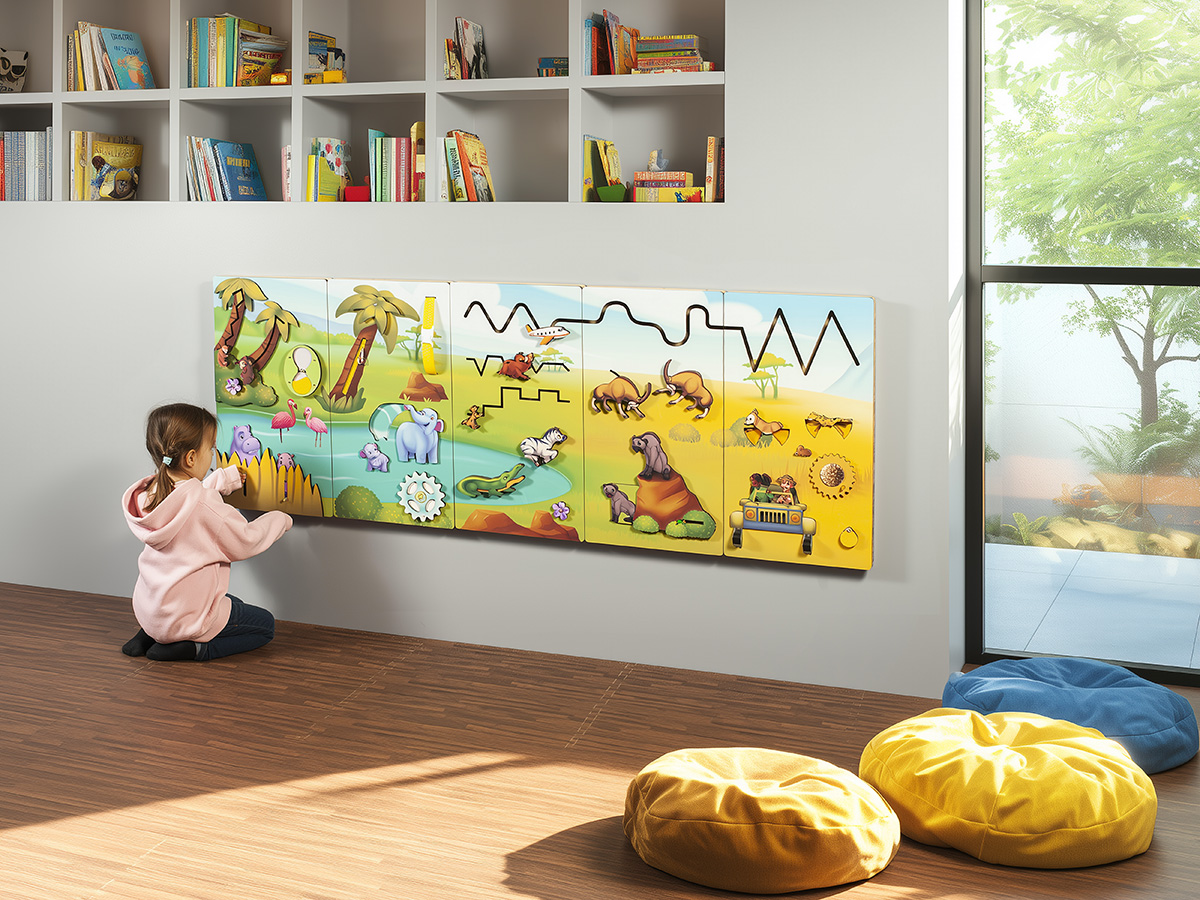
Safari - playful animals for storytelling and pretend play
Warm and lively, with jungle-inspired animal designs, the safari theme invites imaginative play and conversation. It shines in engagement-focused rooms rather than spaces meant to calm.
Why it works: recognizable animals are natural conversation and storytelling prompts, which extends imaginative play and supports language - a real asset in a play-focused room. Watch-out: its higher visual energy makes it a poor fit for spaces meant to calm; keep safari out of anxious waiting rooms and therapy corners.
Ideal for: daycares, playrooms, family restaurants, home play areas. See a safari-themed board →
Space - curiosity and STEM conversation-starters
The space theme is a natural hook for curiosity - planets, counting, and cause-and-effect - with moderate visual energy. It fits older children and rooms built around exploration and learning.
Why it works: planets, rockets, and stars are ready-made hooks for curiosity, counting, and cause-and-effect, which suits older children and learning-focused rooms. Watch-out: it's a moderately stimulating theme, so pair it with a calm surrounding wall and reserve it for spaces built to engage rather than soothe.
Ideal for: STEM corners, older-child play areas, discovery spaces. See a space-themed board →
Want a nature theme with more range than forest or mountains alone? The national park themed sensory panel blends woodland, wildlife and trail elements into one scene, and suits many of the same calm-focus classrooms and reading corners the forest and mountains themes work well in.
Furnishing a gym, sports hall or after-school club instead of a classroom? The soccer themed sensory wall panel fits high-energy, activity-focused rooms the way safari does for playrooms - a good pick where the goal is engagement rather than calm.
Not sure a listed theme fits exactly? Because panels are modular and made to order, you can start from the full theme shaped panels collection, the broader sensory wall panels range, or the busy boards catalog and adjust the palette and activities to your space. Panels can also be produced in custom, branded colors - handy for matching a calming scheme in reception or a consistent look across rooms. Our branded-color panel sets show what that looks like in practice.
How a theme actually gets onto the panel
Most themes in this guide are built on a printed finish panel. A detailed scene like an ocean or a starfield prints more cleanly than it paints, so that's the usual route for a full background. Some themed panels work the other way around. A natural wooden finish base carries themed pieces and cutouts, printed or shaped individually and mounted on top, so the grain still shows through around them. That combination suits Montessori and nature-led rooms that want a theme without losing the natural-materials look.
If what you actually want is a specific solid color rather than a printed scene, hand-painted finish is usually the simpler route. It works well for matching a school's house color or a clinic's brand palette, often better than hunting for a themed print in that exact shade. All three finishes are sealed under the same water-based lacquer topcoat. The choice between them comes down to what you want on the surface, not durability.
How much wall space do you need?
Theme aside, one of the first practical questions is how much wall a sensory panel needs - and the answer is usually "less than people expect." Because panels are modular, you can start small and expand. Individual panels are roughly 25 by 14 inches, and sets combine into a longer run, so the same theme scales from a single feature panel in a small treatment room to a multi-panel wall across a large reception.
Two things make this easy to plan. First, everything is wall-mounted, so a panel uses vertical space and leaves the floor clear - a real advantage in a cramped operatory or a busy waiting area. Second, because panels are made to order, a configuration can be sized to the exact wall you have rather than forcing a fixed product into an awkward gap. Measure the usable, stable stretch of wall at child height, subtract anything you need to keep clear (light switches, door swings), and that's your canvas. A good rule of thumb: start with the smallest set that gives two or three children something to do at once, then add panels if the space earns it.
Matching the theme to a child's age
Age shifts what a theme needs to do. For toddlers and preschoolers, the safest bets are calmer, simpler themes with big, satisfying tactile elements - the sea, forest, and sky themes suit this range, and the imagery matters less than the sliders, spinners, and latches. Overly busy scenes can overstimulate the youngest children, so err toward calm.
For early school-age children, a bit more visual interest and narrative can hold attention longer, which is where mountains, safari, and space start to earn their place - especially in play and learning spaces rather than calming ones. Older children and mixed-age settings benefit from themes that support conversation and pretend play (safari's animals, space's planets) alongside more challenging manipulatives. And because the panels work across ages - some are even used with adults in dementia care - a mixed-age clinic or family space can lean on a grounding, moderate theme like mountains that reads well for everyone. In every case, match the intensity to the youngest and most sensitive users first, then add interest for the older ones.
Beyond the theme: what makes any sensory wall work
The theme sets the mood; these factors decide whether the wall actually earns its place. Whichever theme you choose, hold it to the same practical checklist that a good panel-selection guide would apply.
Tactile quality
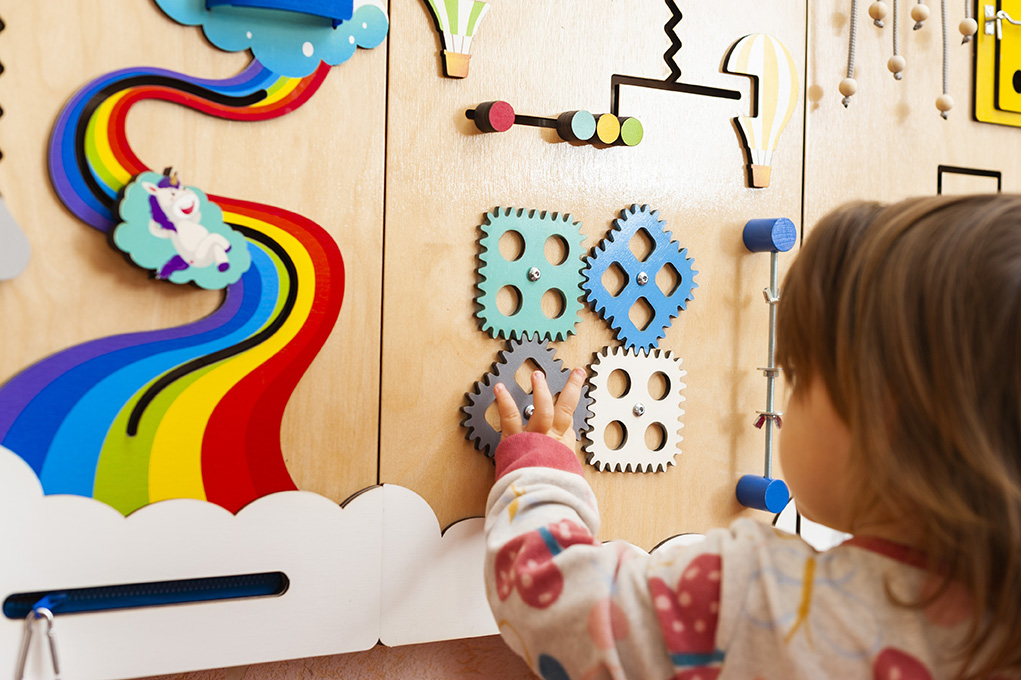
Engagement comes from the activities - sliders, latches, gears, textures -— far more than from the picture. Prioritize tactile variety.
Calm versus stimulating balance
Match visual intensity to the room and, above all, to your most easily-overwhelmed users. For autism-friendly and special-care settings, resources organized around panels for autism-friendly environments lean calmer by default.
Placement and accessibility
Mount at a reachable height; vary heights for mixed ages. For layout in reception areas, this guide to arranging activity walls in waiting rooms helps.
Safety, hygiene & durability
Non-toxic, child-safe materials, secure fixings, and wipe-clean surfaces are essential in clinics and public spaces. Review these safety and childproofing considerations and the installation and care guidance before mounting.
Customization
If you need a specific palette or a cohesive brand look, panels can be produced in custom, branded colors - handy for matching a calming scheme in reception or a consistent look across rooms.
Browsing by theme?
Every theme in this guide, and a few more, are made to order and sized to your wall.
Common mistakes when choosing a theme
Most disappointing installations trace back to one of these:
- Choosing by appearance alone. The prettiest theme in a catalog can be the wrong energy for the room.
- Ignoring the room's purpose. A high-energy theme in a space meant to calm works against you.
- Overstimulating sensitive children. Bright, busy visuals can overwhelm the very children a sensory wall is meant to help.
- Mounting too high. A panel children can't comfortably reach goes unused, whatever the theme.
- Ignoring accessibility. Mixed-age rooms need varied heights; sensitive users need calmer options.
- Mixing multiple visual styles. Competing themes on nearby walls create clutter and reduce the focal effect.
- Overlooking cleaning. In clinical and public spaces, a theme is only as good as how easily its surface wipes down.
Quick recommendations by room
If you want a fast answer, start here and adjust for your specific users.
What the research does - and doesn't - say about themes
It's worth being precise here, because it's where a lot of marketing overreaches. Controlled research supports the broader idea behind sensory walls: in a randomized trial of 162 autistic children, a sensory-adapted dental environment - a room modified across visual, auditory, and tactile channels - significantly reduced physiological and behavioral distress during cleanings, at low cost and with no loss in care quality.1 A 2024 systematic review of randomized trials reached a consistent conclusion.2 And dental anxiety - the problem a calming wall addresses - is common and linked to avoidance of care.3
What that research does not do is test one decorative theme against another. No trial shows that a sea panel outperforms a space panel. So the theme guidance in this article is exactly that - design reasoning built on the broader evidence that calmer visual environments lower arousal, combined with how designers use color and complexity. It's a sound basis for a decision, but it isn't a clinical claim about a specific picture. If you want the mechanism in more depth, this overview of the science behind sensory wall panels is a useful companion read.
The honest summary. Choose the theme for the room's job and the child's needs. The measurable benefits come from the sensory approach - calm visuals, good tactile activities, a reachable wall - not from the theme label itself.

Putting it together: a five-minute decision path
If you're short on time, run these five steps in order and you'll land on a defensible choice without second-guessing.
- Name the room's job. Calm or engage? Write it down — it decides almost everything else.
- Pick the register. Calming (sea, sky, forest) for spaces that soothe; stimulating (safari, space) for spaces that energize; grounding (mountains, natural) for therapy and mixed ages.
- Check your most sensitive user. Design to the child most likely to be overwhelmed, not the average — then add interest for older kids on top.
- Verify the practical basics. Reachable mounting height, wipe-clean surfaces, non-toxic materials, secure fixings, and enough tactile variety to hold attention.
- Size and customize. Measure your usable wall, choose a modular set that fits, and adjust palette or activities if needed.
Notice that the actual theme name only becomes final at step two — after the room's purpose is clear. That's the whole point: the picture serves the space, not the other way around.
Frequently asked questions
Which sensory wall theme is the most calming?
Cool, low-contrast themes such as sea, sky, and forest are generally the calmest, because muted blues and greens and simple imagery keep visual arousal low. This is a design principle drawn from how calmer visual environments lower arousal, rather than a claim that a specific theme has a measured clinical effect. For an anxious waiting room or a child who is easily overwhelmed, start with one of these.
Which theme is best for autistic children?
There is no single "autism theme." Because many autistic children experience sensory over-responsivity, the safer default is a calm, low-stimulation theme (sea, sky, forest, or a muted natural palette) with simple interactions, rather than a bright, busy design. Match intensity to the individual child, and favor calmer options for those who are easily overwhelmed.
Are themed sensory wall panels suitable for waiting rooms?
Yes. A wall-mounted themed panel occupies restless children before an appointment and gives an anxious child a calm focal point, without taking floor space. For waiting rooms, calmer themes (sea, sky, forest) usually work better than high-energy ones.
Which theme works best for Montessori classrooms?
Nature-based themes — forest, mountains, or a natural-palette panel — fit Montessori and Reggio-inspired rooms well, because they favor muted, real-world imagery over cartoonish visuals and encourage focused, self-directed play.
Can sensory wall panels be customized?
Yes. Panels are modular and made to order, so size, colors, activities, and theme can be adjusted to a specific wall or brand palette. Choose between hand-painted, printed, or wooden finish depending on whether you want a solid color, a scene, or plain grain. This is useful for clinics and schools that want a calming or cohesive look.
What theme is best for therapy rooms?
Occupational and speech therapy rooms often suit grounding, moderate-energy themes such as mountains or a natural-palette tactile panel — visually calm but rich in the sliders, latches, and gears that support fine-motor and regulation work.
How do I choose the right sensory wall theme?
Work from the room's purpose and the children who use it, not from appearance. Decide whether the space needs calming or engaging energy, match the theme's intensity to your most sensitive users, then check practical factors: reachable mounting height, wipe-clean surfaces, and secure, non-toxic construction.
Which theme keeps children engaged the longest?
Engagement comes more from the variety and quality of tactile activities than from the picture behind them. Higher-energy narrative themes like safari and space can spark longer imaginative play in play-focused settings, while calmer themes hold attention better in spaces meant to soothe. Choose based on whether the room's job is to calm or to stimulate.
Are theme-specific effects backed by research?
The controlled research supports sensory-adapted environments in general — modifying visual, auditory, and tactile input to reduce distress. It does not test individual decorative themes against each other. Theme recommendations in this guide are design reasoning built on those broader findings, not measured claims about a particular picture.
Still weighing themes for your space?
Start from the room's purpose, match the intensity to your users, then explore the themed options and adjust the palette and activities to fit. Schools, clinics, libraries, and therapy centers can size and customize any theme to the wall they have.
Explore themed sensory wall panels Browse all sensory wall panels
Research referenced
- 1. Stein Duker, Cermak et al. Sensory adaptations during dental visits in autistic children: a randomized crossover trial. JAMA Network Open, 2023.
- 2. Prynda et al. Dental adaptation strategies for children with ASD: a systematic review of randomized trials. J Clin Med, 2024.
- 3. White, Giblin & Boyd. The prevalence of dental anxiety in dental practice settings. J Dent Hyg, 2017.
Educational guide from the BumbleBeeSmart blog. Product details reflect the linked pages; research statements reflect the cited studies; theme recommendations are design guidance, not clinical claims. Not medical advice.

Write a comment