


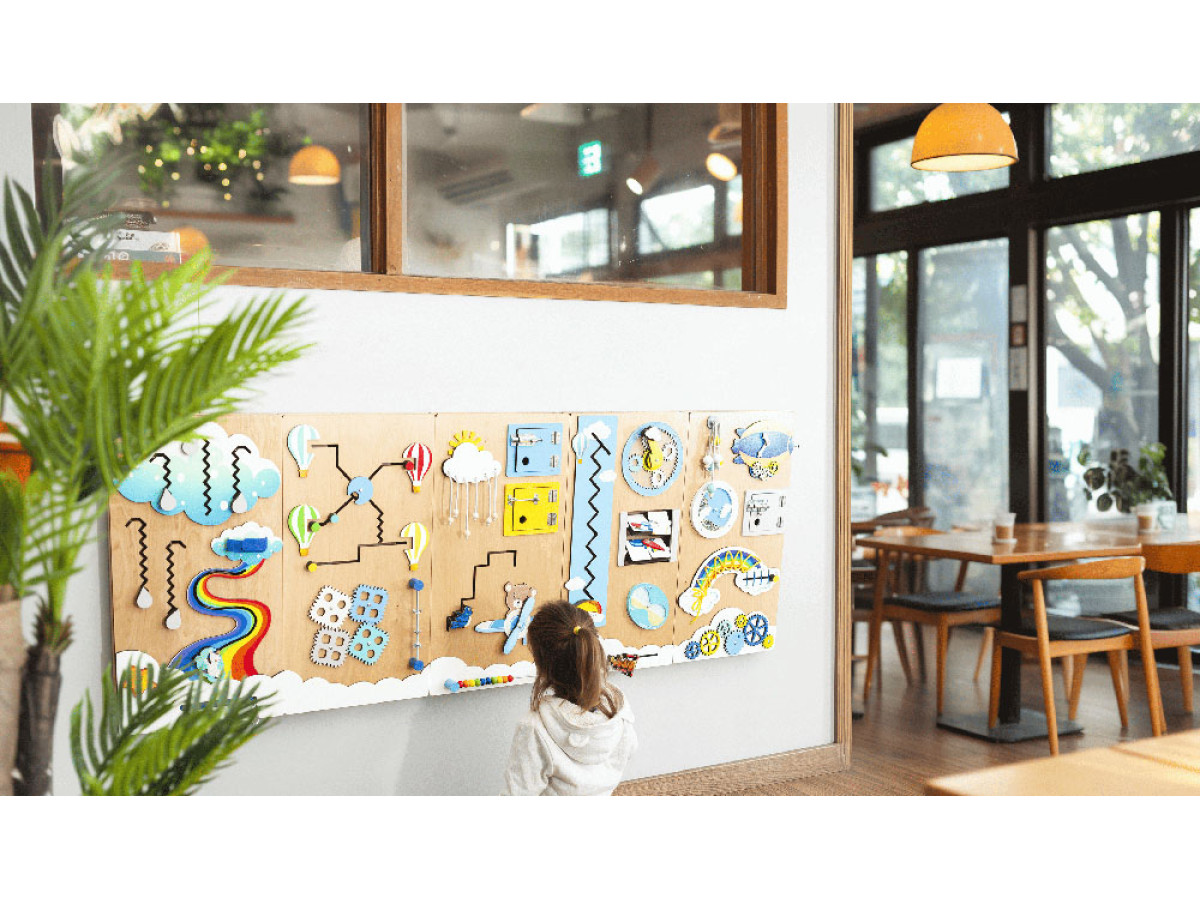
Choosing the right sensory wall panel comes down to matching a specific set of decisions to your situation. That means who will use it, where it will go, what it needs to withstand, and how it will be maintained. This guide walks through that decision process in order. It's written for parents, teachers, daycare and preschool administrators, therapists, and institutional buyers evaluating panels for a clinic or facility.
Who Will Use It
Start with the user, not the product. A sensory wall panel for a single toddler at home has different requirements than one installed in a preschool classroom. A classroom might serve twenty children a day. A dental waiting room, where every visitor is a first-time user, is different again.
The American Academy of Pediatrics recommends selecting activities based on a child's actual developmental stage. This matters more than a general age range printed on packaging.[1] That principle applies directly to choosing the right sensory wall panel: a panel's stated age range is a starting point, not a substitute for matching activity complexity to the specific children who will use it.
Environment
Where the panel will live shapes almost every other decision in this guide. A home playroom, a school classroom, a daycare center, and a pediatric or dental waiting room each carry different expectations. Durability, cleaning frequency, and number of simultaneous users all vary by setting.
If you're buying for a school setting specifically, our sensory wall panels for schools collection is built around classroom-scale use. If you're outfitting a clinical waiting area, see our guides to sensory walls for dental clinics and sensory wall panels for pediatric practices for setting-specific planning. If you're planning a room around more than a single wall panel, browse the wider sensory room equipment category for light, water and other complementary pieces.
Developmental and Activity Goals
Sensory wall panels typically combine tactile, visual and cause-and-effect elements: sliders, buttons, latches, textures. These engage fine motor coordination and hands-on exploration. The developmental research behind these individual activity types is well established. That research is not, however, about sensory wall panels as a manufactured product category specifically. Our separate article on the research behind sensory wall panels covers that evidence in depth, including where it applies directly and where it doesn't.
For this guide, the practical takeaway is simpler. Think about which specific skills you want an activity to support: fine motor manipulation, cause-and-effect understanding, shape or color sorting, shared attention with a caregiver. Then look for a panel whose specific elements match that goal, rather than assuming any panel labeled "sensory" accomplishes all of them equally.
Sensory Features
Panels vary in how many distinct sensory channels they engage. Tactile means textures and moving parts. Visual means color and light. Auditory means sound-producing elements. Proprioceptive means larger gross-motor components, like heavier latches or levers. A panel with a narrower, well-executed set of features is often a better fit than one that tries to include everything.
For institutional settings serving children with sensory sensitivities, consider whether the panel's visual and auditory intensity matches the setting's purpose. A calming waiting room and an actively engaging classroom corner call for different feature sets.
Explore BumbleBeeSmart Sensory Wall Panels
See materials, construction, mounting and activity configurations for our wall-mounted sensory panels.
Size and Available Wall Space
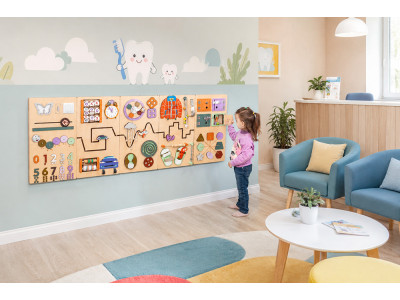
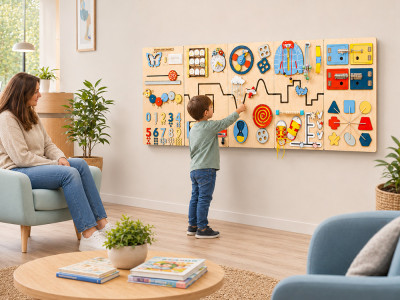
Measure the installation wall before choosing a panel. Panels are typically sold as single units or multi-panel sets. The total footprint, width and height together, determines how many children can interact with it simultaneously and how much clear floor space remains in front of it.
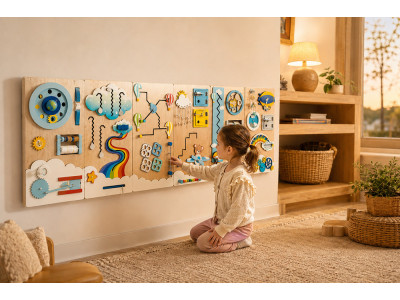
For home use, a smaller single or two-panel installation is often sufficient. For classrooms, therapy centers, or other multi-child settings, a larger multi-panel set allows more than one child to engage at once without crowding.
How many panels do you actually need?
Once you know your available wall width, working out panel count is a short calculation:
- Measure the full width of the wall section you want to use, in cm or inches.
- Subtract a small buffer from each side, about 5-10cm (2-4in), so the installation doesn't run edge to edge.
- Check the panel width for the specific collection you're considering. Most single-row panel sets use a panel width of around 35cm (about 14in) each. This varies by collection - modular and LED grid sets use a different, wider module - so always check the size listed on the product page rather than assuming one number applies everywhere.
- Divide your usable width by the panel width, and round down to the nearest whole panel.
As a worked example: a 200cm (79in) wall, minus a 10cm buffer, leaves 190cm of usable width. At roughly 35cm per panel, that works out to about 5 panels, or 175cm total. That leaves a little room to spare on either side. A narrower 120cm (47in) wall, using the same math, comfortably fits 3 panels.
Height works the same way for taller or multi-row layouts. Measure your usable vertical space. Check the panel height for the set you're considering, and confirm there's enough clearance above and below for safe mounting.
Safety
Safety review should cover three areas the U.S. Consumer Product Safety Commission (CPSC) regulates most directly for children's products: small parts and choking hazards, sharp points and edges, and lead content in paint or surface coatings.[2] Confirm that any small manipulable components can't be pried loose. Check that edges and corners are sanded and rounded. Confirm that painted or coated finishes meet the CPSC's lead limit of 0.009% by weight.[3]
No safety standard replaces active supervision. This matters particularly in group settings, where a panel is used by many different children across a single day.[1] Our complete sensory wall panel safety guide covers this in full detail, including inspection practices and what to ask a manufacturer before buying. We don't claim BumbleBeeSmart panels are independently certified or lab-tested against these standards. The safety guide explains what we can confirm and what to verify directly.
Materials and Durability
Before purchasing, verify the following directly with the manufacturer rather than relying on general marketing language:
- Material specification (plywood grade, hardwood species, or equivalent)
- Coating specification and whether it's water-based
- Whether edges and corners are sanded and rounded
- Whether interactive hardware limits accessibility to small children
- Cleaning and disinfectant compatibility for the specific finish
- Any manufacturer documentation on materials sourcing or testing
BumbleBeeSmart panels use birch plywood construction with a water-based lacquer topcoat across our painted, printed and unpainted finishes.
Mounting
Follow the manufacturer's installation instructions and use fasteners appropriate for the wall construction, mounting system and product weight. Requirements differ for drywall, wood framing, masonry and other wall types. A manufacturer's own instructions should take precedence over general guidance whenever the two differ.
Where detailed instructions aren't provided, the general anchoring principles the CPSC promotes for furniture and TV tip-over prevention are a reasonable reference point. Use hardware rated for the item's actual weight. Avoid plastic anchors or zip-tie style fasteners alone, since these can become brittle over time.[4] Our installation and care manual walks through setup for BumbleBeeSmart panels specifically.
Cleaning and Maintenance
In shared or institutional settings, follow the same cleaning hierarchy public health agencies recommend for shared toys and equipment. Clean visible dirt with soap and water first. Then sanitize or disinfect as needed, using a product registered with the U.S. Environmental Protection Agency.[5] Confirm any specific disinfectant against the panel's finish before adopting it as a standard practice. For home use, a soft damp cloth and occasional child-safe disinfectant is typically sufficient. Our safety guide, linked above, covers cleaning and disinfection in more depth.
Accessibility
In spaces that also serve wheelchair users or seated adults, consider mounting a panel lower, or adding a second panel at a lower height. Where ADA compliance applies, the U.S. Access Board's 2010 ADA Standards set an unobstructed forward reach range of 15 to 48 inches from the floor for operable elements.[6] Facilities outside that requirement's scope may still reference the same range as a design benchmark.
Single Panel vs. Modular Sets
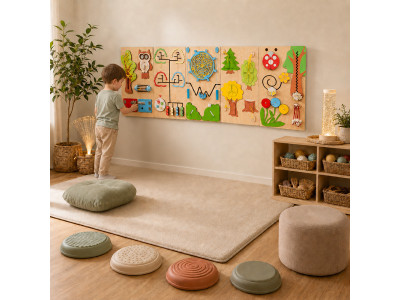
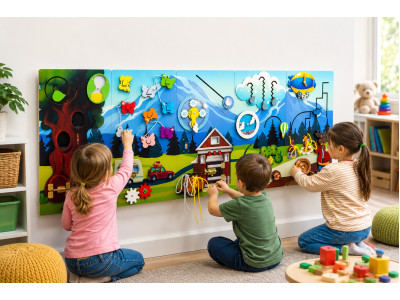
A single panel suits a defined, smaller space or a lower budget. A modular multi-panel set allows different sections to serve different purposes: one area with fine motor activities, another with a color or shape theme, another with a calming, low-stimulation design. It can also be extended over time as budget or space allows. Multi-panel sets let several children interact with different sections simultaneously, which matters more in classrooms and waiting rooms than at home.
Budget and Value
Price generally scales with panel size, material quality and the number of interactive elements. For institutional buyers, factor in the total cost of the installation: panel, mounting hardware, and any professional installation. Weigh that against expected usage volume and lifespan, rather than comparing sticker price alone. A panel intended for daily use by many children over several years carries a different value calculation than an occasional-use home installation.
Considerations for Autism, ADHD and Sensory Processing Needs
Sensory wall panels are commonly used in settings that serve children with autism, ADHD, or broader sensory processing differences. It's worth being precise about what the evidence does and doesn't support here. Structured, sensory-rich activities are a recognized part of occupational therapy practice for children with sensory processing differences. The American Occupational Therapy Association's position statement describes therapists using individually tailored, sensory-rich activities as part of broader therapeutic practice.[7] Separately, education researchers at Vanderbilt University's IRIS Center focus on this in a module about autism spectrum disorder. They note that structure and predictability in a physical learning environment help autistic students feel secure and ready to engage.[8]
Neither source evaluates sensory wall panels as a specific product. We have not found comparable published research isolating ADHD-specific outcomes from sensory-rich environments. A panel is not a medical device and does not treat, diagnose or cure autism, ADHD or any other condition. If you're selecting a panel specifically for an autism-friendly space, our sensory wall panels for autism-friendly spaces page covers design considerations in more depth, within the same limits described here. For a fuller walkthrough of that decision, our complete buying guide for sensory wall panels and autism covers scenarios, buyer personas and a scoring checklist in more depth.
Final Buyer Checklist
- Identify who will use the panel and their developmental stage, not just a printed age range.
- Confirm the installation environment (home, classroom, daycare, clinic) and its durability and cleaning demands.
- Match activity types to the specific skills you want to support.
- Measure available wall space before selecting single vs. multi-panel.
- Verify small parts, sharp edges and lead-in-finish safety directly with the manufacturer.
- Confirm material specifications and cleaning compatibility.
- Follow manufacturer mounting instructions for your specific wall type.
- Consider mounting height for wheelchair users or seated adults, if relevant.
- Compare total installed cost against expected usage volume, not sticker price alone.
Once you've worked through these factors, our sensory wall panels collection is organized by theme, size and finish. If you want a straightforward starting point that covers the core activity types this guide walks through, our 5-piece sensory wall panel set is a solid default for classrooms and therapy rooms. For themed options specifically, our guide to choosing a themed sensory wall panel covers that decision separately.
Frequently asked questions about choosing a sensory wall panel
What age is a sensory wall panel appropriate for?
Most panels list a recommended age range, often starting around 12 months. The AAP recommends matching activities to a child's actual developmental stage rather than relying solely on a printed range. Younger children generally benefit from simpler tactile activities, while older preschoolers engage more with multi-step challenges like latches and puzzles.
Should I choose a single panel or a multi-panel set?
That depends on available wall space, budget, and how many children will use it at once. A single panel works well for a defined home space. A multi-panel set is generally a better fit for classrooms or waiting rooms where several children may interact with the panel simultaneously.
Are sensory wall panels safe for group or institutional use?
They can be, when built and maintained to address small parts, sharp edges and finish safety. Regular inspection also matters, given higher daily use. Our sensory wall panel safety guide covers the specific standards and inspection practices relevant to institutional settings.
Do sensory wall panels help with autism or ADHD?
Structured, sensory-rich activities are a recognized part of occupational therapy practice for sensory processing differences. Predictable environments are documented as helpful for autistic learners specifically. No published research evaluates sensory wall panels as their own tested intervention. A panel does not treat, diagnose or cure any condition.
Related reading
- Best Sensory Wall Panels for Kids: What Actually Matters
- What Should Be in a Sensory Room?
- Wall-Mounted vs. Freestanding Busy Board
Ready to choose your panel?
Browse the full collection by theme, size and finish, or get in touch if you're planning an installation for a classroom, clinic or other institutional space.
Sources Referenced
- American Academy of Pediatrics. How to Buy Safe Toys.
- U.S. Consumer Product Safety Commission. Small Parts and Choking Hazard Labeling FAQs (16 CFR Part 1501).
- U.S. Consumer Product Safety Commission. Lead in Paint (16 CFR Part 1303).
- U.S. Consumer Product Safety Commission. Anchor It! Furniture and TV Tip-Over Prevention Campaign.
- HeadStart.gov. Selecting and Using Cleaning, Sanitizing, or Disinfecting Products.
- U.S. Department of Justice, ADA.gov. 2010 ADA Standards for Accessible Design.
- American Occupational Therapy Association (2023). Sensory Integration Approaches for Children and Youth in Occupational Therapy Practice. American Journal of Occupational Therapy.
- Vanderbilt University, IRIS Center. The Learning Environment (Autism Spectrum Disorder module).
Educational guide from the BumbleBeeSmart blog, referencing publicly available U.S. federal safety standards and pediatric and occupational therapy guidance. This article does not claim that any specific BumbleBeeSmart product is independently certified, lab-tested, or compliant with any standard referenced here unless stated explicitly. Not medical, legal or regulatory advice.






Write a comment