


BumbleBeeSmart · Buying guide · Updated August 2026
If you're trying to decide which sensory wall panel for autism to buy, for a child, a classroom, or a clinic, this guide is for you. It gives you a decision framework, comparison tables, and buyer-specific recommendations for choosing sensory wall panels for autism. You'll also get a scoring checklist and a research-informed account of what the evidence does and doesn't support. Use it to evaluate any manufacturer's product with confidence. If you already know what you need, you can go straight to our sensory wall panels for autism.
It's written for parents, caregivers, occupational therapists, ABA providers, pediatric clinics, autism centers, schools, daycares, hospitals, purchasing managers, and interior designers. It covers what these products are, how to choose one, and how settings differ. It also covers what to compare, how to evaluate build quality and safety, how to plan installation and cleaning, and what to ask a manufacturer before you sign a purchase order.
One thing this guide will not do is overstate the evidence. Sensory processing differences are a well-documented feature of autism. But a sensory wall panel is supportive equipment, not a treatment for autism. No panel has been shown in high-quality research to change core autistic characteristics. The value of a good panel is practical. It's a durable, safe, accessible surface that makes fine-motor and sensory activities available in a shared or home environment. Choose it on that basis, and you won't overpay for promises.
Throughout this guide, we use examples from BumbleBeeSmart products when they help illustrate a design or purchasing principle. Product specifications are presented as manufacturer information, kept separate from independent research. Ask any manufacturer, including us, for documentation before relying on a claim.
Quick buying summary
In one line: buy sensory wall panels for autism that are safe, cleanable, durable for their setting, and matched to the individual's sensory profile. Treat every developmental claim as unproven.
What a sensory wall panel is (and isn't)
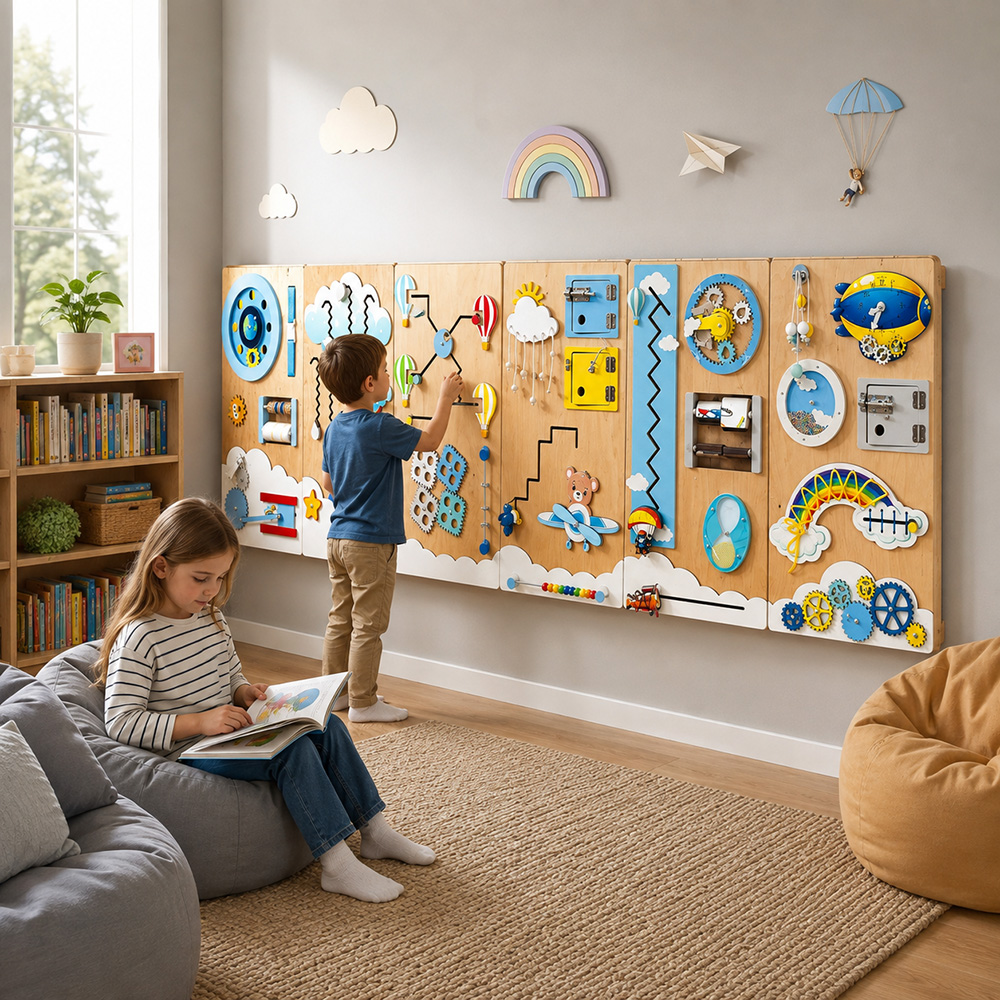
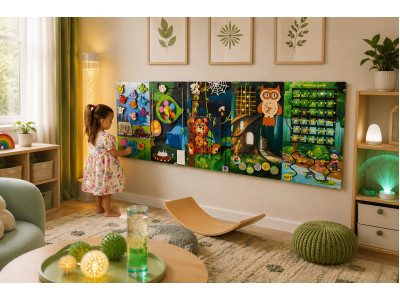
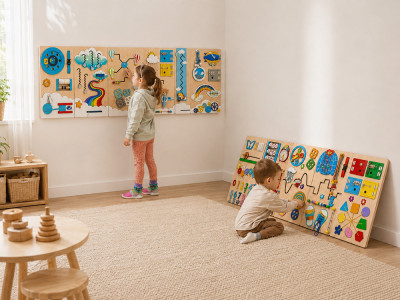
A sensory wall panel for autism, also called a wall-mounted sensory panel or autism sensory wall, is a rigid board mounted permanently to a wall. It presents sensory and fine-motor activities in a fixed vertical layout: textures, gears, sliders, latches, mirrors, tracing paths, beads, and cause-and-effect mechanisms.
It is not a diagnostic tool. It is not a therapy in itself, and not a replacement for occupational therapy delivered by a qualified practitioner. Occupational therapy addresses how a person registers and integrates sensory information and supports participation in everyday activities. A wall panel is one environmental tool a therapist or educator might use within that broader work. See National Autistic Society, AOTA practice guidelines, and Children's Hospital Los Angeles.
Why sensory panels are used at all: sensory processing in autism
Since 2013, "hyper- or hyporeactivity to sensory input, or unusual interest in sensory aspects of the environment" has been part of the formal DSM-5 diagnostic criteria (Autism Speaks; Marco et al.). Atypical sensory-related behaviors are reported in the large majority of autistic children (Marco et al.; AOTA).
A person may be over-responsive to some inputs and under-responsive to others. The same environment can overwhelm one person and under-stimulate another. That's the single most important reason no panel suits everyone. It's why matching the product to the person matters more than any feature list. For a plain-language look at how sensory play is commonly used with autistic children, see this overview of sensory play and autism.
In our experience working with schools and clinics, the buyers who are happiest a year later started with a person and a room. Not a product. "What does this child, or this waiting area, actually need?" is a better first question than "which panel has the most activities?"
How to choose the right sensory wall panel
Start from your primary goal and the setting, then let those drive the format. Use this as a first filter before you compare individual products.
A useful design principle throughout: the best panels let a user engage one element at a time rather than everything at once. It's worth noting these panels are used across age groups, not only with young children, and the same "one element at a time" logic applies whether the user is a preschooler or an adult.
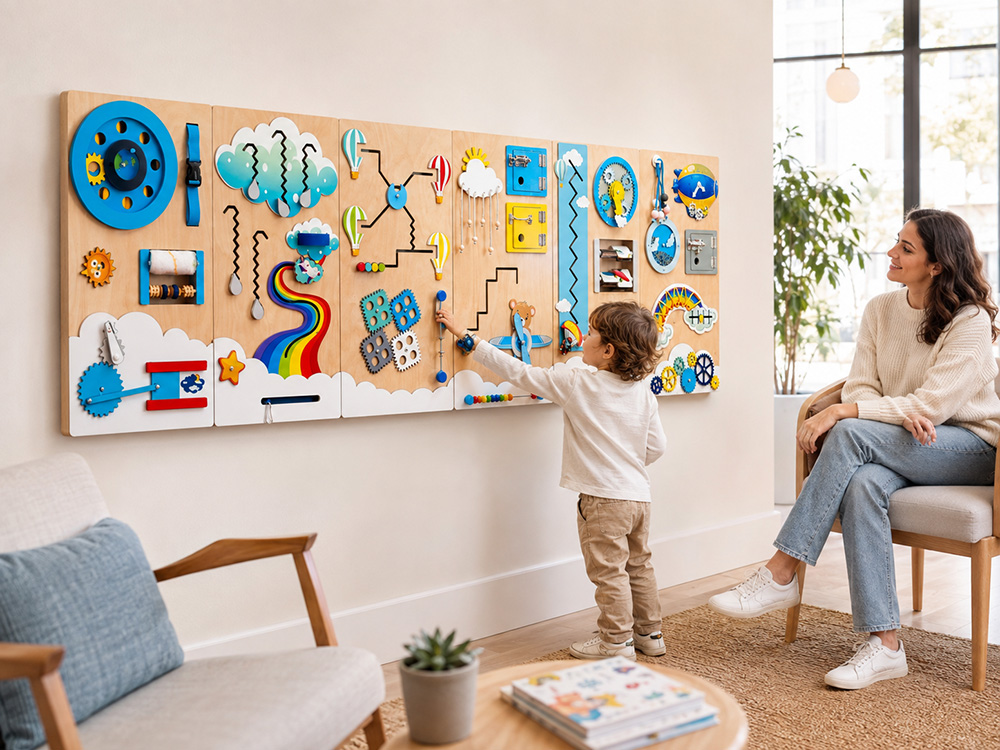
Illustrative scenarios: why certain designs fit certain rooms
Most buyers initially focus on how a panel looks. In practice, the room decides most of the specification. These are typical buying patterns we see, not measured case results.
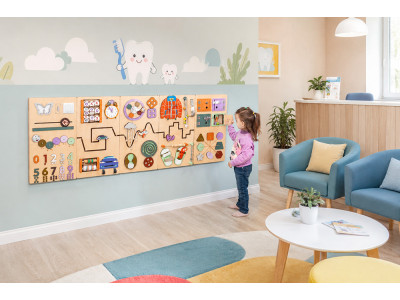
Pediatric clinic. A panel earns its place by occupying a bored, anxious child for a few minutes with near-zero supervision. Smooth, wipeable surfaces and secure mounting matter more than a long activity list. That's why dedicated panels for dental and pediatric offices tend to be specified that way.
Autism classroom. A classroom panel is used by many children with different profiles, all day. Buyers in this setting typically prioritize broad age-appropriateness. They tend to ask about repair support up front, since heavy daily use means something eventually needs fixing.
Daycare. Toddlers mouth things and pull hard. A daycare needs child-safe materials, no choking-size parts, and construction that survives rough, repeated use. This look at wall-mounted panels for daycares and play areas covers those considerations.
Library. Libraries want engagement without noise, clutter, or lost pieces. A wall-mounted panel keeps a focused activity in one place, off the floor, with nothing to scatter.
Home. At home you can tune the panel tightly to one child's profile. This is the one setting where matching the individual outweighs commercial durability, which is the same principle behind BumbleBeeSmart's autism-focused panel designs.
Therapy clinic. An OT clinic sees dozens of children a week, many of whom mouth or repeatedly touch surfaces. Infection control usually drives the specification: smooth, sealed or non-porous surfaces suited to frequent cleaning. The principle holds across healthcare settings. If it can't be wiped down quickly and safely, it's the wrong panel, however appealing its activities. Clinics building a broader fine-motor or rehabilitation station alongside the wall often add peg maze boards as a focused, portable complement.
In our experience, institutional buyers often start by counting activities. Mounting, cleanability, and repair support usually matter more after the first year of use.
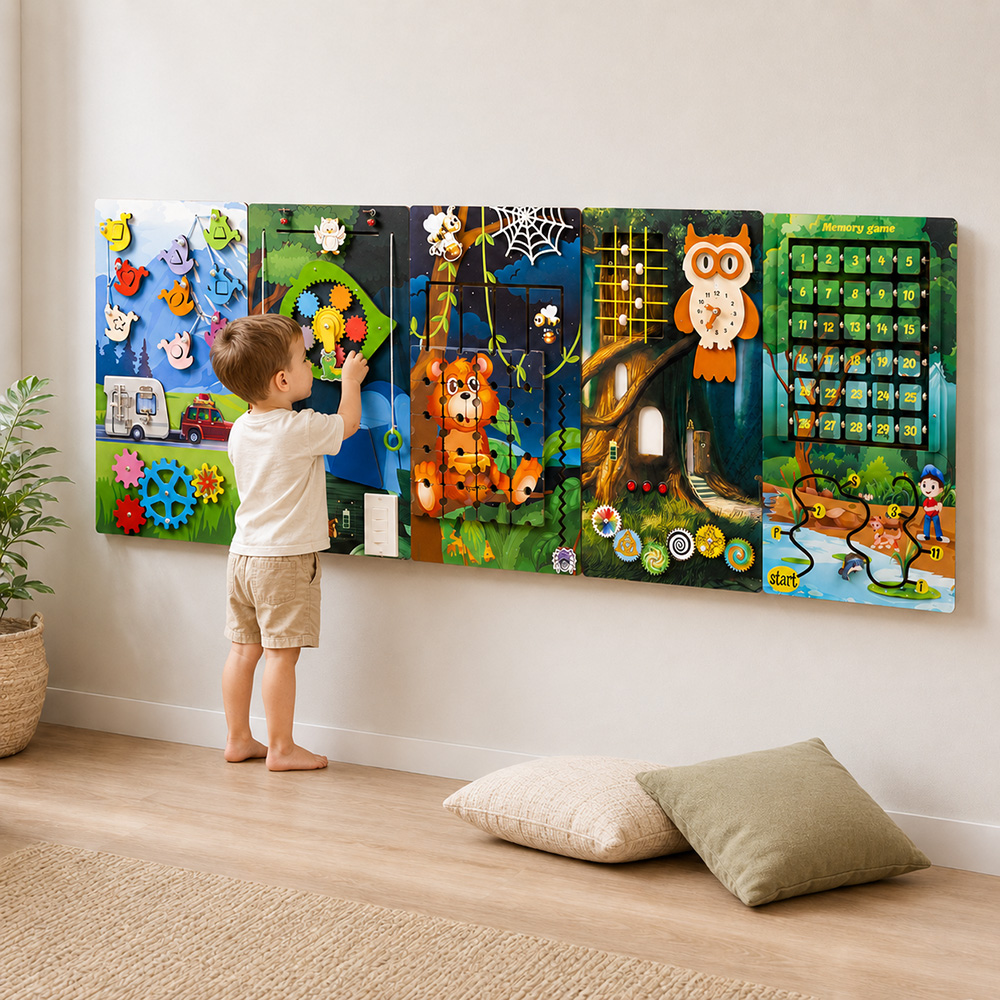
Buyer personas: what to prioritize by setting
Sensory needs, traffic, cleaning demands, and budgets differ sharply by setting.
Comparison tables
Expert tip. One of the most common mistakes we see is buying a beautiful residential-grade panel for a high-traffic clinic or classroom. It may look good initially but wear quickly under repeated daily use. If more than a handful of children will use it daily, ask about construction intended for repeated everyday use. Ask what repair support looks like, too.
Scoring checklist
Score any candidate panel 1 to 5 on each criterion. A high total on paper still fails if it misses safety or cleanability for a shared setting; treat those as gatekeepers.
These criteria draw on general guidance rather than a single sensory-panel-specific standard. Mechanical-hazard considerations align with how the CPSC and ASTM F963 describe children's products generally. Cleaning guidance follows CDC and EPA/CDC recommendations for shared surfaces.
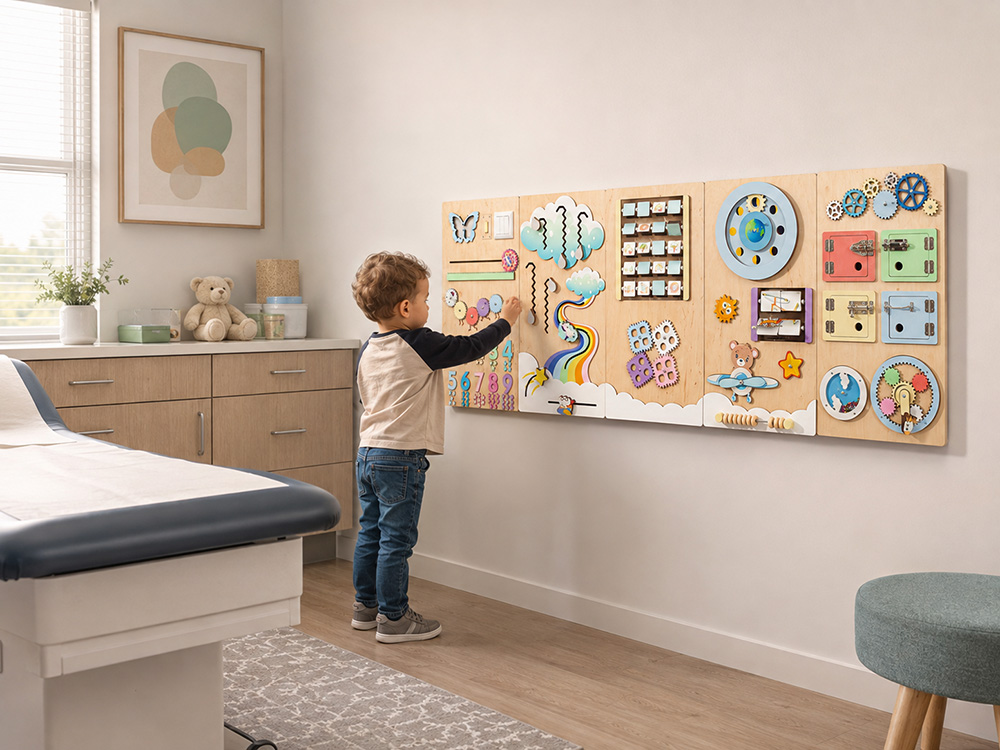
Materials, cleaning, and installation
Buying the panel is only half the decision. How it's built, cleaned, and mounted determines whether it succeeds, and these are the factors most often skipped in a rushed purchase.
Materials and durability
Hard, sealed, or non-porous surfaces, such as sealed wood, high-pressure laminate, durable plastics, or powder-coated metal, resist wear and clean up better than soft, porous materials. In high-traffic clinics and classrooms, ask specifically about construction intended for repeated everyday use rather than finishes meant for lighter home use. Check that moving parts (gears, spinners, latches) are built to survive repeated forceful use. Fabrics and soft textures are harder to disinfect. Use them only where they add clear value and, ideally, choose a removable option (EPA/CDC).
Cleaning and infection control
In any shared setting, cleaning is a purchasing criterion, not an afterthought. Shared objects are a recognized route for spreading infection. Public-health guidance recommends routine daily cleaning of frequently touched surfaces, with disinfection when surfaces are visibly soiled (CDC). Choose smooth, sealed or non-porous, wipeable surfaces with few crevices, and ask the manufacturer which cleaning products are compatible with the finish; healthcare settings may have stricter protocols. Because some autistic users mouth surfaces or touch the same elements repeatedly, cleanability matters more, not less. Our sensory wall safety guide is a useful companion here.
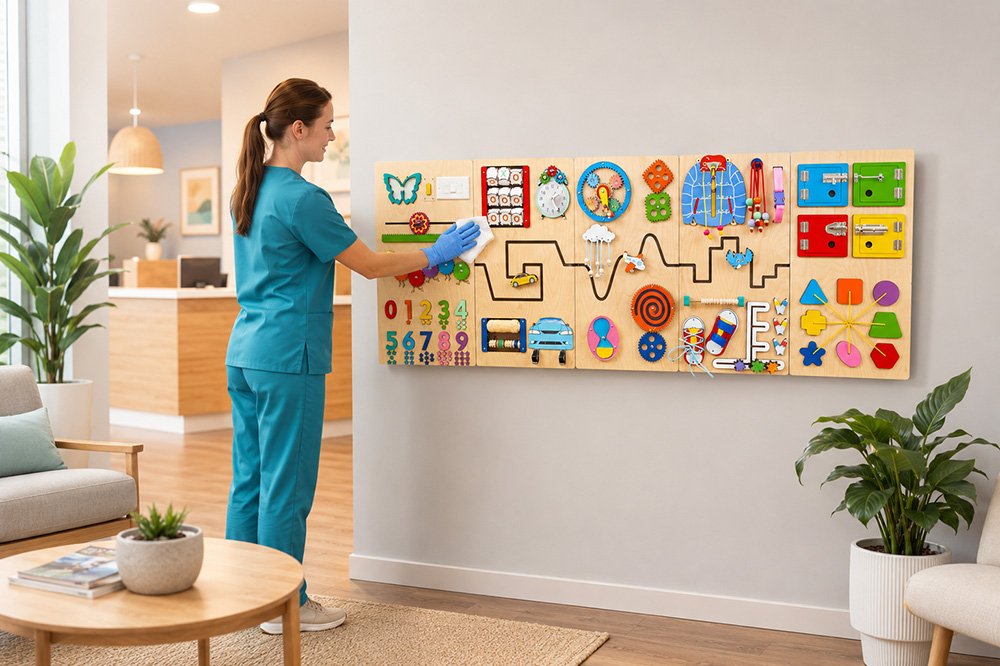
Installation
Fixed panels must be mounted to structural support (studs, blocking, or masonry with appropriate anchors). Hardware needs to suit the panel's weight and a child or adult leaning, pushing, or hanging on it. A panel that detaches becomes an impact hazard. Before buying, ask what mounting method the manufacturer specifies. Confirm whether hardware and instructions are included, and which wall types the system works with. For heavy or large installations, professional installation is worth the cost. Mounting height should suit the intended users, including those who sit or use a wheelchair.
Before you buy. Ask what mounting hardware is included and which wall types it's designed for. Ask, too, whether replacement parts are sold separately if something wears out. Vague answers to any of these are informative on their own.
Safety considerations
Safety should be the first filter, before features or price, especially for products used by young children or anyone who mouths objects. For products marketed as toys or children's products in the United States, applicable CPSC/CPSIA and ASTM requirements may apply depending on product classification and intended age. These generally cover choking on small parts, sharp points and edges, and chemical limits on materials like lead and phthalates (CPSC; ASTM). This is general guidance, not legal advice; verify what applies to a specific product and your jurisdiction.
- Small parts and choking. Especially relevant for autistic children who mouth objects; ask what testing, if any, the manufacturer has done.
- Sharp edges and points. Panels should have rounded, finished edges and no exposed fasteners at height.
- Chemical safety. Ask whether finishes and materials have been tested for lead and phthalates, and request documentation.
- Secure mounting. Hardware should suit the panel's weight and a child bearing weight on it.
- Documentation. Ask whether the manufacturer can provide test certificates or compliance documentation for your market.
Manufacturer note. Treat published safety documentation as verifiable and useful. Treat outcome or benefit claims, and unverified certification claims, as marketing until a manufacturer shows you the documentation.
Common buying mistakes
Most buyers initially focus on appearance and activity count. The costlier mistakes are usually elsewhere. This companion piece on choosing sensory wall panels covers the same ground from a general buying perspective.
- Buying by appearance. A photogenic panel can be flimsy or overstimulating.
- Believing outcome claims without documentation. No high-quality research supports product-specific claims like "improves focus" or "reduces meltdowns" (MSE review; Watling & Hauer, 2015). Ask any manufacturer to show, not just tell.
- Not asking about repair support. Ask whether the manufacturer provides repair support or replacement components if an activity becomes damaged, before you need the answer.
- Skipping warranty questions. A panel you can't get fixed or replaced becomes disposable.
- Ignoring accessibility. The wrong mounting height or stiff mechanisms exclude the intended user.
- Choosing overstimulating panels. Walls of competing lights and sounds can work against the users most likely to benefit.
Questions to ask every manufacturer
- Are there any small parts that could pose a choking risk for the intended age group?
- What are the edges and fasteners like, rounded and recessed?
- What are the surfaces made of, and which cleaning or disinfecting products are they compatible with?
- What mounting hardware is included, and which wall types is it designed for?
- Do you offer repair support or replacement components if something wears out or breaks?
- What is the warranty length and what does it cover?
- Is the design appropriate for our users' age, developmental level, and interests?
- Can activities be engaged one at a time to avoid overload?
- What evidence, if any, do you cite, and is it about this product or extrapolated from general sensory research?
Where each panel works best
How to read the evidence
This guide separates claim types so you can weigh them:
- Established evidence: sensory processing differences are common in autism and part of DSM-5 (Autism Speaks; Marco et al.).
- Clinical experience: OTs and educators use sensory and fine-motor activities to support regulation and skills (AOTA; CHLA).
- Expert opinion: predictable panels may ease transitions or support independent play; reasoned, not proven.
- Manufacturer information: product descriptions of features, materials, and settings; useful for evaluation, not evidence of outcomes.
- Anecdotal reports: testimonials and individual experiences, not proof.
On the therapies nearest to this equipment: Ayres Sensory Integration, a specific therapist-delivered therapy, not a product, has moderate but debated evidence. A 2025 review of randomized trials found it helps children meet individualized goals but not "behaviors of concern" (Schoen et al., 2019; AOTA, 2025). Multisensory environments show limited, mixed effects (2025 systematic review). Wall panels specifically remain essentially unstudied. For a closer look at the developmental mechanisms behind sensory play more broadly, see the science behind sensory wall panels.
Practical implication. Because the product category is unstudied, base your decision on things you can verify. Documentation, materials, cleanability, mounting, warranty, and fit to the individual, rather than on outcome promises you can't.
Choosing a Sensory Gift for an Autistic Child
Searching for a gift for an autistic child often leads to lists of "calming" or "therapeutic" toys. The most useful starting point is simpler: what does this particular child enjoy, and what do they avoid? Autistic children's sensory preferences vary widely. One child seeks out textures, sounds and movement, while another finds the same things overwhelming. A good gift fits the child, not a label.
A few practical questions help narrow the choice:
- Ask a parent or caregiver first. They know which textures, sounds and colors the child is drawn to, and which ones cause distress. If you are buying for a child who is not your own, this one question matters more than anything else on this list.
- Predictable over surprising. Toys with a clear cause and effect, such as a latch that opens or a gear that turns, tend to be easier to enjoy than toys with sudden noises or flashing lights.
- Quiet by default. Built-in sound effects can be fun for one child and unbearable for another. A toy whose sounds the child controls is a safer bet.
- Calm colors and a clear layout. A busy, high-contrast design can feel cluttered. Softer palettes and fewer, well-spaced activities are easier to approach.
- Durable and fixed in place. For children who explore with force, a wall-mounted board with no loose parts is easier to live with than small pieces that go missing.
Gift ideas for a non-verbal autistic child
For a non-verbal child, the best gift ideas usually need no words, reading or instructions to enjoy. Hands-on activities with an obvious result work well: sliding a bolt, turning a key, opening a door to find a picture behind it. The child decides what to do and how long to spend on it, and there is no wrong way to play.
Where sensory wall panels fit as a gift
A sensory wall panel is a larger, longer-lasting gift than most toys, which makes it a better fit for a family gift or a shared gift from several relatives. Two practical options are a pastel panel set you build up one panel at a time, which lets the family start small and add panels later, and a sensory wall panel in natural colours, which uses a wood-grain base with neutral-toned elements for a calmer look. Either way, it is a play and activity product, not a therapy tool, and it works best as one part of a space built around the child's own preferences.
Frequently Asked Questions About Sensory Wall Panels for Autism
Are sensory wall panels backed by research?
Sensory processing differences in autism are well established, but sensory wall panels themselves are essentially unstudied, and research on sensory-based interventions and multisensory environments is mixed and inconclusive. Treat panels as low-risk supportive equipment, not proven interventions.
Can a sensory wall panel replace occupational therapy?
No. It is equipment, not therapy. Occupational therapy is delivered by a qualified practitioner and individualized; a panel can be one tool within a supportive environment.
Do sensory wall panels treat autism?
No. They do not treat autism and should never be sold or bought as a treatment.
How long do sensory wall panels last?
It depends on build quality, traffic, and repair support. Panels built for frequent use with replacement parts available last longest in high-traffic settings; panels intended for lighter home use suit that purpose well. Judge value by cost per year of service.
Which material is easiest to clean?
Hard, sealed, or non-porous surfaces, such as sealed wood, laminate, or durable plastics, are easier to disinfect than soft, porous materials.
Should schools ask about repairable or multi-panel systems?
Usually yes. Ask whether the manufacturer supports repairing or replacing individual components, and whether panels can be added later, rather than assuming any given product is fully user-reconfigurable. This is generally better long-term value in shared settings than an all-or-nothing installation.
Are wooden panels better than plastic?
Neither is universally better. Well-sealed wood is durable and cleanable; quality plastics can work too. Confirm non-toxic finishes, no brittle small parts, and smooth rounded edges either way.
Can adults use sensory wall panels?
Yes. Panels are used across age groups in wellness, healthcare, and senior settings; choose age-appropriate, non-infantilizing designs. See our sensory wall panels for adults collection.
What size panel should I buy?
Match size to users, traffic, wall space, and reach range. In small rooms, oversized panels can cause visual overload; distributed smaller stations often work better in busy settings.
What safety questions should I ask about a sensory wall panel?
For products marketed as children's products in the United States, CPSC/CPSIA and ASTM F963 requirements may apply depending on classification and age range. Ask the manufacturer directly what documentation they can provide for choking hazards, sharp edges, and chemical safety, rather than assuming any given claim.
Is a fixed panel or a portable board better?
Fixed panels suit dedicated corners and shared spaces. A freestanding or tabletop busy board suits itinerant therapists, rentals, and homes short on wall space, though some busy boards are wall-mounted too, so check the specific product.
What is a good gift for an autistic child?
One that matches the child's own sensory preferences. Ask a parent or caregiver which textures, sounds and colors the child enjoys or avoids. Predictable, hands-on toys with controllable sound and a calm layout are usually a safer choice than toys with sudden noises or flashing lights.
Is a sensory wall panel a good gift for a non-verbal autistic child?
It can be, because the activities need no words or instructions: a latch opens, a gear turns, a door reveals a picture. As with any gift, check the child's sensory preferences with the family first. It is a play product, not a therapy tool.
What's the single most important buying factor?
For shared settings: safety documentation and cleanability first, then durability and repair support. For homes: fit to the individual.
Related guides
- Sensory Wall Panels - browse the full collection
- Adult Sensory Walls - all-ages & senior-care use
- Waiting Rooms - clinics, cafes & reception areas
- Fine Motor & Vertical Play - why wall-height activities help
- What Should Be in a Sensory Room for Autism? - room-level planning beyond a single panel
Final recommendation
Use the framework, not the marketing, when comparing sensory wall panels for autism from any manufacturer. Score every candidate on safety, cleanability, durability, mounting, materials, repair support, warranty, activity suitability, age fit, accessibility, and traffic suitability. Match the activities to the individual, not to a brochure. Set realistic expectations. A good sensory wall panel is durable, safe, and genuinely useful as one part of a supportive environment, but it is not a treatment and guarantees no developmental outcome. That honesty is not a limitation of the product, it's the foundation of a purchase you won't regret.
Want the documentation before you decide?
Ask us for materials, finish and mounting details for any panel, or for a layout suggestion for your wall.



Write a comment