


Searching "what should be in a sensory room for autism" turns up dozens of lists that read almost the same. A bubble tube, a weighted blanket, some fairy lights, a bean bag. Those items aren't wrong, but a list on its own skips the part that actually matters. Autistic children vary widely in how they respond to sensory input. Some are under-responsive to input that overwhelms another child completely. There's no single correct shopping list. This guide walks through the equipment by sensory system instead, so you can build toward what a specific child actually needs. That applies whether you're setting up a corner at home, a classroom calm-down space, or a full therapy room. For the general version of this checklist that isn't autism-specific, see our guide on what should be in a sensory room.
Why Sensory Needs Vary So Much in Autism
Every child's nervous system processes sound, light, texture and movement a little differently. For an autistic child, that variation is often wider. Some children seek out intense input like spinning, deep pressure or loud sounds. Others are overwhelmed by the same input at a much lower level, and many children do both depending on the sense involved. The American Academy of Pediatrics notes that research on sensory-based approaches is still developing.[1] Even so, many families and schools find a dedicated room useful in practice. That's why this guide is organized by sensory system rather than as one fixed list. The right combination depends on the child, not a formula that works the same for everyone.
What Should Be in a Sensory Room for Autism, by Sensory System
Here's the equipment most commonly used across autism sensory rooms, grouped by which sense it targets. Not every room needs every category. Start with one or two that match the child's known preferences, then add from there.
| Sensory system | Common equipment |
|---|---|
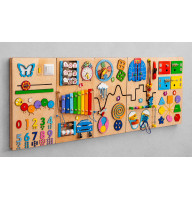
| Tactile | Sensory wall panels with gears, latches and sliders; textured mats and fabric swatches; sensory bins; fidget toys |
| Visual / light | Bubble tubes and bubble walls, fiber optic lights, interactive light panels, dimmable or color-changing lighting |
| Proprioceptive (body awareness) | Weighted blankets or lap pads, crash pads, bean bags, resistance bands |
| Vestibular (balance/movement) | Platform or hammock swings, rocking chairs, balance boards, mini trampolines |
| Auditory | White noise or nature sound machines, noise-reducing headphones, soft music |
| Calming & organization | A designated quiet corner, soft seating, labeled storage bins to keep the room predictable |
Sensory Wall Panels and Busy Boards: The Tactile Core
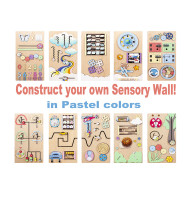
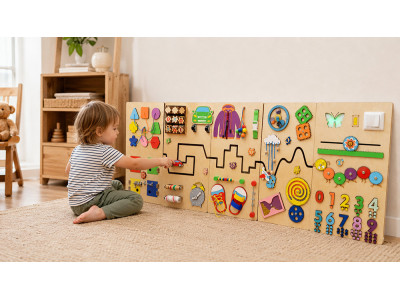
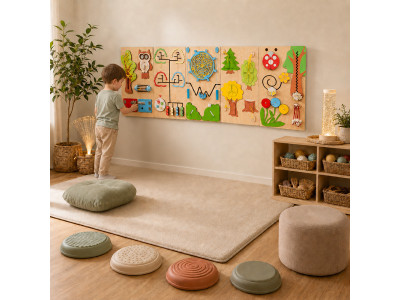
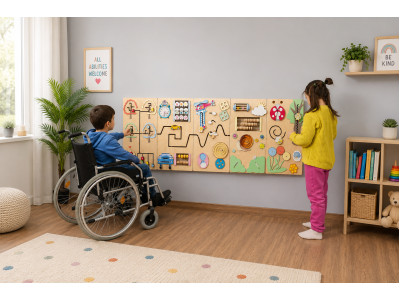
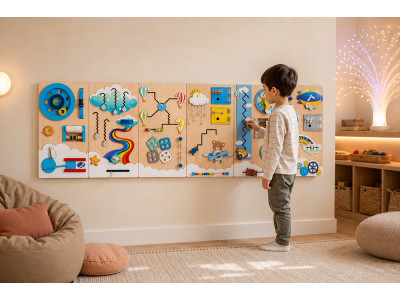
Wall-mounted activity panels are one of the most space-efficient ways to cover the tactile and fine-motor side of the room. Manipulable elements like gears, switches, latches and spinners give a child a safe way to explore cause and effect with their hands. Sensory wall panels are the larger, expandable version of this idea. They're built to be mounted on a shared wall and used by more than one child at a time. That makes them a natural fit for a classroom or clinic. A busy board is the compact alternative: a single panel sized for one child, individual play, or a room where wall space is limited. Neither replaces the other. Many families start with a busy board at home and move to a modular wall as the room grows. Others use both in different rooms. If you already know you want a wall-mounted panel but aren't sure how many or what size, our guide to choosing sensory wall panels walks through sizing and layout.
Visual and Light Equipment
Light-based equipment is one of the most consistently recommended categories across sensory room guides. It's also one of the easiest to get wrong by adding too much at once. A single slow-moving light source, like a bubble tube or a fiber optic fixture, gives a child something to watch and settle into. It doesn't compete for attention the way a busy display would. Dimmable or color-changing lighting lets you adjust the intensity instead of committing to one brightness. BumbleBeeSmart's own sensory room equipment lineup covers this category directly. Wall-mounted options like the LED Bubble Wall work well where floor space is tight. Fiber optic fixtures and an interactive light panel suit children who respond better to hands-on visual play than a purely passive display.
Setting Up the Room Itself
Equipment choice matters, but so does the room it goes into. A few practical points come up across most professional guides to building these spaces:
- Location: a quieter part of the home or building, away from heavy foot traffic, makes the room easier to use consistently.
- Lighting: humming fluorescent lights are a common source of unwanted sensory input on their own; a dimmer switch or lamps give you more control than an all-or-nothing overhead light.
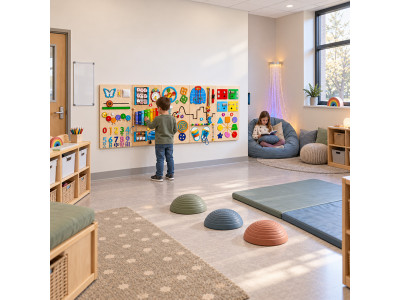
- Flooring: a mix of a soft rug or mat with a durable, easy-to-clean surface covers both comfort and practicality, especially in a shared or institutional setting.
- Predictability: keeping equipment in the same place and storage labeled and tidy helps a child know what to expect each time they enter.
Home, School, Clinic or Daycare
A home sensory corner usually works best as a smaller, flexible space. Build it around one or two pieces of equipment that a specific child responds well to. A school or clinic room typically needs to serve more than one child. That's where wall-mounted, multi-user equipment like sensory wall panels earns its keep over single-user items. Setting this up for a classroom specifically? Our sensory wall panels for schools page covers equipment built for that kind of shared, repeated use. If a clinic or school would rather set up a complete calm-down room in one order, the Calming Sensory Room Package brings the bubble tube, fiber optics, seating, projector and sound system together as one set.
Frequently Asked Questions About Sensory Rooms for Autism
What should every sensory room for autism include?
There's no fixed list, since sensory responses vary widely from child to child. Most rooms draw from a mix of categories: tactile equipment (sensory wall panels, textured surfaces), visual or light equipment (bubble tubes, fiber optics, dimmable lighting), movement equipment (swings, balance boards), and auditory tools (sound machines, noise-reducing headphones), plus a quiet corner for settling down. Start with what matches the child's known preferences rather than installing every category at once.
What's the difference between a busy board and a sensory wall panel?
A busy board is a compact activity panel built for one child and individual play. Sensory wall panels are the larger, expandable version. They're mounted on a shared wall and built for more than one child at a time, which makes them a common choice for classrooms and clinics.
Do I need a bubble tube or fiber optic lighting, or is one enough?
One is usually enough to start. Both give a slow, continuous visual focal point rather than a busy or flashing display. Adding several light sources at once can overload a room that's meant to be calming. Pick whichever fits your wall or floor space, and add a second only if the first gets consistent, positive use.
Can I set up a sensory room at home on a budget?
Yes. Many families start with a single busy board, a comfortable seating spot and one piece of light or tactile equipment. They expand gradually as they learn what the child responds to. A full room isn't necessary to get value from a dedicated sensory space.
Is a sensory room the same as sensory integration therapy?
No. A sensory room is a physical space with equipment a child can use independently or with guidance. Sensory integration therapy is a structured intervention led by a trained occupational therapist. A sensory room can support the kind of exploration a therapist might also encourage, but it isn't a substitute for professional therapy.
Do you offer institutional or bulk pricing for schools and clinics?
Yes. Multi-room and district-wide orders are quoted individually. Contact us with your project details and we will put a quote together.
Why Choose BumbleBeeSmart
BumbleBeeSmart covers both sides of an autism sensory room. We make sensory wall panels and busy boards in-house. We also resell a growing lineup of light and water equipment from Experia, an established manufacturer of institutional sensory fixtures. That means a school, clinic or family can source the tactile wall, the visual fixture and the fine-motor activity board from one place, instead of piecing a room together across several vendors. Browse the full sensory wall panels for autism range to get started, or reach out if you're planning a multi-room installation.
Educational guide from the BumbleBeeSmart blog. This article describes general sensory room concepts and equipment categories for autistic children. It is not medical advice and does not replace guidance from a qualified occupational therapist or other healthcare professional.






Write a comment