


Interactive sensory wall panels are increasingly common in classrooms, therapy spaces and inclusive learning environments. The appeal is not just aesthetic. The science behind sensory wall panels draws on a well-established body of research. That research covers how young children build motor, cognitive, language and social skills. Most of it studies hands-on, sensory-rich play in general, not wall panels specifically. This guide walks through what the research actually shows. It also covers where the evidence applies directly, where it doesn't, and how BumbleBeeSmart panels are designed around these principles.
How Sensory Play Builds the Brain: The Science Behind Sensory Wall Panels
Children begin learning long before they speak, through touch, movement and sensory input. In the first years of life, the brain forms new neural connections, or synapses, at a rapid rate. Which connections strengthen or fade depends heavily on a child's experiences.[1] The Centers for Disease Control and Prevention notes that talking, playing and exploring with a child stimulates this early brain growth. The American Academy of Pediatrics points to play as a driver of brain structure and function. It describes play as facilitating synapse connection and improving brain plasticity.[2] Head Start's early childhood research summarizes the same point plainly. Each new sensory experience helps form or strengthen a connection in a developing brain.[3]
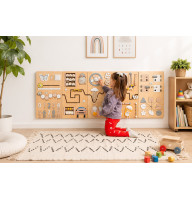
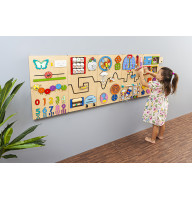
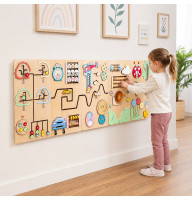
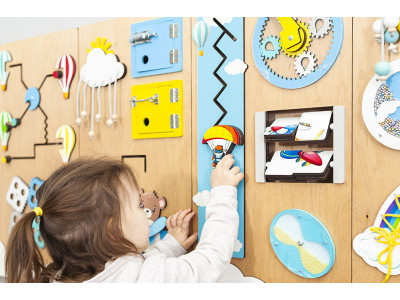
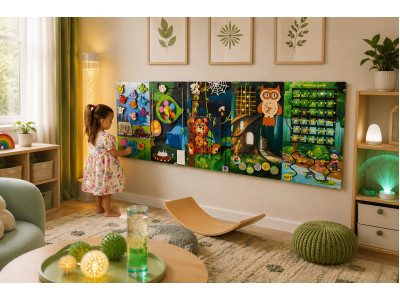
Textures, lights, sounds and movable objects on a wall panel are examples of tactile, visual and cause-and-effect experiences. These are the kinds of experiences discussed in the broader developmental literature. The research does not establish that delivering them through a wall panel produces the same outcomes as the activities studied.

Fine Motor Skill Development Through Hands-On Play
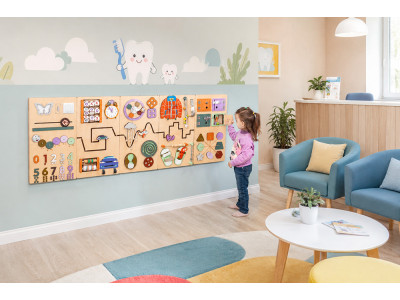
Panels featuring sliders, buttons, beads and switches ask children to use the small muscles in their fingers and hands. These are the same muscles involved in everyday tasks like writing, buttoning clothing or using utensils. This is not a novel claim. A 2024 study published via PMC looked at fine motor skills in 12-month-old infants. It found them closely related to sensory processing, particularly visual-tactile integration and ocular motor control, the coordination between what a child sees and how their hands respond.[4] A systematic review in the American Journal of Occupational Therapy examined the link between play and sensory processing in children aged 3 to 12. It concluded that play is central to how children develop sensory-motor skills. It also noted that more rigorous research on specific play formats is still needed.[5] Cleveland Clinic's guidance on sensory play echoes this. Tactile play involving building, pouring, twisting or fastening helps children build the small-muscle control behind tasks like tying shoes or zipping a coat.[6]
For a closer look at how these skills develop stage by stage, see our guide to how fine motor skills develop in children.
Executive Function, Memory and Self-Regulation
Features like memory-matching games and tic-tac-toe ask children to remember positions, follow sequences and make decisions in real time. These are executive function skills: working memory, mental flexibility and self-control. Harvard's Center on the Developing Child describes this system as the brain's "air traffic control system." It is the ability to filter distractions, hold information in mind and switch between tasks.[7] NAEYC points specifically to matching and memory games as tools that build working memory and cognitive flexibility in early childhood settings.[8] A classroom-based randomized trial of a game-based executive function program tested this directly. It involved 626 students across 36 classrooms. It found measurable gains in these core regulatory skills when structured games were used consistently.[9] These foundational skills go on to influence attention span, behavior regulation and classroom readiness, well beyond the specific game used to build them. Our peg maze boards are one example of a sequencing-and-planning activity built around this same principle.
Color, Shape and Early Classification Skills
Color and shape sorting activities support visual discrimination and symbolic thinking. Both are building blocks for early math and language skills. NAEYC's guidance on early math learning describes sorting and classification as one of the clearest ways young children build reasoning skills. This means grouping items by shared characteristics like color, shape or size. That reasoning later supports number sense and pattern recognition.[10] A related NAEYC resource on shape recognition recommends this same kind of hands-on comparison and sorting to build spatial reasoning.[11] University of Nevada, Reno's early childhood extension program has a relevant finding here. Most children between 3 and 4 years old begin sorting by a single characteristic first, such as color alone. They progress to sorting by multiple characteristics only later.[12] Panels that let children sort, match or group elements by color and shape, such as our theme-shaped panels, apply this same progression in a wall-mounted format.
Visual Tracking and Cause-and-Effect Learning
Lights, sliders and interactive buttons give children immediate, visible feedback for their actions, reinforcing an understanding of cause and effect. A widely cited study in the Proceedings of the National Academy of Sciences found that even brief visual experience improved infants' tracking ability. Just two minutes of watching an object's trajectory measurably improved infants' ability to anticipate where a moving object would reappear. This shows that visual tracking develops through repeated, structured looking experience. It is not fixed from birth.[13] Research using eye-tracking methods in infancy has shown something related. How infants visually engage with goal-directed actions, like pressing a button to trigger a light, is closely tied to how they build early expectations about outcomes.[14] The same infant sensory-processing study cited above also found visual-tactile integration and ocular motor control to be closely linked to fine motor development. These are not separate skills; they develop together.[4]

What Montessori Research Can, and Cannot, Tell Us
Inspired by Montessori methods, sensory wall panels are designed to promote child-led learning and self-correction. Activities are simple, repetitive and within reach, allowing for safe, independent exploration. The most-cited research behind this approach is a 2017 longitudinal study published in Frontiers in Psychology. It followed children admitted to two public Montessori magnet schools. Admission was by randomized lottery, a design that let the researchers draw causal conclusions. The study found that Montessori preschool improved academic achievement, executive function and social skills compared to a control group. It also found that the model helped narrow typical achievement gaps linked to family income.[15] The National Center for Montessori in the Public Sector points to this same body of research. It describes how the method's core features support executive function development specifically: limited materials, student choice and open-ended activities.[16] A more recent study in PLOS ONE extended this work. It found that Montessori education was also linked to stronger creativity skills, which independently predicted academic outcomes.[17] What this research evaluated, in every case, was the full Montessori classroom model. It did not evaluate any individual material or piece of equipment. Referring to a panel as "Montessori-inspired" means it borrows specific, well-documented design principles: child-led activity, self-correction, a small set of purposeful materials. It does not mean the panel itself was part of any study.
Inclusive Design for Neurodiverse Learners
Sensory wall panels are widely used in inclusive classrooms and therapy spaces. There is a well-established professional consensus here, though again not a claim specific to wall panels as a product. Structured, sensory-rich activities are a recognized part of occupational therapy practice. This applies to children with sensory processing differences, including many autistic children. The American Occupational Therapy Association's position statement on sensory integration approaches describes the role occupational therapists play here. They support children with varied sensory processing patterns. They use individually tailored, sensory-rich activities as part of broader therapeutic practice.[18] A 2024 systematic review looked at sensory-based interventions in occupational therapy, covering studies from 2015 through 2024. It examined the evidence for sensory-based approaches for children and youth, excluding more intensive Ayres Sensory Integration protocols specifically.[19] Separately, education researchers at Vanderbilt University's IRIS Center focus on this in a module about autism spectrum disorder. They note that structure and predictability in the physical learning environment help autistic students feel secure and ready to engage. This principle comes from consistent, repeatable activities, not any single product or material.[20] We have not found comparable research evaluating sensory-rich environments specifically for ADHD. We are not extending this claim to ADHD here. For families and educators focused on autism specifically, our sensory wall panels for autism-friendly spaces page goes into more depth on design considerations.
Language and Social Development Through Shared Play
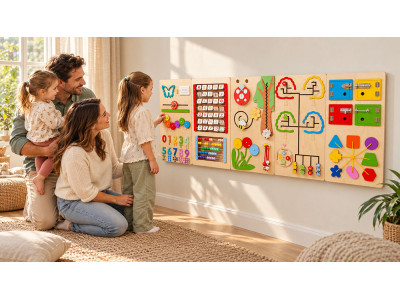
Using a sensory wall in a shared adult-child setting supports communication in a low-pressure way. Naming textures, shapes and actions together builds vocabulary. For children who are nonverbal or still developing spoken language, panels offer a shared point of focus without requiring words. This shared-focus dynamic has a name in developmental research: joint attention. That's when a caregiver and child focus on the same object or activity together. A review of joint attention research found it consistently linked to vocabulary growth in toddlers. It describes a two-way relationship: joint attention supports word learning, and growing language use in turn reshapes how children and caregivers engage.[21] A study of parent-child play with novel objects found that children's sustained attention created natural opportunities for parents. Parents could name what their child was focused on, at exactly the right moment for learning.[22] A 2025 longitudinal study followed 70 children from 10 months of age. It found that supportive parental behavior during shared play, not joint attention alone, was the strongest predictor of later vocabulary growth. This shows that the adult's engagement matters as much as the activity itself.[23] This is exactly the dynamic settings like daycares rely on, where a caregiver and child explore a panel together throughout the day.
What the Science Behind Sensory Wall Panels Does, and Doesn't, Show
It's worth being precise about what this body of research actually supports. The studies cited throughout this guide establish something specific. Hands-on, tactile, cause-and-effect and sorting-based play meaningfully supports fine motor, cognitive, language and social development in early childhood. They also show that structured, predictable sensory activities are a recognized part of professional practice for supporting neurodiverse learners. What the research does not do is evaluate sensory wall panels as a specific product category. No published study we are aware of has tested a wall-mounted sensory panel as its own intervention, from BumbleBeeSmart or any manufacturer. The developmental principles behind textures, sorting, matching and cause-and-effect feedback are well studied. The panel is one way, among many, of putting those principles into a physical, wall-mounted format. We think that distinction matters. We would rather be precise about it than overstate what a single product can claim to do.
Putting the Research Into Practice
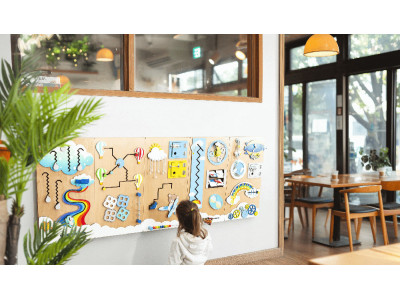
Sensory wall panels bring several of these researched activity types together in a single wall-mounted format: tactile exploration, manipulation, matching and cause-and-effect play. The evidence discussed above supports the underlying developmental activities. It does not support sensory wall panels as a distinct, tested intervention. The panel is simply one practical way to offer them. If you're deciding which panel fits your space, our guide to choosing the right sensory wall panel walks through the practical side of that decision. Our safety guide covers what to check before buying. The same underlying activity types apply well beyond childhood. Our sensory wall panels for adults and dementia care apply the same non-medical, engagement-first design to adults.
To learn more or request a personalized guide, contact our team.
Frequently asked questions about the research behind sensory wall panels
Is there research specifically on sensory wall panels, or just on sensory play in general?
The research base is on the underlying activities: tactile exploration, sorting, cause-and-effect feedback, shared attention. It is not on wall-mounted panels as a specific product. No published study has tested a sensory wall panel as its own intervention. We link directly to the studies throughout this guide so you can see exactly what has and hasn't been tested.
Can sensory wall panels help children with autism or ADHD?
Occupational therapy research supports structured, sensory-rich activities as part of therapeutic practice for children with sensory processing differences. Predictable physical environments are recognized as helpful for autistic learners specifically. We have not found comparable research for ADHD. A panel is not a medical device and does not treat, diagnose or cure any condition. For a deeper look at inclusive design considerations, see our sensory wall panels for autism-friendly spaces page.
At what age do children benefit most from this kind of sensory play?
The research cited here spans infancy through early elementary age. Visual tracking and cause-and-effect learning begin developing in the first year of life. Fine motor and classification skills develop heavily between ages 2 and 5. Executive function continues developing well into adolescence. Panels are typically used from around 12 months onward, with activities that scale in complexity as a child grows.
Does Montessori research really apply to a wall-mounted panel?
The Montessori research cited in this guide evaluated the Montessori classroom model as a whole, not any single material or panel. What transfers is the underlying design principle: child-led, self-correcting activities with limited, purposeful materials. Panels are built to reflect that principle. It's a design philosophy borrowed from validated research, not a claim that the panel itself was studied.
Research Referenced
- Centers for Disease Control and Prevention. Early Brain Development and Health.
- American Academy of Pediatrics. Power of Play in Early Childhood.
- HeadStart.gov. Early Experiences Build the Brain.
- Relationship between sensory processing skills and motor skills in 12-month-old infants. PMC, National Institutes of Health.
- Watts, T., Stagnitti, K., & Brown, T. (2014). Relationship Between Play and Sensory Processing: A Systematic Review. American Journal of Occupational Therapy.
- Cleveland Clinic. What Is Sensory Play? The Benefits for Your Child and Sensory Play Ideas.
- Center on the Developing Child, Harvard University. InBrief: Executive Function.
- NAEYC. Building Executive Function Skills Through Games: The Power of Playful Learning.
- Barnes, S. P., Bailey, R., & Jones, S. M. (2021). Evaluating the Impact of a Targeted Approach Designed to Build Executive Function Skills: A Randomized Trial of Brain Games. Frontiers in Psychology, via PMC.
- NAEYC. Rocking and Rolling: Nurturing Early Math Play and Discovery.
- NAEYC. Discovering Shapes and Space in Preschool.
- University of Nevada, Reno Extension. Math in the Preschool Classroom: Classification, Matching, Seriation and Patterning.
- Johnson, S. P., Amso, D., & Slemmer, J. A. (2003). Development of object concepts in infancy: Evidence for early learning in an eye-tracking paradigm. Proceedings of the National Academy of Sciences.
- Infant Eye-tracking in the Context of Goal-Directed Actions. PMC, National Institutes of Health.
- Lillard, A. S., Heise, M. J., Richey, E. M., Tong, X., Hart, A., & Bray, P. M. (2017). Montessori Preschool Elevates and Equalizes Child Outcomes: A Longitudinal Study. Frontiers in Psychology, via PMC.
- National Center for Montessori in the Public Sector. Montessori and Executive Function.
- Beyond executive functions, creativity skills benefit academic outcomes: Insights from Montessori education. PLOS ONE.
- American Occupational Therapy Association (2023). Sensory Integration Approaches for Children and Youth in Occupational Therapy Practice. American Journal of Occupational Therapy.
- American Occupational Therapy Association (2024). Sensory-Based Interventions in Occupational Therapy for Children and Youth (May 2015-January 2024). American Journal of Occupational Therapy.
- Vanderbilt University, IRIS Center. The Learning Environment (Autism Spectrum Disorder module).
- An Expanded View of Joint Attention: Skill, Engagement, and Language in Typical Development and Autism. PMC, National Institutes of Health.
- Parent-Child Joint Behaviors in Novel Object Play Create High-Quality Data for Word Learning. PMC, National Institutes of Health.
- Wengman, J., & Forssman, L. (2025). Developmental Relationships Between Early Vocabulary Acquisition, Joint Attention and Parental Supportive Behaviors. Infancy, via PMC.
Educational guide from the BumbleBeeSmart blog, referencing publicly available developmental and occupational therapy research. This article does not evaluate any specific product, including BumbleBeeSmart panels, as a tested intervention. Not medical advice.
© BumbleBeeSmart, Sensory Wall Panels for Inclusive Learning






Write a comment