


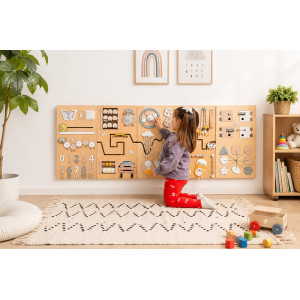

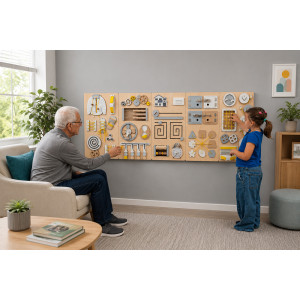


Sensory wall panels for adults are wall-mounted panels of tactile, hands-on activities built for grown-ups rather than children. Most wall-mounted activity panels on the market are designed for toddlers. Put one in a memory care lounge and residents notice immediately, and so do their families. Bright primary colors, cartoon shapes and small, fiddly parts read as a children's toy, and adults disengage from things that were clearly made for someone else.
This page is for memory care directors, nursing home and assisted living administrators, occupational therapists, rehabilitation clinics and families caring for someone at home. It covers four things: what makes an adult panel different, how to specify one for a person or room, what the evidence supports, and how these wall mounted sensory activities hold up in daily commercial use.
What makes sensory wall panels for adults different
A sensory wall for adults is built from the opposite starting point to a children's panel. Every design decision assumes a grown-up will stand or sit in front of it.
The two factors most often overlooked at specification stage
Two of those deserve expanding.
Larger elements are a functional decision, not an aesthetic one. Bigger latches, lever-style catches and wide dials suit reduced grip strength, arthritis or tremor. Sizing up keeps the panel usable as hand function changes.
Height is the single most consequential choice you make. You set it at installation, because these panels mount to the wall rather than stand on the floor. A panel hung for a standing user is effectively unusable for someone who spends the day in a wheelchair. The table below gives working ranges.
Who benefits from sensory wall panels for adults
Care teams and families use adult sensory panels with a wider range of people than the dementia label suggests:
- Adults living with dementia or Alzheimer's disease: a dementia sensory wall offers familiar, repeatable hand actions that need no instructions and have no wrong answer. See our guide on how busy boards support adults with dementia and Alzheimer's for practical ideas on choosing and using one.
- Adults experiencing memory loss or cognitive decline: a low-pressure activity that is always available and needs no setup.
- Stroke and neuro rehabilitation: a rehabilitation sensory wall supports graded, repeated fine-motor movement, often alongside peg maze boards where progression needs to be measurable.
- Adults with developmental disabilities: hands-on activity presented in an age-appropriate way. Sensory panels for seniors and younger adults use the same design principles.
- Autistic adults: predictable tactile input in a form that is not styled for children.
- Adults managing anxiety or restlessness: somewhere to put your hands during a wait or a difficult moment.
For a broader look at how adults use wall-mounted sensory activities across different settings, see BumbleBeeSmart's guide to adult sensory walls.
Where sensory walls for adults are used
- Memory care communities: a memory care sensory wall works in lounges, corridors and activity rooms. Facilities often configure several rooms identically so the experience stays familiar.
- Nursing homes and residential care: a nursing home sensory wall suits day rooms and quiet corners.
- Assisted living communities: assisted living sensory activities work best in communal areas residents pass through repeatedly.
- Adult day centers: structured activity sessions and the free time between them.
- Rehabilitation hospitals and neuro units: day spaces and therapy rooms.
- Occupational therapy clinics: one-to-one sessions with a fixed, repeatable setup.
- Hospitals: waiting areas and family rooms.
- Home care: living rooms and hallways, where a shared activity takes some of the pressure off conversation.
How to choose a sensory wall for adults
Start with the person, not the product. Three questions decide most of the specification.
1. Will they use it standing, seated or from a wheelchair?
These are starting points, not a standard. Confirm against the individual's actual reach before drilling, and involve an occupational therapist where one is available. BumbleBeeSmart's guide to inclusive sensory walls for all abilities covers reach ranges and accessible placement in more detail.
2. What is their grip strength and hand function?
Limited grip favors larger dials, lever-style latches and sliding elements over small knobs and pinch closures. Where hand function is a rehabilitation goal rather than a constraint, graded difficulty matters more. A geometry peg maze board or a square spiral peg maze gives a therapist a way to increase challenge in defined steps and record repetitions.
3. What level of cognitive support do they need?
Some people engage with a varied wall of eight or ten actions. Others do better with fewer elements, repeated. A five-panel set like the sensory wall for adults and dementia care can be specified with a simpler or richer element mix depending on who will use it, and elements can be chosen around a person's history, such as a latch or catch from a trade they worked in.
Specifying a wall for a lounge, day room or therapy space?
Send us the wall dimensions and who will be using it, and we will suggest a configuration and mounting height.
What the evidence does and does not show
We want to be straight about this, because the alternative is the vague benefit language that makes procurement teams stop reading.
Sensory wall panels are activity and engagement products. They are not medical devices. They support engagement, fine motor activity, tactile experience and shared interaction between a person and their carer. They do not treat, cure, slow or prevent dementia, and they are not a substitute for professional care.
A fair expectation. The published research in this area evaluates complete Cognitive Stimulation Therapy programs (structured, facilitated group sessions delivered over a set number of weeks), not individual sensory wall panels sold on their own. No study has tested a wall panel in isolation. Treat a panel as one tool within a wider activity program; the evidence belongs to the program, not the product.
About Cognitive Stimulation Therapy
Cognitive Stimulation Therapy (CST) is a structured group program of themed activities for people living with mild to moderate dementia. It is typically delivered by trained facilitators over several weeks and focuses on active engagement, discussion and enjoyment rather than testing. UK national guidance recommends that group cognitive stimulation therapy be offered to people living with mild to moderate dementia.1 A Cochrane systematic review of 37 trials found moderate-certainty evidence of a small benefit to cognitive test scores from cognitive stimulation, with substantial inconsistency between the studies and no negative effects reported.2
A panel is not a cognitive stimulation wall in the clinical sense, and no wall panel replaces a facilitated program. Think of it as one of the sensory activities for adults that sits alongside one. If you are building or reviewing an activity program, those are the sources worth reading first, alongside the Alzheimer's Society's plain-language overview for families and care staff.3 Nothing on this page is medical advice. Decisions about care and therapy should be made with qualified health professionals who know the individual.
Sensory wall panels for adults in commercial care environments
One person uses a panel in a family home. Dozens use a sensory wall for elderly residents in a memory care lounge, every day, for years. We build for the second case.
- Commercial-grade construction. Birch plywood and quality hardware that withstand repeated daily operation. Not lightweight fittings that work loose within months.
- Easy cleaning. Smooth, sealed surfaces and durable wipe-clean finishes that fit a facility's daily cleaning routine.
- Modular design. Start with a single panel or a five-panel wall and expand later; panel sizing stays consistent so additions line up.
- Smooth, rounded wood. Hand-sanded, with rounded edges throughout.
- Water-based lacquer finish. The same finish we use on our panels for children.
- Replaceable panels. Swap a single panel rather than the whole wall if one gets damaged or the element mix needs to change.
- Long-term durability. Every panel is made to order by hand, by the people who make them, so if you ask what is in it, you get an answer.
Frequently Asked Questions About Sensory Wall Panels for Adults
Are adult sensory walls only for people with dementia?
No. Dementia care is the most common use, but the same panels are used in stroke and neuro rehabilitation, with adults who have developmental disabilities, with autistic adults, and in hospital and clinic waiting areas. The design principle of hands-on activity presented in an adult, dignified way applies far beyond a single diagnosis.
What mounting height should we specify for wheelchair users?
As a starting point, center the panel at 85-110 cm (33-43 in) from the floor, and make sure there is clear floor space and knee clearance at the wall so a user can get close enough to reach comfortably. Confirm against the actual reach of the people who will use it before drilling, as reach varies considerably between individuals and chair types. Where an occupational therapist is available, ask them to sign off the height.
How many panels does a communal lounge or day room need?
A five-panel wall covers roughly 175 cm (about 5 ft 9 in) of wall and comfortably serves one or two people at a time, which suits most lounges and day rooms. For a busy communal space where several residents may use it at once, a longer run or two separate walls at different heights works better than one crowded panel. Send us the wall dimensions and the typical number of users and we will suggest a layout.
Can one wall serve residents with different abilities?
Yes, within limits. Mixing element difficulty across a single wall lets people engage at whatever level suits them on the day, and a compromise height of 100-120 cm (39-47 in) works for most standing and seated users. Where a facility has both ambulant residents and regular wheelchair users, two panels at two heights usually works better than one compromise height that suits neither group well.
Do these panels fit our infection control policy?
Panels are finished with sealed, smooth surfaces intended for damp wiping between users, and there are no fabric or absorbent components. They are not autoclavable and should not be soaked or cleaned with harsh solvents, which damage the wood finish over time. If your policy specifies particular disinfectant products or contact times, send us the details before ordering and we will confirm compatibility with the finish rather than guess.
Are sensory walls appropriate for stroke rehabilitation?
Therapists use wall-mounted activities to encourage repeated, graded hand and arm movement in a fixed setup that stays the same between sessions, and working at a vertical surface engages the shoulder and wrist differently from tabletop work. For rehabilitation specifically, peg maze boards are often the better starting point, because difficulty progresses in defined steps and repetitions are easy to record. Any use within a rehabilitation program should be directed by the treating clinician.
Wholesale and multi-site orders
We work directly with nursing homes, memory care communities, assisted living operators, rehabilitation centers and hospital groups on bulk and multi-site orders. That includes standardized configurations across multiple rooms or sites, consistent lead times for procurement schedules, formal quotes, and specification support if you are working to a refurbishment or move-in date.
Research referenced
- 1. National Institute for Health and Care Excellence. Dementia: assessment, management and support for people living with dementia and their carers (NG97): Recommendations. NICE guideline, 2018.
- 2. Woods B, Rai HK, Elliott E, Aguirre E, Orrell M, Spector A. Cognitive stimulation to improve cognitive functioning in people with dementia. Cochrane Database of Systematic Reviews, 2023, Issue 1, Art. No. CD005562.
- 3. Alzheimer's Society. Therapy and approaches for memory loss support, including an overview of cognitive stimulation therapy.
Buying guide from BumbleBeeSmart. Product details reflect what the linked pages state; claims about cognitive stimulation therapy reflect the cited sources. Sensory wall panels are activity products, not medical devices. Not medical advice.