All about product
 Specification
 Reviews
 Questions


Geometry Peg Maze Board for Adult Rehabilitation
A peg maze with multiple intersecting paths and a non-removable peg, 45×45cm (18×18"). Unlike a single continuous track, the geometry layout offers branching routes, so the user chooses a path before moving rather than simply following a groove.
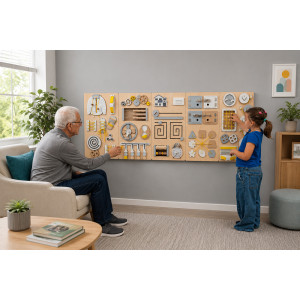
This is the most demanding board in the range. Mount it on a wall for a fixed station or use it flat on a table. Nothing detaches, so there is no setup and nothing to collect afterwards.
Used this way, a peg maze becomes a fine motor skill rehabilitation tool, one piece of a broader practice routine set by the treating clinician.
Part of the peg maze board range, alongside our sensory wall panels for adults.
What makes this track different
On a single-track board, the route is fixed and the task is purely motor: guide the peg from start to finish. On the geometry board the route is not fixed. The user has to decide where to go at each junction, then execute the movement.
That combination - choosing, then moving - is why therapists keep a branching board alongside single-track ones. It is the same physical action performed under a different demand, using the same equipment and the same setup.
How therapists use it
Peg mazes are a standard fixture in occupational therapy rooms because they make repetition measurable. The setup is identical between sessions, completed passes are easy to count, and the challenge can be raised without changing the equipment.
Common ways to progress the task on a branching board:
- Name the route in advance. The user states the path before starting, then follows it.
- Switch hands. Non-dominant hand raises difficulty immediately.
- Add a repetition or time target. Gives the session a measurable goal.
- Change position. Seated, standing, or at a different mounting height.
- Step back a level. Move to the square spiral if the branching layout proves frustrating.
What this board does and does not do
We want to be straight about this, because the alternative is the vague benefit language that makes clinicians stop reading.
A peg maze board is an activity and practice tool. It gives a person a defined, repeatable hand and arm movement, performed at a vertical or flat surface, with a fixed setup that does not change between sessions. The branching layout adds a decision to that movement.
A fair expectation. Repetitive task practice is an established component of rehabilitation programmes, but the research in this field evaluates complete programmes delivered by clinicians - not individual pieces of equipment. This board is not a medical device, does not treat or cure any condition, and does not replace assessment or therapy. Any use within a rehabilitation programme should be planned and directed by the treating clinician.
Where it is used
- Occupational therapy clinics - one-to-one sessions with a fixed, repeatable station
- Rehabilitation units and neuro wards - day rooms and therapy spaces
- Memory care and residential settings - see also our guide to activity boards for dementia
- Adult day centres - structured activity sessions
- Home use - where a clinician has recommended continued practice between appointments
Build and materials
- Solid wood, hand-sanded, with rounded edges throughout
- Non-removable peg - nothing detaches, nothing to lose
- Sealed wipe-clean finish suited to damp wiping between users in shared settings
- Non-toxic water-based coatings
- Wall mounting hardware included; also works flat on a table
- Made to order by hand - track layout and finish can be adjusted
For mounting height guidance for seated and wheelchair users, see our notes on inclusive placement for all abilities.
Specifying for a clinic or care setting?
We work directly with rehabilitation units, therapy practices and care providers on single and multi-site orders, including custom sizing, finishes and track designs. Graded sets - the same board at increasing difficulty - are available for therapy rooms.
Custom designs
Every space and every caseload is different. We can adjust size, track complexity, groove width, colour and finish, or build a graded set for a therapy room. The same applies across our sensory wall panel range.
Get in touch with the dimensions of your space and who will be using it, and we will suggest a configuration.
Frequently Asked Questions
Is the geometry board too difficult to start with?
For most people, yes. This is the most demanding track in the range, and a board that frustrates gets abandoned. Start with the Butterfly or Sailboat, move to the Square Spiral, and keep the Geometry board as the step after that. Many therapy rooms hold two or three at different levels so the same person can progress without new equipment.
What is the difference between this and the square spiral?
The square spiral is a single continuous track - the route is fixed and the task is purely motor. The geometry board has intersecting paths, so the user chooses a route at each junction before moving. Same physical action, different demand. If you want measurable repetition without route choice, the spiral is the better fit.
Wall-mounted or tabletop?
Both work. Wall mounting engages the shoulder and wrist differently from tabletop use and keeps the surface clear, which suits a fixed therapy station. Tabletop suits bedside use and situations where the person cannot reach a wall comfortably. Mounting hardware is included either way, so the decision can be made after delivery.
What mounting height suits wheelchair users?
As a starting point, centre the board at 85–110cm (33–43") from the floor, with clear floor space and knee clearance at the wall. Confirm against the reach of the people who will actually use it before drilling - reach varies considerably between individuals and chair types. Where an occupational therapist is available, ask them to sign off the height.
How is it cleaned between users?
The surface is sealed and smooth, intended for damp wiping between users. It is not autoclavable and should not be soaked or cleaned with harsh solvents, which damage the finish over time. If your infection control policy specifies particular disinfectants or contact times, send us the details before ordering and we will confirm compatibility with the finish rather than guess.
Peg maze boards are activity and practice products, not medical devices. They do not treat, cure or slow any condition. Nothing on this page is medical advice - decisions about rehabilitation and therapy should be made with qualified health professionals who know the individual.


No questions about this product, be the first and ask your question.