


An activity board for dementia gives hands something familiar to do. It is a wall-mounted or portable panel fitted with the everyday objects most adults have handled all their lives - latches, switches, zips, laces, gears, bolts. There is nothing to learn, no instructions to follow, and no wrong way to use it.
This guide is for families, care home activity coordinators and occupational therapists deciding whether an activity board suits someone they care for. It covers what these boards are, what goes on them, what they realistically do and do not do, and how to choose one. If you're setting up a whole room rather than a single board, see our guide to how to plan the room around it. Care home teams furnishing a lounge or corridor can also browse our sensory wall panels for care homes.
Why familiar, repetitive activity matters
Before boards like these were sold commercially, families often turned to knitting or crochet. A relative would buy large-gauge needles and brightly coloured yarn, and the repetitive, rhythmic motion gave the person something absorbing to do with their hands.
It worked well for people who had knitted all their lives, because the movement was already in muscle memory. It did nothing for anyone who had never learned. An activity board takes the same principle - familiar, repeatable hand movements requiring no new skill - and makes it available to anyone, whatever their history.
That principle also explains why the objects on a good board are ordinary. A person who spent forty years opening a workshop door recognises a barrel bolt. That recognition is the point.
How adult boards differ from children's sensory panels
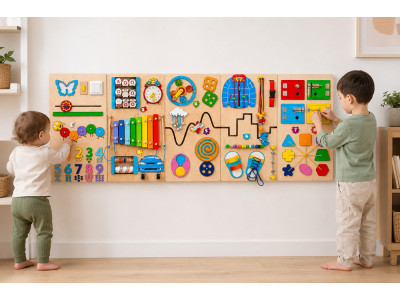
Sensory panels for children are bright and playful. They are designed to entertain and to teach something new.
An adult board is built on the opposite assumption. The palette is muted. Objects are the same size, colour and weight as their real-world counterparts. Decorative elements that serve no purpose are minimal or absent. The person is not learning a new skill - they are staying connected to a familiar one, and the board should look like something a grown adult would reasonably have on their wall.
Dignity is a design requirement here, not a nicety. A panel covered in cartoon animals communicates something to the person using it and to everyone who walks past. Our sensory wall panels for adults are built to adult scale and finish for exactly that reason.
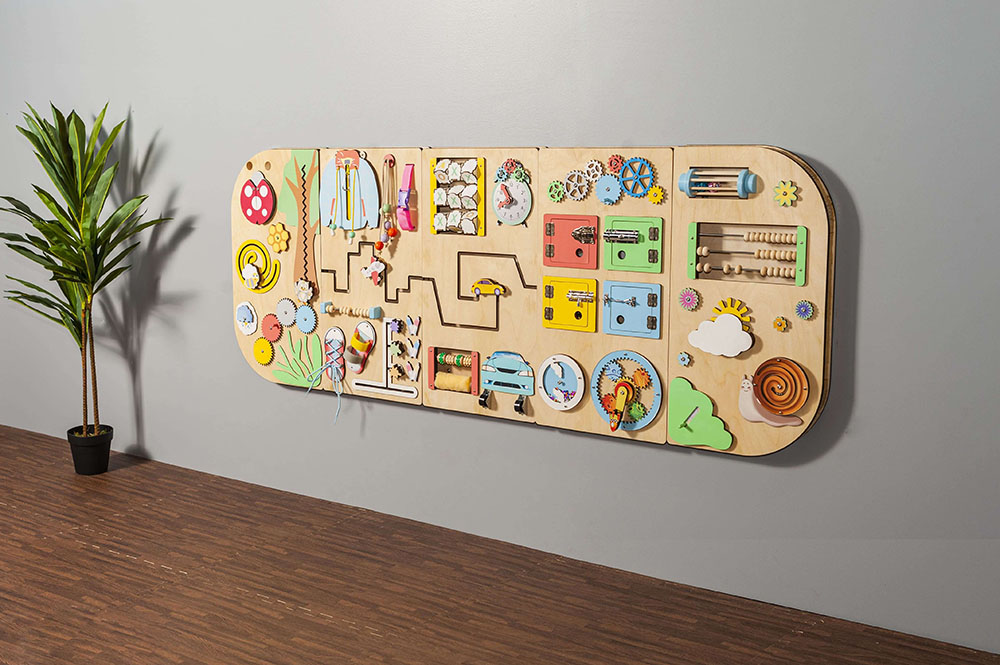
What goes on an activity board for dementia patients
A well-built adult board usually carries a mix of the following:
- Knobs and dials. Vary the sizes and shapes. Knobs with privacy locks that push or turn add a further step for someone who still manages complex sequences comfortably.
- Switches. Standard wall switches with faceplates are the most recognisable. Metal toggle switches add a different feel and sound.
- Bolts and latches. A sliding barrel bolt is one of the most-used elements on any adult board. Metal buckles and plastic clasps of the kind found on an old lunchbox or backpack work well.
- Gears. Lined up so turning one turns the rest. Painting each a different colour makes the connection easier to follow.
- Flippy chains. A fidget element resembling a bicycle chain, and quiet in use - which matters in a shared lounge.
- Zips, laces, snaps and velcro. These keep dressing movements in practice, which is often the most practically useful part of the board.
- Squeeze elements. Attached on a short chain. These are for comfort rather than task practice, and both matter.
What these boards do, and what they do not
Families ask this question first, and it deserves a direct answer rather than marketing language.
What an activity board can offer: something absorbing to do; familiar hand movements that stay in practice; tactile and visual variety; a shared activity that takes pressure off conversation during a visit; and a sense of doing something under one's own control, which is in short supply as dementia progresses.
What it cannot do: treat, cure, slow or prevent dementia or Alzheimer's disease. It is not a medical device and not a substitute for care, therapy or medical advice.
A fair expectation. The research in this area evaluates complete cognitive stimulation therapy programmes - structured, facilitated group sessions run over several weeks - not individual activity boards. A Cochrane review of 37 trials found moderate-certainty evidence of a small benefit to cognitive test scores from cognitive stimulation, with substantial variation between studies.1 UK national guidance recommends offering group cognitive stimulation therapy to people living with mild to moderate dementia.2 No study has tested a board on its own. Treat it as one tool that can sit alongside a programme, not as the programme.
Safety and supervision
Two points that older guidance on this topic often gets wrong.
Supervision is a clinical judgement, not a product feature. How much supervision a person needs depends on their stage, their swallowing risk, and their tendency to dismantle or mouth objects - and it changes over time. Discuss it with the care team or clinician who knows the person. Do not assume a board can be used unsupervised because it is well made.
Check fixings regularly. Elements on a good board are fitted to withstand determined daily handling, but no fixing is permanent. Build a check of every moving part into the same routine as cleaning, and remove or replace anything that has worked loose.
Where a person is prone to mouthing objects, discuss element selection before ordering. Some elements suit that situation and some do not.
Choosing a board
Start with the person rather than the product.
Match complexity to current ability, not past ability. A board that frustrates gets abandoned. It is better to start simpler and add complexity than to buy something that becomes a source of failure.
Consider how they will use it. Seated, standing, or from a wheelchair - this decides mounting height, and it is the most common thing to get wrong. Wall-mounted boards leave the floor clear and cannot be knocked over.
Look for elements tied to their life. A latch from the trade they worked in, or a bolt like the one on their old shed door, will hold attention longer than a generic component.
Check the build. Solid wood, smooth rounded edges, sealed wipe-clean surfaces and securely fitted hardware. In a care setting, cleaning between users is a daily requirement.
When occupational therapy or rehab calls for something more structured
An activity board like this one is built for open engagement. There is no sequence to complete, and no wrong way to use it. Some occupational therapists want something different for part of a session. Stroke rehabilitation programmes especially call for a task with a fixed path and a clear endpoint. A clinician can grade it up or down as a person's hand function changes.
That calls for a different tool, not a bigger version of this one. Our peg maze boards are built for that structured, session-based work. The peg maze board for stroke rehabilitation uses a simpler square spiral path for early grip and sequencing practice. The peg maze board for occupational therapy steps up to a more complex layout, for longer and more precise sequences.
In a care home or rehab setting, the two tend to sit side by side rather than replace one another. The wall-mounted board covers calm, unstructured engagement between sessions. The peg maze board covers the structured practice an occupational therapist sets and tracks.
A sensory wall made for adults
Handmade, wall-mounted panels that support purposeful activity and calm - designed with the dignity of an adult in mind, in muted colours and at adult scale.
Buying from BumbleBeeSmart
Every panel is made to order by hand from birch plywood with non-toxic, water-based finishes, with rounded edges throughout. Because we manufacture rather than resell, we can tell you exactly what is in a board and adjust the element mix for a specific person or setting.
Custom builds are available: element selection, size, and colour. For care homes, memory care communities and rehabilitation units we also handle bulk and multi-site orders with consistent configurations across rooms. See our busy boards range for the wider collection, or get in touch to discuss a specific requirement.
Frequently Asked Questions About Activity Boards for Dementia
What are the best toys for people with dementia?
The most useful options rarely look like toys. Activity boards with everyday hardware, simple sorting tasks and familiar textured fabrics tend to work best, because they use movements a person already knows. Choose items that look adult rather than childlike, match the complexity to the person's current ability, and check that nothing can come loose.
Is a fidget board the same as an activity board for dementia patients?
The names overlap. Fidget board, fidget blanket, busy board and activity board all describe hands-on objects with familiar things to turn, open and fasten. Fidget boards and blankets are usually small enough to sit on a lap. A wall-mounted activity board stays in one place, so it suits a shared lounge or corridor and cannot be dropped or knocked over.
Where should an activity board go in a care home?
Somewhere residents already pass or sit: a lounge wall, a corridor with seating, or near the dining area. Mount it at a height that works seated and from a wheelchair, and keep the area well lit so every element is easy to see.
Research referenced
- 1. Woods B, Rai HK, Elliott E, Aguirre E, Orrell M, Spector A. Cognitive stimulation to improve cognitive functioning in people with dementia. Cochrane Database of Systematic Reviews, 2023, Issue 1, Art. No. CD005562.
- 2. National Institute for Health and Care Excellence. Dementia: assessment, management and support for people living with dementia and their carers (NG97) - Recommendations. NICE guideline, 2018.
- 3. Alzheimer's Society. Therapy and approaches for memory loss support.
Guide from the BumbleBeeSmart blog. Activity boards are engagement products, not medical devices. They do not treat, cure, slow or prevent dementia or Alzheimer's disease. Nothing here is medical advice - decisions about care and therapy should be made with qualified health professionals who know the individual.





Write a comment