


BumbleBeeSmart · Age guidance · 10-minute read
Parents often search for the single best age for a busy board and expect one clean answer. There isn't one number. It's a range that starts in toddlerhood and runs through early elementary school. The board itself changes as the child does. What matters most isn't a strict age cutoff. It's matching element size, mechanism complexity and mounting height to where a specific child actually is developmentally. This guide breaks that down stage by stage. Use it to pick, or build, a board that fits now and grows with your child.
Why Age Matters More Than It Seems
A board designed for a 4-year-old may be too complex or frustrating for a 1-year-old: the latches can be too stiff, the pieces too small, the tasks too many steps. The reverse happens too: a board built for toddlers can lose a 5-year-old's interest quickly. A manufacturer's age rating is the first safety boundary to follow. Within that stated range, matching the board's complexity to the individual child's developmental stage helps determine whether it will remain usable and engaging.[1] A busy board is a single fixed panel, not a drawer full of interchangeable toys, which is a big part of why getting the age-fit right matters more here than it does for most other toy categories.
Busy Boards by Age: A Stage-by-Stage Guide
The ranges below are practical selection guidelines, not fixed developmental milestones. Always follow the product's stated age rating and consider the individual child's abilities.
Under 12 Months: Only Products Specifically Designed for Infants
A standard busy board is not built for this age. If you're considering an activity panel for a child under 12 months, it needs to be a product specifically designed and labeled for infants, with oversized, securely fastened elements and no small parts. Close supervision matters at every age, but supervision on its own doesn't make an age-inappropriate product safe. Products intended for children under 3 fall under stricter small-parts requirements in the U.S., since a part that fits inside a standard test cylinder is a real choking risk at that age.[2] Check the manufacturer's stated age range before buying anything for this age group, including from BumbleBeeSmart.
1-2 Years: The Early Latch-and-Slide Stage
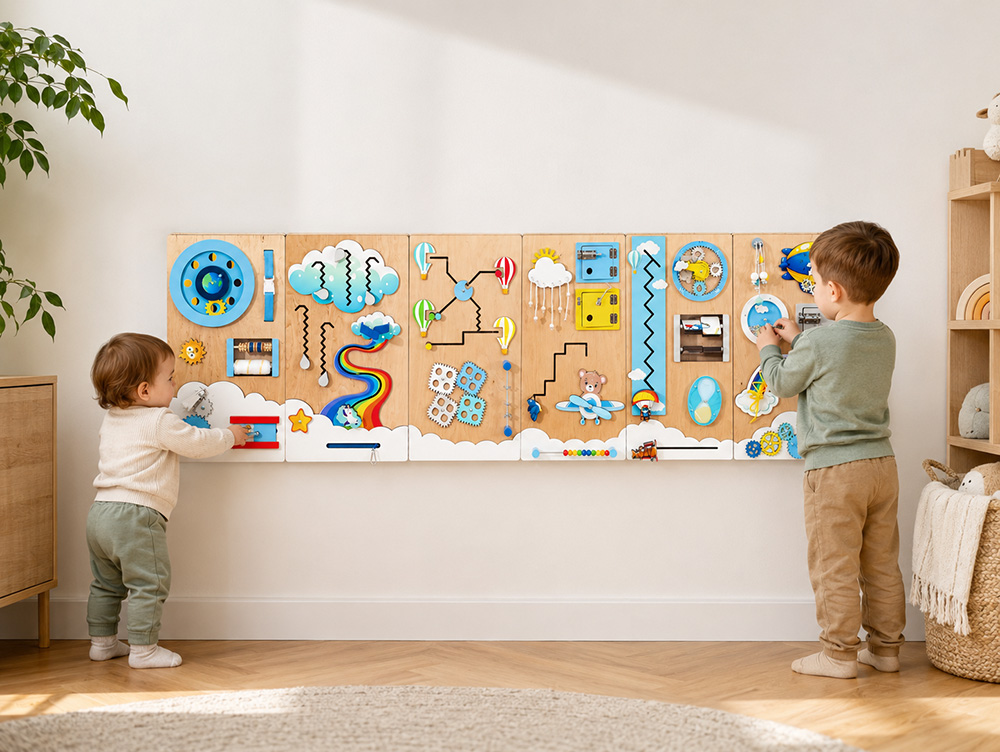
Many busy boards, including BumbleBeeSmart designs, are intended to start in this range. Large latches, chunky sliders, big buttons and simple zippers suit the still-developing pincer grip. Patience for multi-step tasks is still limited at this age. Mount the board low enough for a standing toddler to reach comfortably, roughly waist to chest height for the child, not the adult.
2-3 Years: Locks, Doors and Cause-and-Effect
Many children become able to engage with a wider range of mechanisms during this window, including working locks, small doors that open onto a picture or mirror, and simple gear sets. Children this age often also start enjoying the story or theme of a board. A house with doors to open, or a car with a working wheel, can add appeal beyond the raw mechanism.
3-5 Years: Multi-Step Mechanisms
Many preschool-age children are ready to explore finer, multi-step activities, such as buckles, laces, dials that need to be turned a specific way, or a small maze that requires planning ahead. Many children this age also respond well to a themed or story-driven board, such as a farm, a spaceship or a town, though interest varies a lot by child and a purely functional board works fine for others.
5-8 Years: Complexity and Independence
Many early elementary-age children have moved past needing a busy board as their primary activity, though some still return to one that offers real challenge. Combination-style locks, intricate gear trains, or a board that's part of a larger shared installation in a classroom or waiting room can hold up at this age. For children who stay engaged, a board's value often shifts from "keeps them occupied" to "still interesting enough to choose over a screen."
Not Sure Which Board Fits Your Child's Age?
Browse our collection by element complexity, or send us your child's age and we'll help you pick a layout.
Signs Your Child Is Ready for the Next Level
Rather than watching the calendar, a few practical signs tell you it's time to move up in complexity:
- They solve every mechanism on the current board within seconds, and stop returning to it.
- They've started asking how things work, or trying to take mechanisms apart out of curiosity rather than frustration.
- Their pincer grip and wrist control have visibly improved. They can turn a key or dial with intention, not just brute force.
- They show interest in multi-step tasks elsewhere: buttoning their own coat, working a zipper independently, following a two-step instruction.
How Long Do Children Typically Play at Each Stage?
Session length follows a similar pattern to complexity. A toddler under 2 often engages with a board for 5 to 15 minutes at a stretch before moving to something else. Between 2 and 3, many children settle into longer stretches of 20 to 45 minutes, as attention span and manual dexterity both increase. From 3 to 5, sessions of 30 minutes or more aren't unusual, especially once a child starts working through mechanisms in a specific order rather than exploring at random.
These are single-session estimates, not a daily total. Most children return to the same board several times over a day, and a well-designed board with a mix of mechanisms tends to get revisited for months rather than days, since new skills keep unlocking new ways to use the same elements.
Choosing Mounting Height and Element Size by Age
Age determines two practical choices as much as it determines board complexity. One is where you mount it. The other is how big the individual elements are. A board mounted too high for a toddler gets ignored. One mounted at toddler height in a shared classroom forces older children to stoop. As a rule of thumb, center the board at the child's chest height when standing, and keep the smallest elements toward the middle rather than the edges. For placement ideas in waiting rooms, classrooms and mixed-age spaces, see our guide to wall-mounted busy boards. If you're planning for a specific room or a mix of ages, send us the ages and wall size and we'll suggest a height.
A Quick Reference Table
| Age | What works best |
|---|---|
| Under 12 months | Infant-specific products only; check the manufacturer's stated age range |
| 1-2 years | Big latches, chunky sliders, simple zippers; low mounting |
| 2-3 years | Working locks, small doors, simple gear sets, themed panels |
| 3-5 years | Buckles, laces, multi-step mechanisms, story-driven boards |
| 5-8 years | Combination locks, intricate gear trains, shared installations |
Multi-Age and Shared Spaces
Daycares, waiting rooms, sibling bedrooms and classrooms rarely serve just one age group. A few practical approaches work well:
- Stack two boards at different heights: a simpler one lower for younger children, a more complex one higher for older ones.
- Choose a wide board with a mixed element range: large latches on one end, finer mechanisms on the other, so children naturally gravitate to what suits them.
- Favor mechanically fastened elements over glued ones in any shared setting. They hold up far better across many hands and many ages per day. See our safety and construction guide for what to check before buying for a shared space.
Best Age for Busy Board Use in a Group Setting
For a single family with one child, the best age for a busy board is simply whatever age that child is now. The board gets adjusted to match. Group settings are different. A daycare room, a pediatric waiting area or a preschool classroom serves several ages at once. The "best age" question becomes a range question instead of a single answer. Based on our experience working with these settings, most shared installations end up built around a 2-to-5-year window, since that range tends to cover the widest span of children likely to use the space on a given day. This is practical guidance from our own customer projects, not a published statistic. A lower or higher panel can be added for the age extremes, when the room allows it.
What About Older Children and Adults?
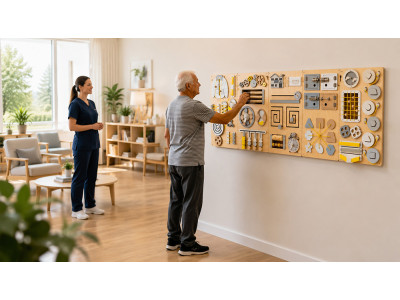
This guide focuses on the core toddler-to-elementary range that standard busy boards are built for. Panels with a similar hands-on format are also used well outside early childhood, including in occupational therapy and with older adults managing dementia or recovering from stroke. We aren't making a clinical claim about outcomes in those settings here. If that's what you're planning for, see our dedicated guides on how busy boards benefit seniors and activity boards for dementia and memory care, where the claims for that audience are addressed directly.
Frequently asked questions about busy board age ranges
What is the best age for a busy board?
Many busy boards, including BumbleBeeSmart designs, are intended to start in toddlerhood. The appropriate starting age depends on the individual product's stated age range, construction and activity elements. The core age range where they tend to hold the most value runs through about 6 years old.
Is a busy board safe for a 1-year-old?
It can be, if the product's stated age range covers 1-year-olds. Look for large, securely fastened elements with no small or loose parts, mounted at a height the child can reach while standing, and use normal supervision.
How do I know if my child has outgrown their busy board?
Two signs usually mean it's time for more elements or finer mechanisms: they solve everything quickly and stop returning to the board, or they start asking how things work instead of just operating them.
Can one busy board work for siblings of different ages?
Yes. A wide board with a mixed range of element sizes, or two boards mounted at different heights, both work well for mixed-age households or classrooms.
What age is too old for a busy board?
There isn't a strict cutoff. Most children move on from busy boards as a primary activity by early elementary age. More complex versions can still hold interest longer. The same style of panel is also used well beyond childhood, in therapy and senior care settings.
Related Reading
- What is a busy board?
- Sensory wall panels
- Wall-mounted busy boards
- What should a busy board include?
- How to develop fine motor skills
- Wall-mounted vs. freestanding busy boards
Find the Right Fit for Your Child's Age
Send us your child's age, or the ages in your room, and we'll help you choose the right complexity and layout.
Sources referenced:
1. Healey A, Mendelsohn A; American Academy of Pediatrics Council on Early Childhood. Selecting Appropriate Toys for Young Children in the Digital Era. Pediatrics. 2019;143(1):e20183348.
2. U.S. Consumer Product Safety Commission. Toy Safety Business Guidance (ASTM F963 / 16 CFR Part 1250).
Educational guide from the BumbleBeeSmart blog. Not medical or developmental advice. Every child develops at their own pace.



Write a comment