


Your child doesn't need facts before age three - what they need are foundations. As much as it may be thrilling to listen to your toddler read off the alphabet or count up to a hundred, these early scholastic achievements are not the skills that actually set them up for life. What really make a difference are those foundational skills that underpin all future learning: concentration, communication and confidence.
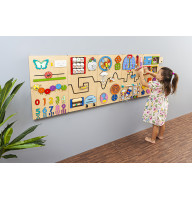
That's where sensory wall panels and wall-mounted busy boards come in. These interactive play tools enable children to construct essential life skills through discovery, touch and exploration - exactly what their emerging brains need most.
Why Early Foundations Matter More Than Memorization
Your child's brain develops more rapidly between the ages of three and three than it will develop again in life. Brain connections are created by movement, sensory input and play. Flashcards and early lessons may look like they're productive, but they don't build long-lasting, deep skills that build your child's success.
Real learning is done by doing - turning a gear, turning a wheel, opening a door, or exploring textures. That's why sensory busy boards are so successful: they invite your child to explore, imitate and achieve little tasks in his own time and in his own way.
1. Focus: The Hidden Foundation of All Learning
Most classroom issues begin with attention - not genius. A child who has never learned to focus will struggle with following directions, getting the job done, or even listening.
Sensory wall panels are ideal for practicing concentration in preschool children. Each element - locks, switches, gears, latches - is designed for interactive play that automatically grabs a child's focus. When your child is playing with knobs or sliding beads, he or she isn't playing around - he or she is training his or her brain to stay focused.
Here's a small secret which works: when your child is absorbed, don't stop them. Don't correct, don't over-praise and don't interrupt. Just sit nearby and leave them to explore. Concentration grows best when it's encouraged.

2. Language: The Bridge Between Thought and Expression
Language is more than words - it's the way your child connects to the world. And sensory play provides it with the best grounding.
Every wall mounted busy board is a conversation waiting to happen. Describe what your child is doing:
"You're turning the yellow wheel."
"That door opens - now it's closed."
"This texture feels rough and this one feels smooth."
By naming their actions and waiting for their responses - whether through gestures, sounds, or words - you help them link experiences to language. Over time, this back-and-forth communication builds confidence, vocabulary and emotional understanding.
Narration is the best method to assist with speech development. It turns ordinary playtime into rich lessons in language - without pressure or form.
3. Confidence: Built Through Independence and Accomplishment
Children are not born confident - it is built by the activities of each day.
When your child learns to open a latch or move a gear on their sensory busy board, they're learning a very valuable lesson: "I can do this." These repeated success experiences show your child that they can trust themselves.
That freedom and sense of safety combined - "I can attempt and I can do it myself while I'm safe" - is what fuels lifelong learning. It's why sensory play is important, too: it gives children safe, structured ways of exploring and achieving on their own terms.
Why Sensory Wall Panels and Busy Boards Are Worth It
Unlike screens or battery-powered toys, sensory wall panels encourage open-ended, screen-free play that responds to the curiosity of your child. They're durable, interactive and usable from toddler age through preschool age.
For families, they're convenient as well. Wall-mounted busy boards free up floor space, stay organized and bring a warm sensory corner to any playroom, classroom, or waiting area.
But above all - they encourage the three abilities that matter most to your child's future:
Attention – through naturally attracting curiosity and attention.
Language – by encouraging real-life conversations.
Confidence – by applauding small achievements and independence.

The Takeaway
Before age three, your child doesn't need to memorize the alphabet or numbers - they need to explore, try out and build with sensory play.
By incorporating sensory wall panels and sensory busy boards into your home or classroom, you're not just giving your child a toy - you're giving them the tools to build lifelong skills in focus, communication and confidence.
So, do away with the flashcards and gift your child with the real gift of exploration. Because the best start in life is not through memorizing facts, but in acquiring the skills to explore the world in wonder and joy.
Looking to Add a Sensory Wall to Your Space?
Support your students’ focus and wellbeing with our handcrafted sensory wall panels. Perfect for classrooms, clinics, libraries and more - designed with inclusion in mind.


Write a comment