


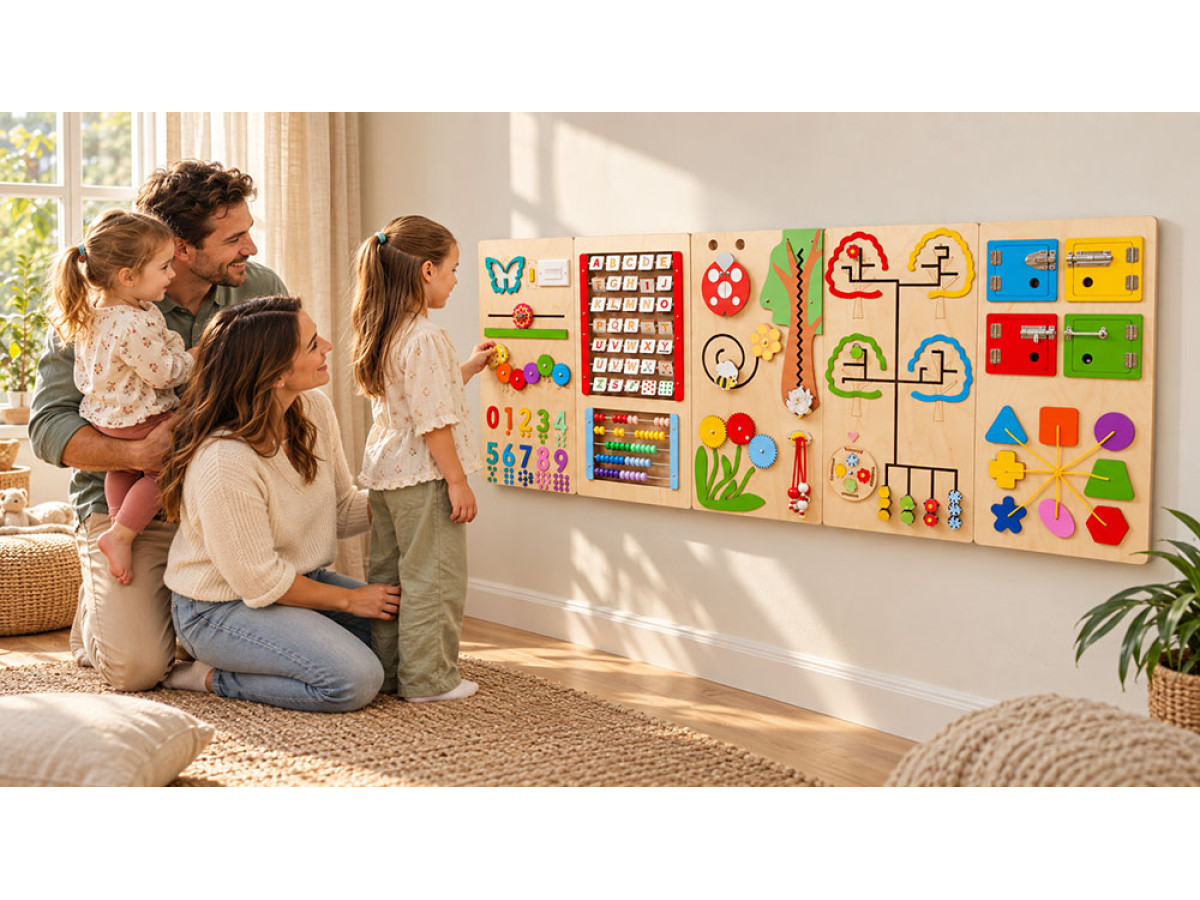
The best busy board activities are the ones you do together. A busy board is easy to hand to a child and walk away from, and solo play has real value. But the same latches, gears and switches turn into something different when a parent sits down too. They become a game with turns, a puzzle to solve as a team, a few minutes of shared attention in a busy day. This guide collects simple busy board activities for parents and children, grouped by age, plus ideas for building a small play corner around the board at home.
Why Shared Play on a Busy Board Works
Young children learn a lot by watching an adult do something and then trying it themselves. A busy board makes that easy, because every element has a clear action: turn, slide, open, close. You show the move once, your child copies it, and then it is their turn to show you.
Shared play also needs no preparation. There are no pieces to set out and nothing to clean up afterwards, since everything stays fixed to the board. That makes it realistic on a weekday evening, not just on a free weekend. Five minutes of play together, done often, is more useful than an occasional long session.

10 Busy Board Activities to Do Together
These games work on most boards that have a mix of latches, switches, gears and sliders. Adjust the rules to your child, not the other way round.
- Copy me. You perform one action, such as opening a latch. Your child repeats it. Then swap roles and let your child lead.
- Find the sound. Close your eyes while your child makes a sound with a bell, a clicker or a xylophone key. Guess which element it was.
- Open and close race. Open every door and latch on the board together, then close them all again. Count them out loud as you go.
- Color hunt. Name a color and ask your child to find every element in that color. Older children can take a turn calling out colors for you.
- Two-step instructions. Give a short sequence, such as "turn the gear, then open the red door." Add a third step as your child gets confident.
- Story time on the board. Use the elements as props in a short story. The door is a house, the gear is a car wheel, the switch turns on the lights.
- Counting game. Spin a gear five times, flip a switch three times, slide a bead twice. Let your child choose the next number.
- Hide and find. Hide a small sticker or a familiar picture behind one of the doors. Your child opens doors until they find it.
- Same and different. Point to two elements and ask what is the same about them and what is different: shape, color, or the way they move.
- Freeze. Play with the board while music plays. When the music stops, everyone freezes until it starts again.
Busy Board Activities by Age
The same board can serve a child for several years if the activities grow with them. As a rough guide:
- Around 12 to 24 months. Keep it simple: big switches, sliders, doors that open easily. Name each action as your child does it ("open", "click", "spin") and celebrate small wins.
- Around 2 to 3 years. Introduce latches, zips and simple locks. Copy-me games and color hunts work well. Short turn-taking games start to make sense at this age.
- Around 3 to 5 years. Add rules and sequences: two- and three-step instructions, counting games, and simple strategy games. Let your child invent games for you to play.
Every child moves at their own pace, so treat these ranges as a starting point. Our guide to the best age for a busy board goes into each stage in more detail.
Classic Two-Player Games on the Board
Some boards include a tic-tac-toe grid or a memory match game. These are ideal for family play, because they need a partner by design. A quick round of tic-tac-toe practises taking turns and thinking a move ahead. A memory match game asks a child to remember where a picture was and find its pair.
Our guide to memory games and the best toys for improving memory explains how these games work on a wall-mounted board and how to make them easier or harder.
Making Busy Board Play a Family Routine
The easiest way to keep shared play going is to tie it to something that already happens every day. A few ideas:
- Five minutes at the board while dinner is cooking.
- One game before bath time, chosen by your child.
- A weekend "new game" morning, where someone invents a rule nobody has used before.
- Older siblings teaching a younger child a game they know.
Rotating the activities matters more than adding new equipment. A board that feels familiar can still surprise a child when the game changes.
Building a Family Play Corner at Home
A busy board often becomes the centre of a small play corner. If you are planning one, it helps to think about the space as a whole rather than one item at a time.
For a wall that several family members can use at once, larger sensory wall panels give everyone their own section to play with. Some families also add one light-based piece. The PixelPop interactive light panel is a large peg board that lights up as pegs go in. More than one person can build the same picture at once, which makes it a natural shared activity for children aged 3 and up. A portable LED bubble tube adds a slower, visual activity for the end of play time. It should only be moved once drained, and young children should use it with an adult nearby. If floor space is tight, an LED bubble wall gives a similar effect from the wall. In a room with at least 8 feet of ceiling height, a fiber optic jellyfish light adds strands that a parent and child can reach into and explore together.
You can browse light, water and tactile pieces together in our sensory room equipment category. For layout ideas, our guide to sensory home design covers how to plan a calm, practical play space at home.
Choosing a Busy Board for Family Play
Three questions help narrow it down.
Wall-mounted or tabletop? A wall-mounted board stays in one place, is always ready, and lets a parent and child stand side by side. A tabletop board can move from room to room. Our comparison of wall-mounted and freestanding busy boards covers the trade-offs.
Which activities? Look for a mix of elements: some that are easy to master and some that take practice. If you want to pick the activities yourself, you can choose your own set of finished panels by theme, with nothing to build or paint.
Is it safe for your child's age? Check that every element is firmly attached, edges are rounded, and the board is mounted securely. Our sensory wall panel safety guide lists what to check before and after installation. Supervise younger children during play, whatever board you choose.
Frequently Asked Questions About Busy Board Activities
What activities can parents do with a child on a busy board?
Simple turn-based games work best: copy-me, color hunts, counting games, two-step instructions and hide-and-find behind the doors. Classic two-player games such as tic-tac-toe or memory match are also a good fit if the board includes them.
How long should a busy board play session last?
Short and frequent is better than long and occasional. Five to ten minutes of shared play, tied to a daily routine, is realistic for most families and keeps the board interesting.
Can siblings of different ages play on the same busy board?
Yes. A larger wall-mounted board gives each child their own section. Older children can also lead the games, teaching a younger sibling a sequence or calling out colors to find.
How do I keep a busy board interesting over time?
Change the game rather than the board. New rules, new sequences and new stories make familiar elements feel fresh. Letting your child invent a game for you to play is one of the easiest ways to do it.
Looking for a board the whole family can gather around?
Browse busy boardsWall-mounted and tabletop boards for homes, playrooms and family spaces.



Write a comment