


A touch and feel board gives a toddler's hands something real to work with. A rough patch of bark, a smooth stone, a soft scrap of fleece - all mounted where small fingers can reach and compare them. It's one of the simplest forms of sensory play there is. Tactile input is also the starting point most of our boards, panels and walls build on.
This guide covers what one of these boards actually is, what typically goes on it, how it compares to a larger sensory wall, and what to look for when choosing one.
What Is a Touch and Feel Board?
This kind of board - sometimes called a tactile board or texture board - is a panel fitted with different materials and surfaces for a child to explore by touch. Unlike a busy board built around mechanisms like locks and latches, this format is built around texture itself. How something feels is the point, not what it does.
In practice, the line between the two is blurry. Most wall-mounted busy boards and sensory wall panels combine mechanical elements with genuine texture variety. So this is less a separate product category than a way of describing the tactile side of the same format.
What Goes on One
The materials vary, but they're chosen to give a child a real range of sensations to compare:
- Fabric textures - felt, fleece, corduroy, burlap, smooth cotton
- Natural materials - bark, smooth stones, rope, woven grass
- Contrasting surfaces - rough sandpaper next to polished wood
- Themed shapes - animals, plants or geometric forms, each with a different surface
- Raised or textured paint - adding a tactile layer to a printed design
A well-built board mixes these deliberately. A child encounters real contrast: soft next to rough, warm-toned wood next to cool stone. That contrast is what makes the exploration interesting past the first few seconds.
Why Tactile Play Matters
Touch is one of the first senses a child uses to understand the world. It comes well before language catches up to describe it. Reaching for a new texture, pausing on it, comparing it to the last one - that's a child building a working model of "rough," "smooth," "soft" and "hard." They're doing it through direct experience, not through being told.
That process supports several things at once:
- Language. Naming a texture out loud while a child touches it - "that's bumpy," "this one's soft" - connects a new word to a felt experience. That tends to stick better than a word alone.
- Fine motor control. Running fingers along an edge, pressing into a raised surface, or tracing a shape all use the same small hand muscles involved in later tasks like writing and buttoning.
- Focus. Genuine texture variety gives a child a reason to slow down and compare, rather than moving on after one glance.
For a deeper look at the research behind sensory play more broadly, see our guide to the science behind sensory wall panels. It covers what the research does and doesn't establish about wall-mounted formats specifically.
Touch and Feel Boards vs. Sensory Walls
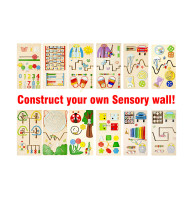
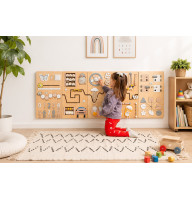
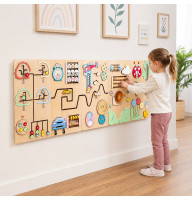
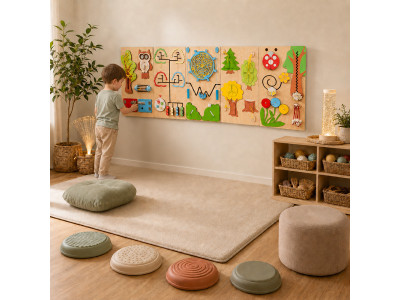
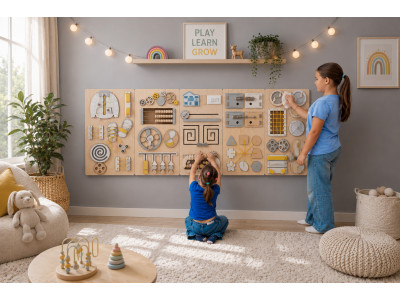
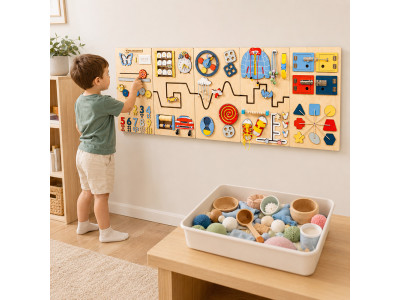
This kind of board is usually a single panel or a small set, focused mainly on texture. A sensory wall is typically larger. It's mounted across several panels and combines texture with mechanical elements - locks, gears, sliders - alongside the tactile pieces.
Which one makes sense depends on the space and the goal:
- A single board suits a small wall, a car seat area, or a first introduction to tactile play for a younger toddler.
- A full sensory wall suits a playroom, classroom or waiting room where several children use it, or where mechanical elements alongside texture make sense.
Choosing One
A few things matter more than how many textures a board has:
- Secure attachment. Every material should be firmly fixed, with nothing that can be pulled loose or come away with repeated tugging.
- Genuine contrast. A board with five similar-feeling fabrics teaches less than one with three clearly different textures.
- Non-toxic materials. Finishes and fabrics should be safe for a toddler who's likely to also explore the board with their mouth.
- Age-appropriate scale. Larger, simpler textures suit younger toddlers. Finer detail work suits preschool-age children with more hand control.
BumbleBeeSmart Touch and Feel Collection
We build tactile elements into our busy boards and sensory wall panels as standard, alongside the mechanical pieces. Browse our themed panel collection for boards built around a specific texture-rich theme, or get in touch if you want a board built around texture variety specifically.
Frequently asked questions
What age is this appropriate for?
There's no strict age limit. Younger toddlers do well with large, simple, clearly contrasting textures. Older toddlers and preschoolers can handle finer detail and more variety on the same board.
What's the difference between this and a busy board?
This format focuses on texture and material variety. A busy board is usually built around mechanical elements like locks and latches. Most BumbleBeeSmart boards combine both, so the distinction is more about emphasis than a hard product line.
Should I get a small board or a full sensory wall?
A single board is enough for a small space or a first introduction to tactile play. A full sensory wall makes more sense for a playroom, classroom or shared space, or once a child is ready for mechanical elements alongside texture.
Explore our full sensory wall panels collection, or browse busy boards for a more compact option.




Write a comment