


It is 6:14 a.m.
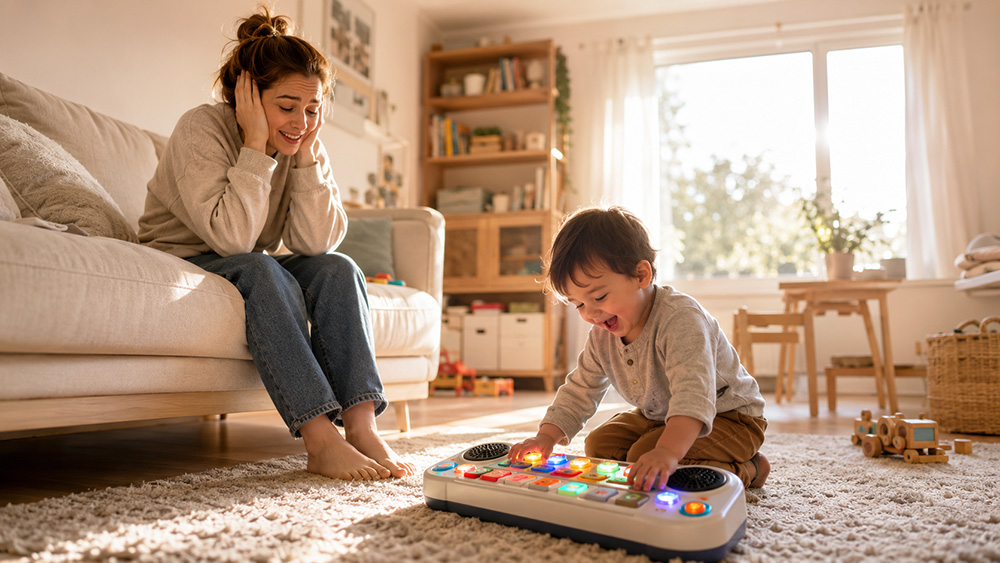
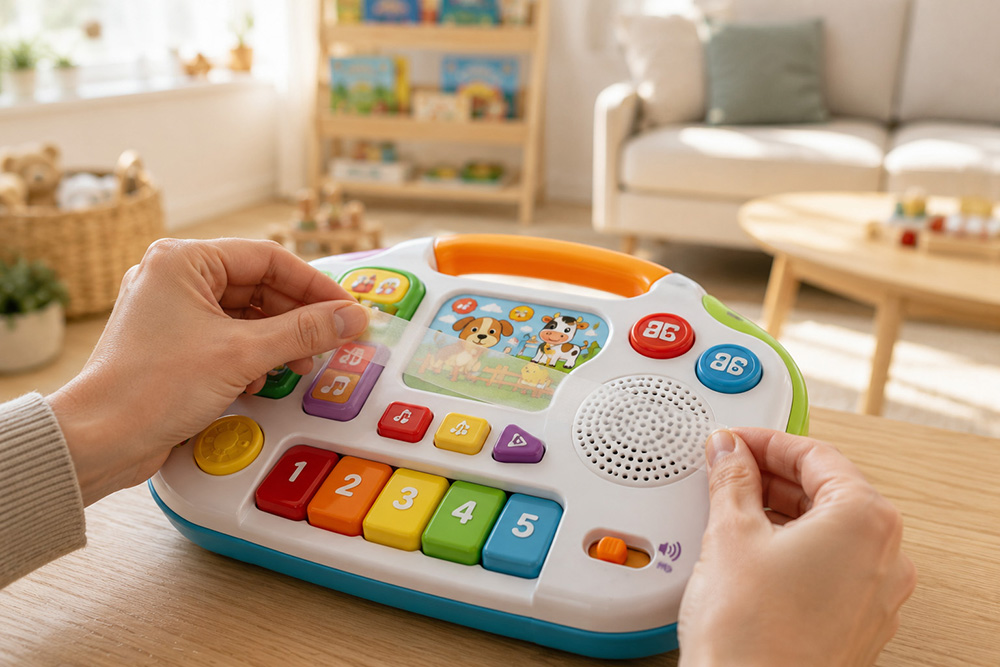
You are not awake. You are not a person yet. And from somewhere in the hallway, a plastic farm animal has begun singing about the letter B.
Nobody touched it.
If you've ever negotiated with a toy tractor in a dark kitchen, removed batteries and blamed the battery fairy, or stepped on a plastic brick at 2 a.m. and made a sound you didn't know you could make, you're in the right place.
We design sensory play products for a living, so we spend an unusual amount of time talking to parents about toys they love and toys they'd like to launch into the sun.
This isn't just a list. It's an answer to three questions nobody really addresses:
- Why does one toy make you want to leave your own house, when your child plays with it happily for forty minutes?
- Are loud toys actually bad for kids, or just for us?
- What should you buy instead?
Some answers surprised us. A few of the "most annoying" toys turn out to be genuinely brilliant. Some of the quiet, expensive, educational-looking ones do almost nothing.
The 12 Most Annoying Toys for Kids
The same categories come up again and again: in parenting forums, in audiologists' noisiest-toy roundups, and in the bottom of every thrift store donation bin in the country.
Honest verdict on each. Some deserve their reputation. Some really don't.
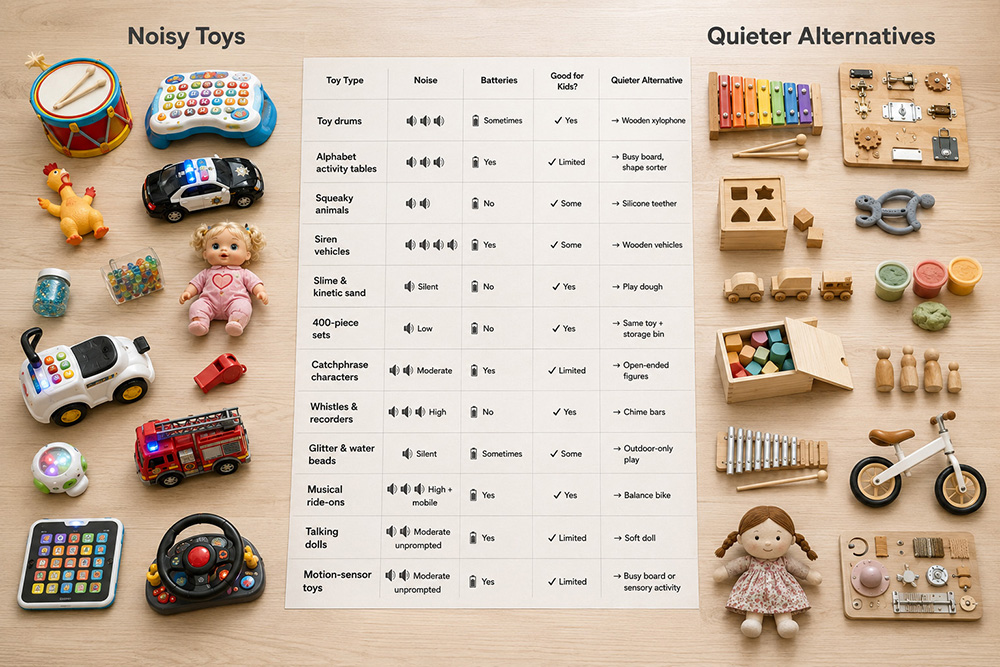
1. The toy drum. Cheap, indestructible, capable of a rhythm with no beginning and no end. There is no volume dial on a toddler's arm.
Keep it. Good for rhythm and coordination. It's the battery-powered drum pad with backing tracks you want to avoid. That one plays the music for them.
2. Anything that sings the alphabet on a loop. Activity tables, toy laptops, talking books. Marketed as educational. Astonishingly persistent.
The worst offender here, and we'll explain why below.
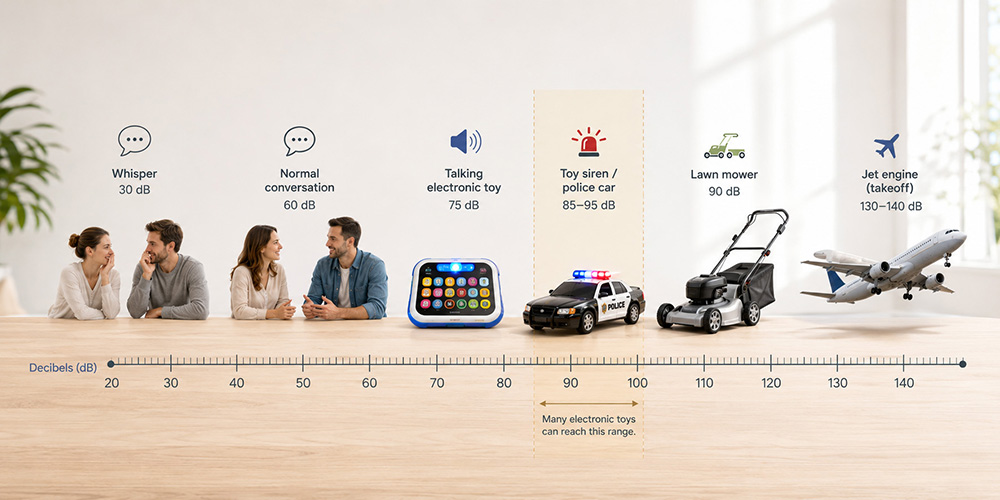
3. Squeaky rubber animals. Much louder than they look. The American Speech-Language-Hearing Association notes squeaky toys and toy sirens can hit around 85 decibels, roughly a lawn mower, and a level where adults at work would legally need ear protection. (ASHA)
Fine at arm's length. A problem squeezed against an ear, which is roughly always.
4. Emergency vehicles with sirens. Frequently the loudest object in the house.
Great pretend play, terrible acoustics. Check for a real off switch. Many have only "loud" and "louder."
5. Slime and kinetic sand. The quiet menace. Makes no noise and still ruins your week.
Actually worth it. That squishing is real sensory regulation. But contain it: one tray, one table, non-negotiable.
6. Toys with four hundred tiny pieces. Nobody hates the toy. Everybody hates the floor.
Some of the best toys ever made. This is a storage problem in a toy costume.
7. The catchphrase character. One line, several thousand times, in a voice engineered to cut through household noise.
The line that was funny in the shop is the line that will end you.
8. Recorders, kazoos and whistles. The gift that says "I do not have to live with you."
Real musical value, brutal learning curve. A boundary problem, not a ban.
9. Bubble machines, glitter and water beads. Magical in the backyard. Catastrophic on a carpet.
Outdoor toys that got indoors. Water beads carry a genuine safety warning: they expand after swallowing. Older children, supervised, only.
10. Ride-ons with a built-in sound system. Loud and mobile, so the noise follows you room to room like a small, cheerful stalker.
Excellent for gross motor. The speaker is usually easy to reach. Do with that what you will.
11. Interactive pets and talking dolls. They speak unprompted. Some wake up in the night, which nobody warns you about.
The unprompted talking is what makes these uniquely maddening, and it's not your imagination. More below.
12. Anything with a motion sensor. The toy that greets you cheerfully in the dark.
Remove the batteries. We can find no developmental argument for this category. There isn't one.
The Annoying Toy Cheat Sheet
Why Some Toys Drive Parents Genuinely Mad
Here's what surprised us most: it's not really about volume.
Sound that keeps changing (different notes, voices, melodies) is dramatically harder to tune out than steady sound at the same level. In one 2025 study, background sound averaging just 59 decibels, quieter than conversation, measurably wrecked people's memory performance. Adults were hit as hard as children. (Scientific Reports, 2025)
So what does this actually mean for parents?
Your dishwasher runs at 60 decibels and you never notice it. A toy cycling through eight melodies at 60 decibels makes you want to lie down in the road. Same volume, completely different effect on your brain.
Electronic toys are designed to keep changing. That's how they hold a child's attention. It's also exactly why you can't ignore them.
Did you know? Researchers in that study specifically checked whether people got used to the noise over time. They didn't. If you've been waiting to stop noticing the toy: that's not coming. Tape the speaker.
And the toy you didn't activate is always worse. A motion sensor chirping in a dark hallway is more jarring than a drum your child is deliberately hitting, even when the drum is louder. Sound with no warning and no obvious cause is the hardest kind to filter out, which explains the specific horror of the doll that talks when nobody's in the room.
You're not being precious. A UK study in PLOS ONE found around 18% of adults report everyday repetitive sounds causing real problems in their lives. It's called misophonia. (Oxford / King's College London) You're not failing at parenting. You're having an ordinary human reaction.
Are Loud Toys Actually Harmful?
Annoying and harmful are different questions. This one has a clearer answer.
The CDC estimates 12.5% of children and teenagers aged 6 to 19 (around 5.2 million young people in the US) have permanent hearing damage from noise. (CDC) The NIH's hearing institute puts the teen figure as high as 17%. (NIDCD)
Toys aren't the main driver; headphones matter more. But there's one detail that changes everything: toy safety standards test sound at 50 cm away, and children do not play at 50 cm. They hold toys against their faces. Held at the ear, ASHA notes, a 90-decibel toy can effectively reach 120 decibels, comparable to a jet taking off.
For scale: when the Sight & Hearing Association tested popular toys with a calibrated meter, 19 of 24 exceeded 85 decibels. The loudest hit 109.7. (Sight & Hearing Association)
So what does this actually mean for parents?
An occasional loud toy at arm's length won't hurt your child. A loud toy played with daily, pressed to an ear, for years, is a real and entirely preventable risk. Noise damage accumulates, and per the CDC it can't be fixed medically or surgically. The AAP's toy safety guidance is blunt: avoid toys that are loud. (HealthyChildren.org)
The two-second shop test: if it sounds too loud to you in the aisle, it is definitely too loud pressed against your child's ear. Better still, open a free sound meter app and hold your phone where the child's ear would be, not at arm's length. The number will surprise you.
So Why Do Kids Love These Toys?
Your child does not have bad taste.
Zero to Three explains that repeating an action is how babies learn cause and effect: doing this specific thing produces that specific result. Rattles, instruments and busy boxes get named specifically. (Zero to Three)
So what does this actually mean for parents?
When your eighteen-month-old presses the same button ninety times, they aren't winding you up. They're running an experiment and confirming the result. Ninety times, because that's how certainty gets built. A loud sound is simply excellent feedback: proof the experiment worked, and a rare taste of controlling their own world.
Which raises the obvious question: what happens when the toy does the work instead?
What Child Development Experts Actually Recommend
One principle reorganizes how you shop for toys forever, and Zero to Three states it bluntly:
"The more a toy does, the less your child has to do. If your child can sit and watch the toy 'perform,' then it is likely more entertaining than educational... the most useful toys are those that require the most action on the part of a young child." (Zero to Three
There's a sharper point buried in the same guidance: when a toy lights up without a clear button, a child can't tell which of their actions caused it. So the toy sold on cause-and-effect learning quietly undermines it.
The research on electronic toys and talking. A JAMA Pediatrics study recorded 26 parents playing with their babies using three toy sets: electronic toys, traditional toys, and books.
The researcher's own summary: parents "let the toys do the talking for them." (Sosa, 2016) Two further teams have since found the same pattern, including in autistic children, where researchers also found children themselves spoke less with electronic toys. (Sturman et al., 2022; Venker & Johnson, 2022)
So what does this actually mean for parents?
When the toy talks, you stop talking. Not from laziness, but because the conversation is already happening and there's no gap to fill. And you're the part that matters:
"A good toy does not have to be trendy or expensive. The best toys are those that support warm, verbally rich interactions and quality time for the parent or caregiver and the child." (American Academy of Pediatrics
The Quiet Ones Kids Keep Coming Back To
Here's a pattern we see constantly in our own work.
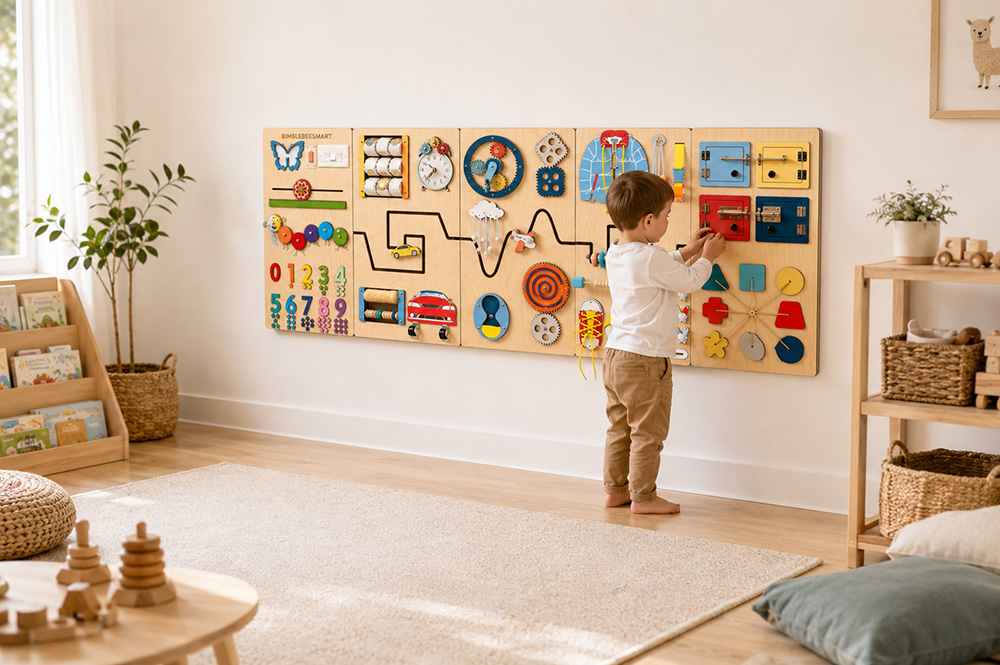
The toys parents describe as "the one she goes to every single day" are almost never the loud ones. They're usually silent, and they share one feature: nothing happens until the child makes it happen. A latch that opens. A zip that runs. A bolt that slides because a small hand slid it.
Same cause-and-effect loop the noisy toys are chasing, minus the soundtrack, with the child doing the work instead of watching. That's the design principle behind every busy board and sensory wall panel we make, and we'll come back to it. But first, something cheaper you should try.
You Probably Have Too Many Toys
Occupational therapy researchers at the University of Toledo watched 36 toddlers play in two setups: four toys available, or sixteen.
With only four toys, children:
- Played with each toy twice as long
- Played in 63% more different ways: stacking, dumping, pretending, sorting
- Switched between toys half as often
Too many toys, they concluded, is a distraction that pulls children out of deeper play. (Dauch et al., 2018) For context, families in that study reported an average of 87 toys at home. One reported 300.
So what does this actually mean for parents?
Put most of them in a cupboard. Rotate a handful every week or two. Novelty returns for free, the floor becomes walkable, and the noisy ones can spend rather more time in the cupboard than out of it.
If your playroom is the problem rather than the toys, the same logic points upward. Anything mounted to a wall can't be tipped out, scattered or stepped on, which is why families dealing with clutter tend to end up at boards fixed to the wall rather than another storage box.
Parent tip: rotation only works if children can't see the cupboard. Out of sight genuinely is out of mind at this age. A lidded box in a closet beats a shelf in the playroom every time.
How to Survive the Toys You Already Own
What to Buy Instead, by Age
Under one, keep it simple. Babies learn through mouths, hands and faces. Skip anything mounted, anything electronic, and most things marketed as developmental. Zero to Three points out you barely need toys at this age at all. Peek-a-boo outperforms most of the shelf.
Annoying toys for 3 year olds deserve a note, because this is where the biggest shift happens. Pretend play begins, and toys that dictate the script actively limit it. A doll with twelve recorded lines has already decided what the game is. It's also the age where mounting play up starts to make sense. Three-year-olds can stand, reach and concentrate for longer stretches, so a wall-mounted board or panel set gives them something that holds attention without loose pieces to scatter, works for siblings side by side, and doesn't surrender any more floor space. Panels can be added as they grow, which matters more than it sounds: the AAP specifically recommends choosing toys that grow with the child.
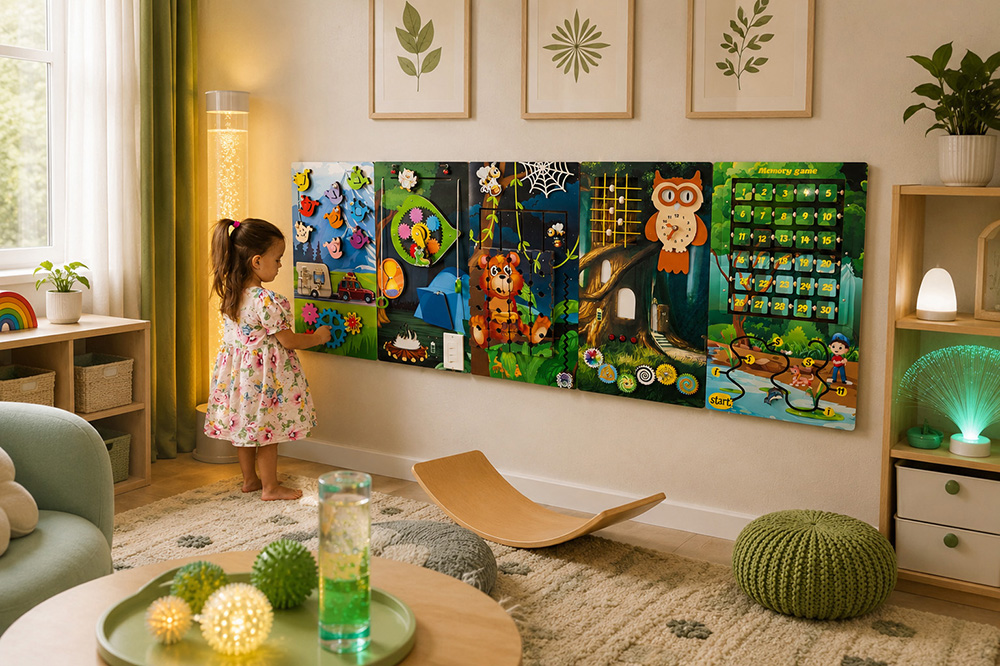
By four to six, the appetite is for harder challenges and cooperative play. Larger modular systems earn their place here: more complex mechanisms, enough surface for two or three children to work at once, and enough variety to support the elaborate imaginative scenarios this age invents. If you're building a dedicated play corner rather than buying another individual toy, this is the point where that decision pays off.
Annoying toys for 7 year olds are a different complaint entirely. By seven it's not what the toy does but how often: the repetitive click, the tinny speaker, the same effect on loop. Headphones stop being a luxury and become a peace treaty. Be honest with yourself here, too: most seven-year-olds are better served by strategy games, engineering kits and real instruments than by anything tactile on a wall. The exception is children with sensory needs, for whom a quiet tactile surface stays genuinely useful well past the age it stops being a toy.
Noisy Toys vs. Sensory Toys Parents Actually Enjoy
Every problem in this article traces to one root: the toy is doing the work the child should be doing.
That single flaw explains all of it. The looping soundtrack exists to hold attention the toy hasn't earned. The unprompted talking restarts interest. The short lifespan happens because once novelty burns off there's nothing underneath. And the noise reaches your ears because the feedback has to compete with everything else in the room.
Fix the root and the symptoms disappear.
A busy board is a panel of real working mechanisms (latches, bolts, zips, buckles, gears, laces) mounted so a child operates them independently. Sensory wall panels are the same idea, scaled up and fixed permanently to a wall. Neither does anything until a child makes it.
Those latches and buckles are doing real work: pincer grip, using both hands together, rotating the wrist. Fine motor ability measured at kindergarten entry predicts later reading, math and science achievement, in some analyses more strongly than early reading and math scores themselves. (Grissmer et al., 2010; Cameron et al., 2012)
So what does this actually mean? The child fiddling with a bolt for ten minutes isn't just occupied. They're building the hand control they'll need to hold a pencil.
Why the Wall Changes Everything
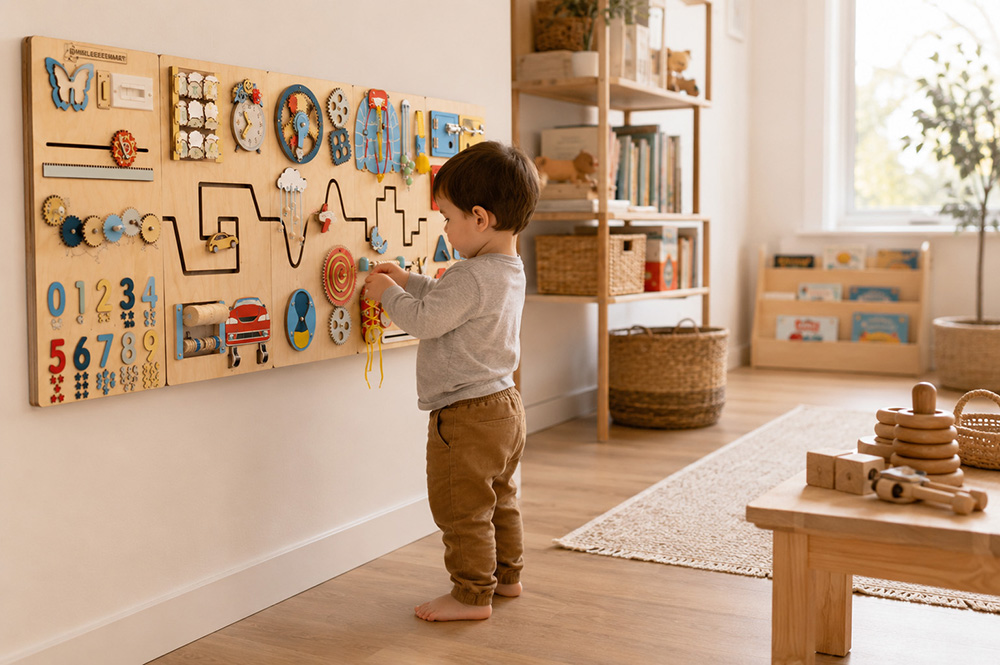
Parents are usually skeptical about wall-mounting until they see it. Then the reasons stack up fast.
Developmentally, pediatric occupational therapists deliberately use vertical surfaces: working against a wall promotes wrist extension, shoulder and elbow stability, core engagement and reaching across the body, all foundations for handwriting. (NESCA; Your Therapy Source) That's clinical practice reasoning rather than trial evidence (worth being straight about), but it's consistent across the profession and costs nothing to use.
Practically, a fixed panel has no floor footprint, no pieces to lose, no box to tip out, and nothing to step on at 2 a.m. Several children can use one at once without the territorial disputes a single toy creates. And it wipes clean in seconds, because there's nothing to disassemble.
That combination is why panels end up somewhere most toys never go.
Furnishing a playroom or a shared space?
Wall-mounted panel setsThey keep the floor clear and grow panel by panel.
Why Clinics and Classrooms Choose Panels
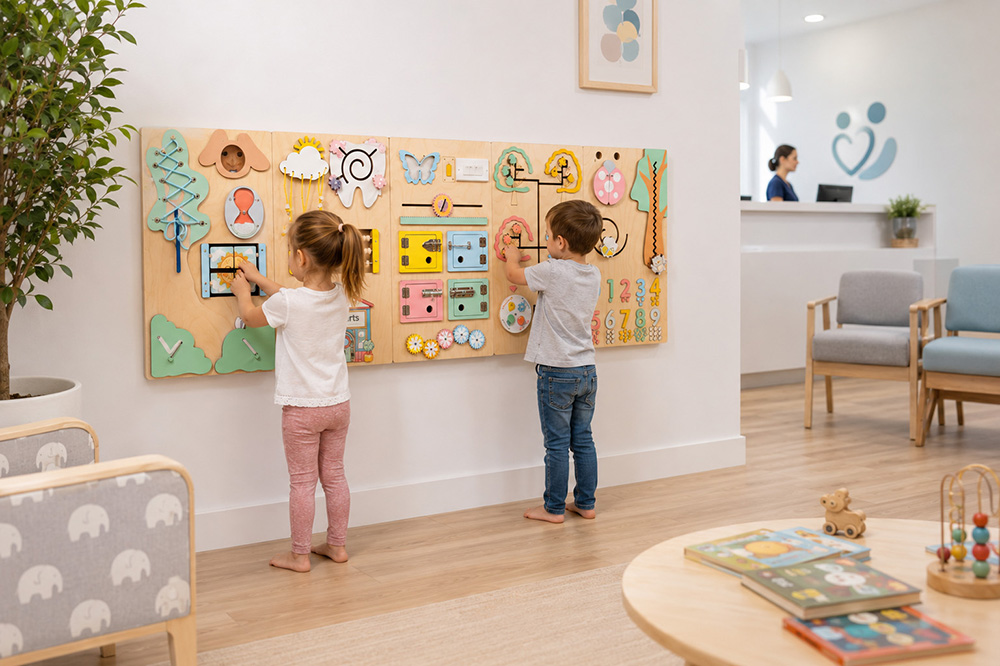
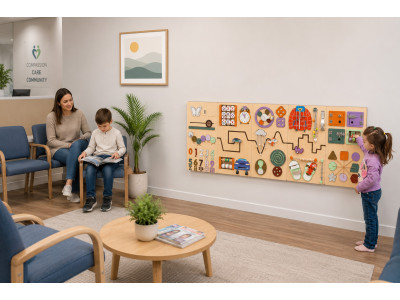
A pediatric waiting room has a brutally specific brief: engaging enough to distract an anxious child, quiet enough not to carry into a consultation, impossible to lose pieces from, sanitizable between patients, and safe for several children to share. Almost nothing meets all five. A toy box fails at least three.
A wall-mounted panel meets all of them, and holds up to heavy daily use, which is why panels suit dental practices, pediatric clinics, therapy centers, daycares and schools as well as family homes. The same logic holds in libraries, children's museums, family cafés and community centers: wherever floor space is contested and supervision is thin, vertical wins.
If you're specifying for a shared space rather than a single child, the practical questions are surface area, mounting height and how easily panels can be added later. Our sensory wall panels for clinics and shared spaces are modular for exactly that reason, and come in a range of themes if a specific scene fits the room better than a plain finish. Our guide to choosing a sensory wall theme covers which ones suit a calming versus an engaging space.
For Children With Sensory Differences
Auditory processing differences are reported in more than 70% of autistic children and stay prevalent through at least age nine. (PubMed, 2023)
For these children an unpredictable loud toy isn't mildly irritating. It can be genuinely distressing. Quiet, tactile, predictable, child-controlled materials do real regulatory work.
If you're setting up a home calm corner or a therapy space, sensory wall panels configured for autism support prioritize predictable tactile input and remove the startle factor entirely.
Why We Care About Getting This Right
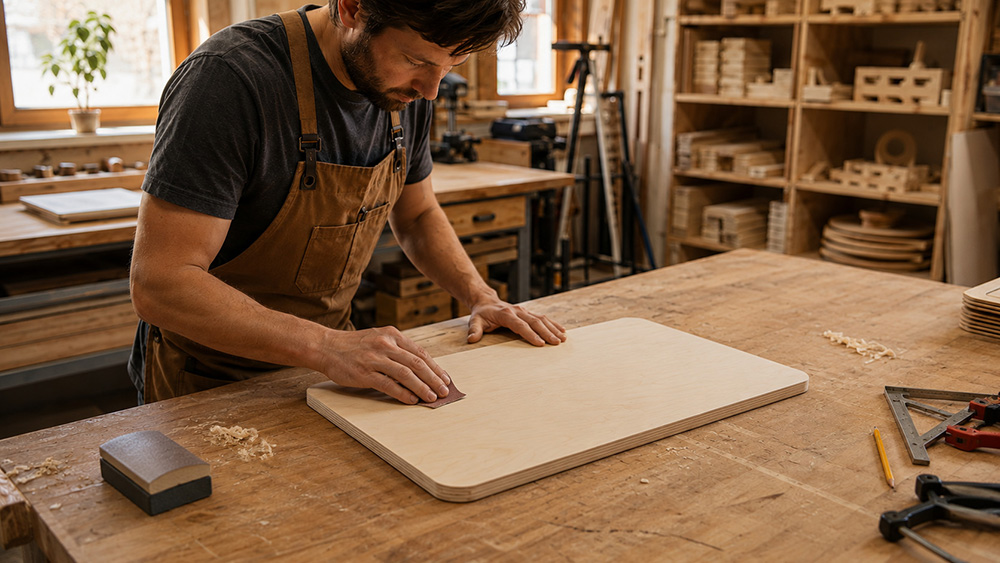
We're a small workshop, and every board is made by hand.
That matters here for one reason: when you build by hand rather than molding by the thousand, every mechanism has to justify itself. There's no room for a component that exists purely to make a noise in a shop.
So the first question on any design isn't "what can this do?" It's "what does the child have to do?" Which is the same question Zero to Three and the AAP keep arriving at from the other direction.
Replacing a noisy activity table?
Our handcrafted busy boardsThey cover the same ground with none of the soundtrack.
Frequently Asked Questions
Why do kids love noisy toys so much?
Loud sound is unmistakable feedback. Zero to Three explains that repeating an action is how babies learn cause and effect. A big noise on command confirms the experiment worked, and hands a small child a rare taste of control.
Are loud toys actually harmful?
They can be. The CDC estimates 12.5% of children aged 6 to 19 have permanent noise-related hearing damage. The risk sits in how toys are used: ASHA notes a 90 dB toy held at the ear can effectively reach 120 dB. Occasional use at arm's length is low risk. Daily use pressed to an ear is not.
What toys are safest for toddlers?
The AAP's checklist: age-appropriate, no small parts under three, no accessible button batteries or magnets, non-toxic, no strings over 12 inches and, explicitly, nothing loud. Shape sorters, blocks and simple puzzles are named as good developmental choices.
What toys don't make noise but still hold attention?
Building blocks and magnetic tiles, wooden puzzles, busy boards and sensory panels, play dough, small-world figures, peg mazes, water and sand trays, board books, art materials, marble runs. And fewer of them: the Toledo research found children played twice as long per toy when only four were available.
Are electronic toys bad for language development?
The research points one way consistently. Parents use markedly fewer words and have fewer back-and-forth exchanges during electronic toy play than with traditional toys or books. Three separate teams have now found this, including with autistic children. The mechanism is simple: when the toy talks, you stop.
Do busy boards actually help development, or is that marketing?
Honest answer: the product category itself hasn't been tested in randomised trials, and any brand claiming otherwise is overstating. What is established is each underlying component: that fine motor skill predicts school readiness, that toys requiring child action beat toys that perform, and that clear cause and effect supports early learning. Judge any board by whether it demands real manipulation, not by what the box says.
What age is a busy board useful for?
Roughly 10–12 months, when a child can sit and manipulate objects deliberately, through to about five or six, with mechanism complexity setting the upper limit. Younger toddlers do best with a small board at floor or crawling height; from around three, mounting it on the wall suits their standing reach and longer concentration far better.
The Bottom Line
The toys that annoy you most are rarely the ones that matter least.
The genuinely loud ones (drums, xylophones, whistles) are often excellent, precisely because your child is producing the sound. The ones doing quiet damage are the toys that perform on your child's behalf, wearing an "educational" sticker the research doesn't support.
Three things to take away:
- It's not volume, it's variation. A toy cycling through eight melodies costs you more than a dishwasher twice as loud.
- Fewer toys, rotated more often, beats more toys. Free, immediate, and the best change most households can make this week.
- Ask what the child has to do. If they can sit and watch it perform, it's entertainment, not education.
You're not being precious about the noise. You're having a well-documented reaction to a well-documented problem, and you're not going to get used to it.
Tape the speaker. Fill the cupboard. Buy fewer, better things.
And when someone asks what to get your child for their birthday, for the love of everything, tell them.


Write a comment