


A busy board and a sensory bin solve a similar problem in almost opposite ways. If you're weighing busy board vs. sensory bin for a specific child or space, the short answer is that they're built for different kinds of play, not really competing head to head. One is a fixed panel of mechanisms a child works with their hands. The other is a container of loose material a child digs through, scoops, and pours. Here's an honest comparison.
What each format actually is
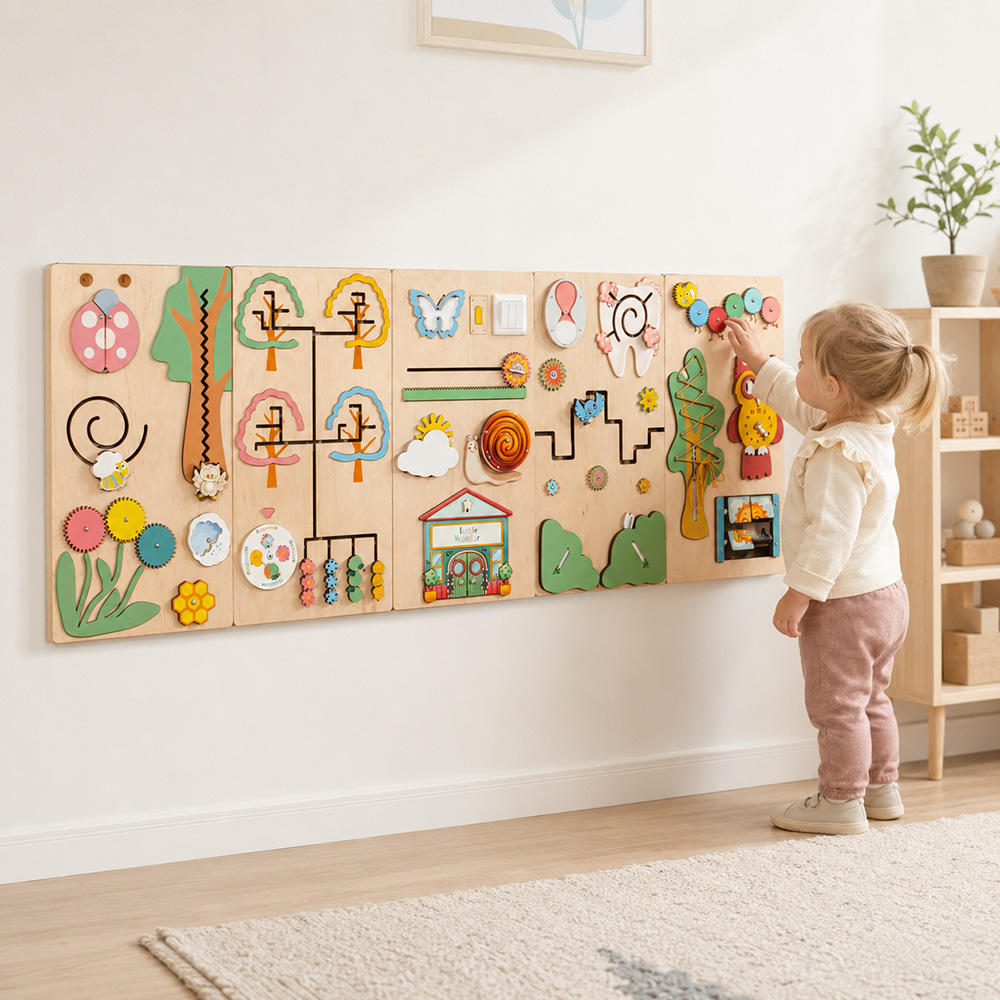
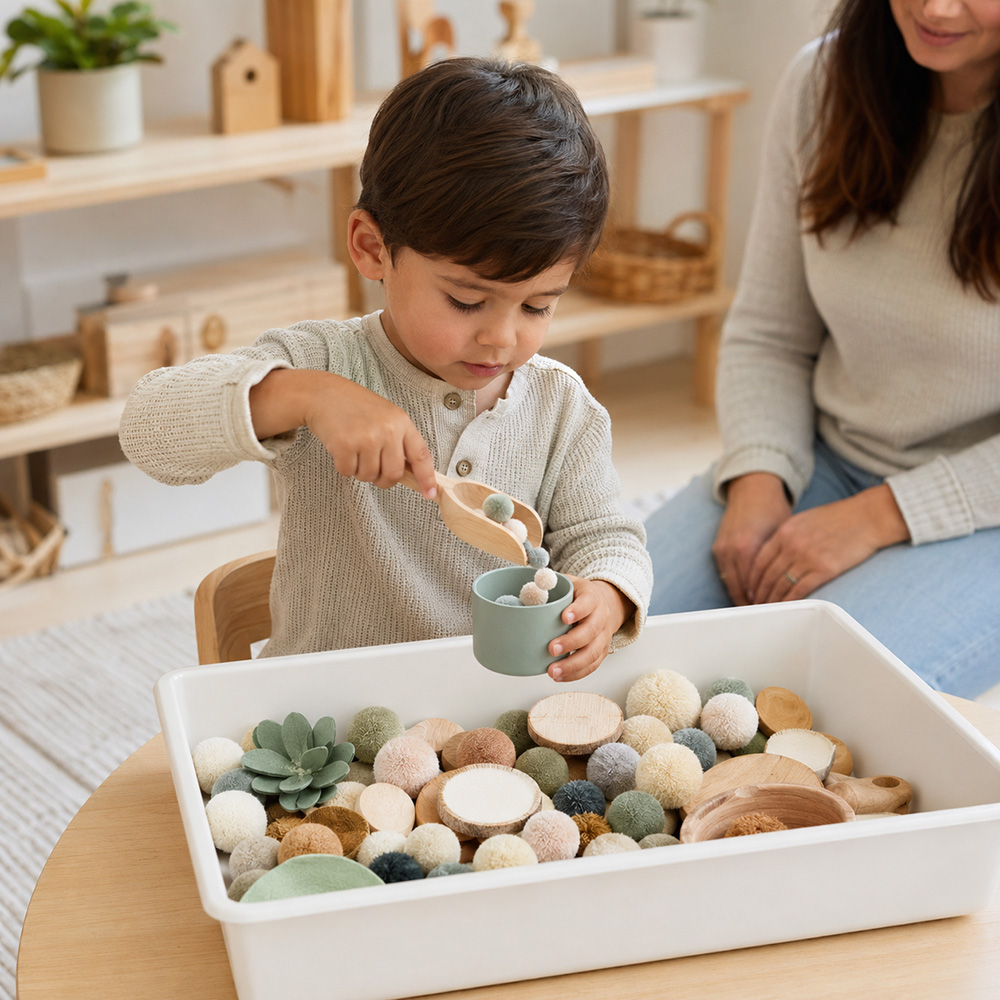
A busy board is a panel with fixed activities. Latches, gears, zips, sliders, and locks are mounted permanently, rather than left loose for a child to pull free during play. A sensory bin is different. It's a container, usually a plastic tub or tray, filled with a loose material such as rice, dried beans, water beads, sand, or pasta. Small scoops or toys are often buried inside for a child to find.
They target different things. A busy board asks a child to operate a specific mechanism and get a specific, repeatable result. A sensory bin asks a child to explore an open-ended material with their whole hand, with no fixed right answer.
We've built and installed busy boards for homes, Montessori classrooms, daycares, libraries, pediatric clinics and therapy centers over the years. Often that's alongside sensory bins rather than instead of them. The pattern we see most often is practical, not ideological. Caregivers reach for whichever format fits the moment, the space, and the child's age, and many settings use both at different times.
Where a busy board wins
A well-built busy board uses securely attached activities rather than loose sensory fillers. That matters more than it might sound like. Loose fillers are a real choking risk for children who still mouth objects. The Consumer Product Safety Commission's small parts rule specifically targets items that fit inside a child's throat. That covers a lot of common sensory bin fillers for children under three (CPSC). A well-built panel without loose fillers avoids one common source of choking risk associated with many sensory bins. Any mounted item should still be checked periodically for loose hardware, as with any wall fixture.
It's also low-mess and low-maintenance. There's no filler to spill, replace, or clean out of carpet. A fixed panel adds zero floor footprint and, once properly secured, stays firmly in place during normal use. See our safety and childproofing guide for what to check before mounting one. The activities provide repeated opportunities to practice movements such as pinching, turning, rotating the wrist, and using both hands together, through a specific mechanism, rather than open-ended tactile exploration. See our guide to fine motor development for more on how activities like these fit into a child's broader skill-building.
Where a sensory bin wins
This is worth saying plainly: a sensory bin does things a busy board can't. Full-hand, whole-arm immersion in a material is a different kind of sensory input entirely. Some children prefer that kind of whole-hand tactile input. Scooping and pouring can also introduce early experiences with volume, quantity, and cause and effect that a fixed mechanism doesn't offer.
Bins are also cheap to reinvent. Swapping rice for dried beans or adding a seasonal theme costs a few dollars and a few minutes. A busy board's activities, by contrast, are fixed once it's built. For open-ended, imaginative play, a bin has no script, and that's a real advantage for some children and some goals.
The comparison
The stability and small-parts advantages above assume a busy board is properly built and securely mounted. A panel that's only propped up, or hardware that isn't checked periodically, doesn't carry the same guarantee.
For most families, the choice isn't about which toy is "better." It's about matching the activity to the child's age, developmental goals, and the amount of supervision available. Age suitability for either format depends more on the child's developmental stage than on a fixed cutoff. Younger toddlers often benefit from the simplicity and predictability of a busy board, while older children can enjoy the open-ended exploration that sensory bins offer.
The considerations change a little in shared public spaces, where durability, hygiene, and ease of maintenance become just as important as developmental benefits.
Why many commercial spaces choose wall-mounted busy boards
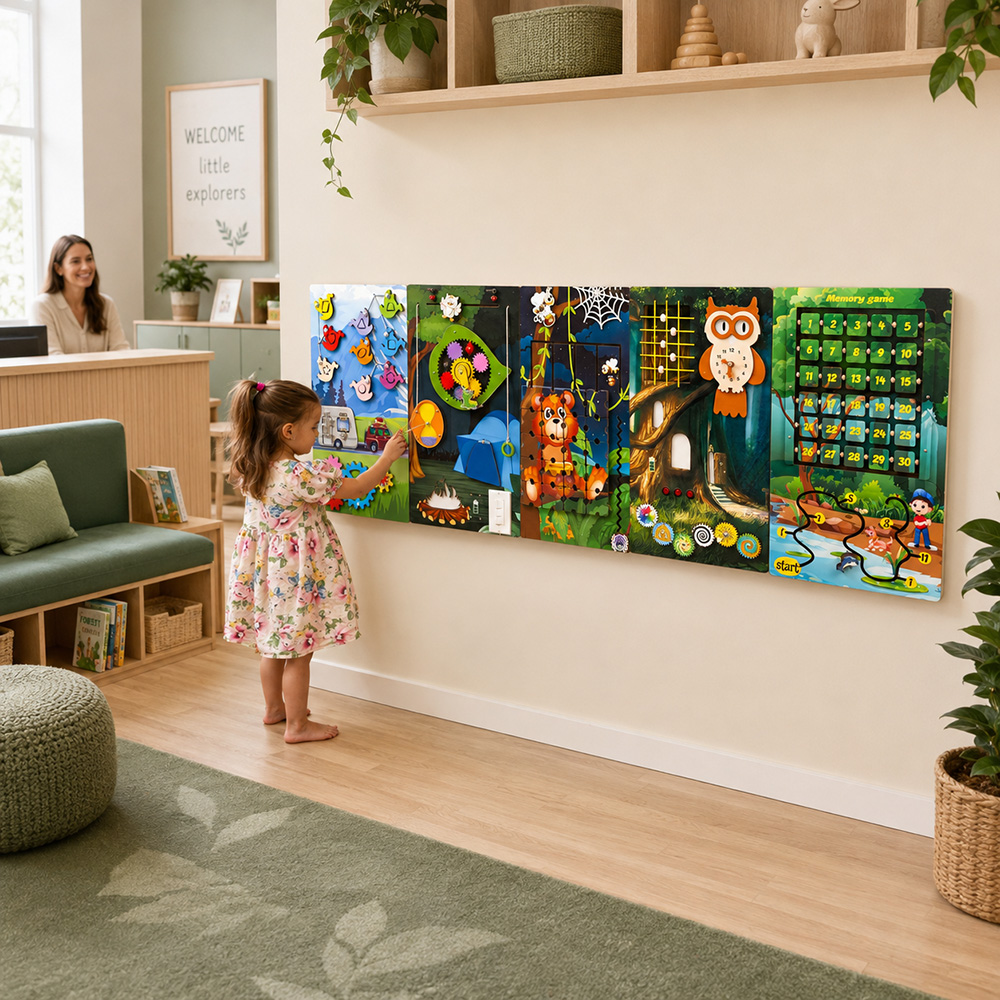
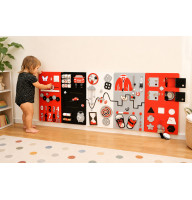
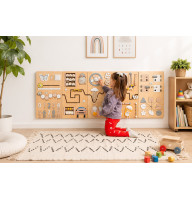
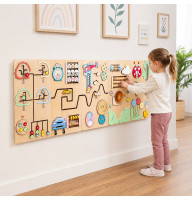
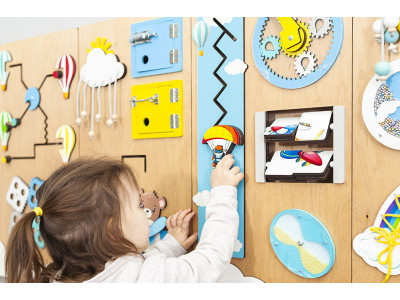
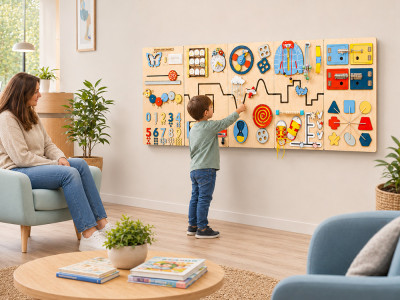
One advantage unique to wall-mounted busy boards is the vertical working position. Working on a vertical surface promotes wrist extension and shoulder stability, two movement patterns pediatric occupational therapists commonly encourage during play (NESCA; Your Therapy Source). While this reflects established OT practice rather than busy-board-specific clinical trials, it's one reason many therapists include vertical activities in treatment plans. Our guide to vertical surface activities covers the mechanism in more depth, and our wall-mounted collection shows the format in practice.
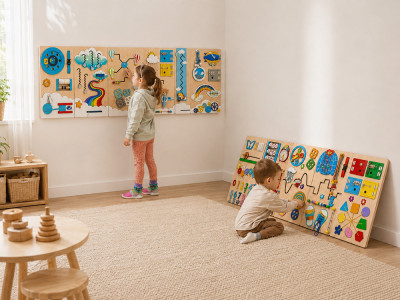
Wall-mounted busy boards are a common choice for schools, clinics, libraries and daycare centers outfitting permanent shared spaces, alongside our school, daycare, and clinic collections built for exactly that use. Beyond the developmental reasoning above, a few practical points come up again and again:
- No daily setup. A permanently installed board is ready the moment a child walks up, with nothing to fill, arrange, or put out each morning.
- Easier to sanitize. A fixed panel with no loose material is easier to wipe down between users than loose-fill sensory materials, which matters in a clinic or classroom used by many children throughout the week.
- No loose fillers to manage. Nothing to top up, sweep, or account for at the end of the day.
- Always ready to use. There's no "the bin is a mess right now" moment that takes it out of rotation.
- Several children at once. A mounted panel supports side-by-side use without one child blocking or emptying out a shared bin.
Choose a busy board if
- Your child still mouths objects or is not ready to use loose fillers safely.
- You want low mess and low ongoing maintenance.
- You're outfitting a school, clinic, or daycare where hygiene and safety oversight matter.
- You want a specific fine motor skill practiced repeatedly, not open-ended exploration.
Choose a sensory bin if
- Your child has moved beyond mouthing small objects and can use the chosen filler safely with close supervision.
- You want whole-hand, immersive tactile input, not just fingertip mechanisms.
- You're happy to supervise closely and clean up regularly.
- You want something cheap to reinvent with a new theme or filler often.
You don't have to pick just one
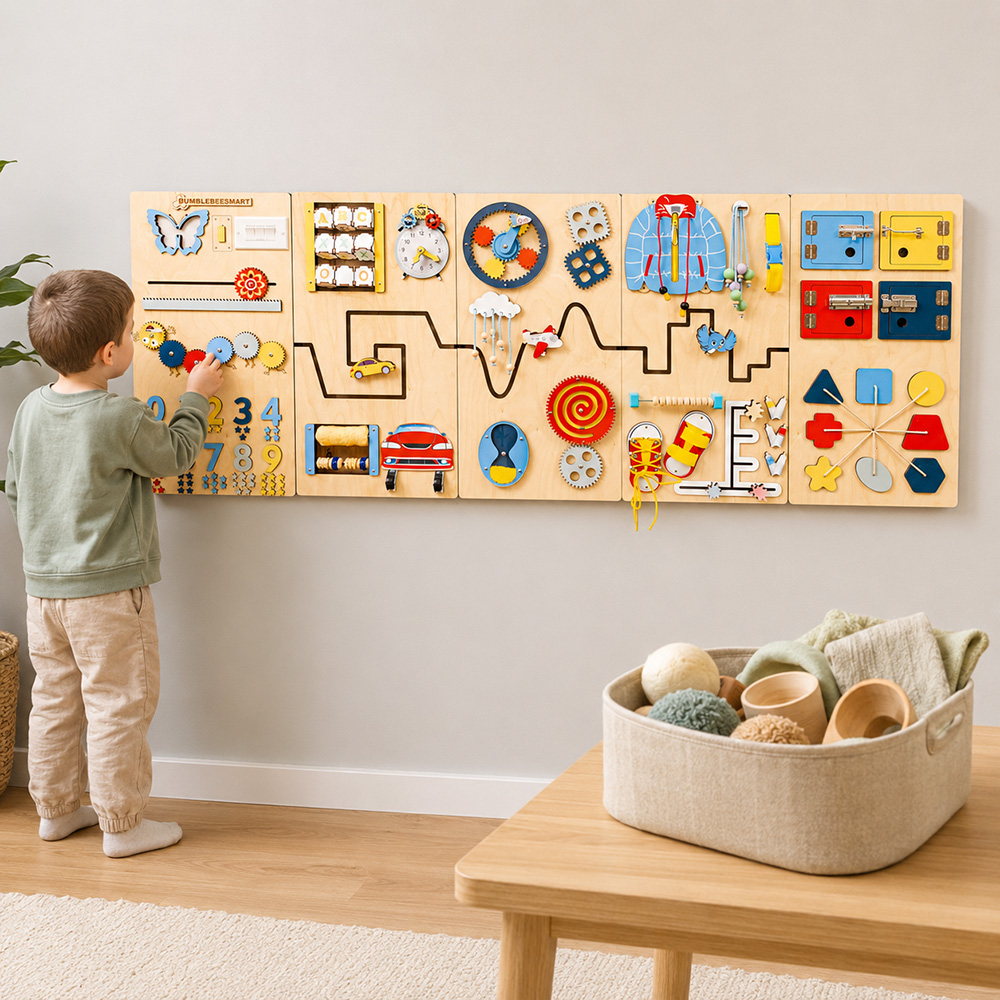
In practice, many families use a busy board for everyday independent play and bring out a sensory bin for occasional supervised sensory exploration. Rather than replacing one another, the two often complement each other at different stages of development and in different parts of the day.
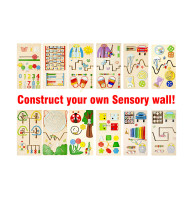
If a busy board fits your family's needs, our busy boards collection covers the format in more depth. Our panel-selection guide walks through sizing and safety considerations. Our themed panels and larger sensory wall panels are worth a look if you want more surface than a single busy board offers.
Leaning toward a busy board?
Explore handcrafted busy boards for homes, schools and clinicsSecurely attached activities, no loose sensory filler to manage, and a wall-mounted format designed for repeated everyday use.
Frequently asked questions
Is a busy board or a sensory bin better for toddlers?
A properly built busy board with securely attached activities avoids the loose-filler choking risk associated with many sensory bins. Sensory bins with small fillers carry a real choking risk during the mouthing stage and are better suited to children who have outgrown it.
Are sensory bins safe for young children?
It depends on the filler and the child's age. Many common fillers, like dried beans, small beads, or pasta, meet the size the CPSC defines as a choking hazard for children under three. Larger, food-based fillers under close supervision can work for younger children, but a well-built busy board without loose fillers avoids that particular source of choking risk.
Do schools and daycares use sensory bins or busy boards?
Both, but busy boards are generally easier to maintain across a shared space, since there's no filler to clean, replace, or supervise as closely. Sensory bins are still common in classrooms for supervised, structured activities.
Do I need both a busy board and a sensory bin?
Not necessarily, but many families find they cover different needs rather than competing directly. A busy board supports more independent play with less active monitoring, while a sensory bin suits supervised, open-ended sessions once a child is past the mouthing stage.
Do occupational therapists recommend busy boards over sensory bins?
It's not usually framed as one over the other. Pediatric occupational therapists often favor vertical, wall-mounted work for wrist extension and shoulder stability, while sensory bins serve a different goal around tactile exploration. An occupational therapist may use either or both depending on the child's goals and sensory profile, and this is general clinical practice reasoning rather than a head-to-head trial of the two formats.
What kinds of movements can a busy board help a child practice?
Busy boards focus on specific fine motor mechanisms, like pincer grip, wrist rotation, and cause-and-effect through a fixed latch or gear. Sensory bins provide different kinds of practice, such as scooping, pouring, and whole-hand tactile exploration, which a fixed mechanism doesn't offer.




Write a comment