


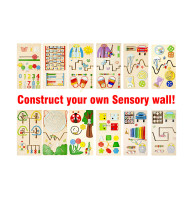
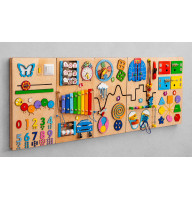
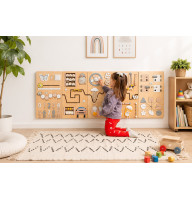
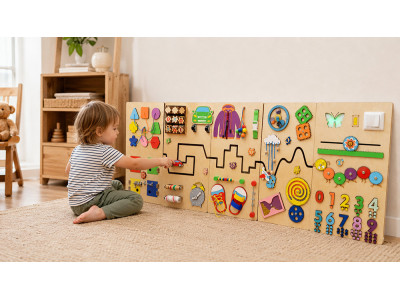
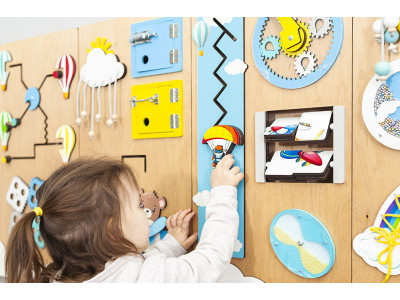
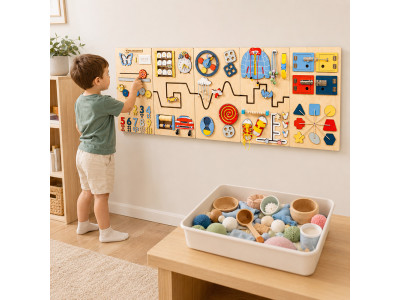
If you're a parent, teacher or caregiver, you may have wondered what you can use a busy board for. Busy boards, also known as sensory walls or activity boards, are wall-mounted panels covered in everyday objects. Zippers, latches, switches, buttons - children explore them by hand. They turn practical, real-life actions into hands-on learning.
How Busy Boards Help Children Develop
Manipulating the various elements on a busy board - buttons, latches, dials, zippers - helps develop fine motor skills. These are the small hand and finger movements needed for tasks like writing, buttoning clothing and turning pages.
Busy boards also build hand-eye coordination. A child has to look at an element, work out how it moves, then match their hand movements to what they see. It's the same skill used in eating, sports and handwriting.
Working out how to open a latch or turn a dial to the right position also builds reasoning skills. Children learn to solve small problems through trial and error rather than being shown the answer.
What Items Are Used on a Busy Board?
A busy board pulls together real-life inspired components that give children something concrete to practice on:
- Zippers and zip closures for dressing skills
- Buttons and snaps for finger strength
- Shoelaces for tying practice
- Fabric textures for tactile exploration
- Light switches (non-electric) for cause-and-effect learning
- Plugs and sockets (safe, non-functional)
- Letters and numbers for early literacy and math
- Bells and sound elements
- Analog clocks for time recognition
- Sand timers for visual time understanding
- Locks, latches and clasps for problem-solving
- Xylophones for musical exploration
- Gear wheels for mechanical thinking
- Abacus for early counting skills
- Small labyrinths for coordination and focus
Most boards combine a handful of these rather than all fifteen. Which elements make sense depends on the child's age and what a parent or teacher wants the board to practice.
Busy Boards and Imaginative Play
Beyond the mechanics, a busy board becomes whatever a child decides it is. The same panel of switches and dials might be a spaceship control panel one afternoon and a locked treasure chest the next. A parent can lean into this by turning play into a simple story - "unlock this door to find what's hiding behind it." That gives the child a reason to work through an element rather than just flip it once and move on.
This kind of open-ended, narrative play supports creativity alongside the fine motor practice. It also changes every time a child plays, so the same board stays interesting well past the first few sessions.
Sensory and Calming Benefits
Busy boards give children a focused, repeatable activity to settle into. Working through a familiar set of elements - the same latch, the same gear, the same texture - can have a calming effect. There's nothing new to figure out and no risk of getting it "wrong."
That predictability is part of why busy boards show up in calm corners, waiting rooms and quiet play areas. They give restless hands something purposeful to do.
Bonding Over a Busy Board
Playing together on a busy board is also a chance for shared attention. Show a child how one element works, then step back and let them explore the rest at their own pace. Narrating what they're doing - "you're turning the key, now it's unlocked" - builds vocabulary alongside the hands-on practice.
Patience matters here. Let a child experiment and get it wrong a few times before stepping in. Working it out themselves is most of the point.
Busy Boards by BumbleBeeSmart
At BumbleBeeSmart, we design Montessori-inspired sensory wall panels and busy boards that bring these elements together on one wall-mounted panel. They're used in homes, classrooms and therapy environments to help children build fine motor skills and independence through hands-on play.
For more on choosing the right elements and layout, see our guide to how busy boards support fine motor development.
Frequently asked questions
What age is a busy board good for?
Most children can start around age one to two with simpler elements like large latches and switches. Older toddlers and preschoolers can handle finer elements like zippers, shoelaces and small locks.
Do I need to show my child how each element works?
A quick demonstration helps for trickier elements like zippers or latches. Most of the value, though, comes from letting a child work it out themselves afterward.
Can a busy board replace other toys?
It's best thought of as one activity among several, not a replacement for open play, books or time outdoors. It's a good fit for moments that call for a focused, independent activity.
Is a busy board safe for young children to use unsupervised?
Always supervise young children during play, particularly under age three. Choose a board with securely fastened elements and no small parts that could detach.



Write a comment