


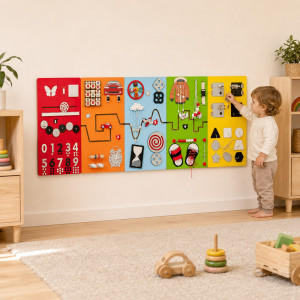
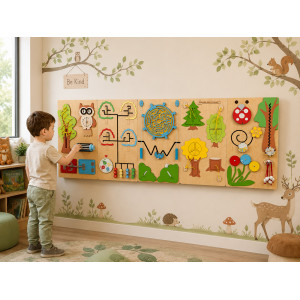

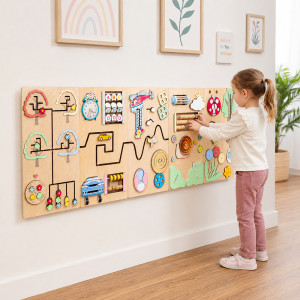


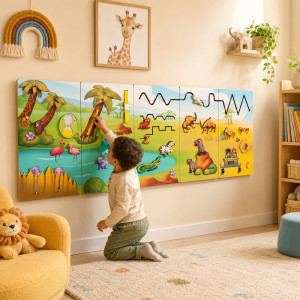

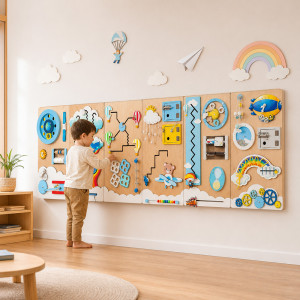


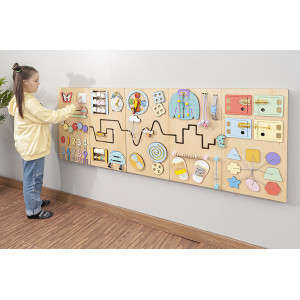
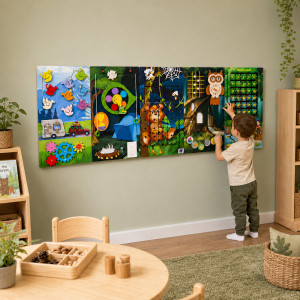
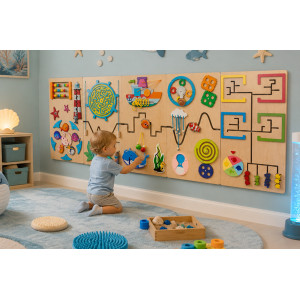


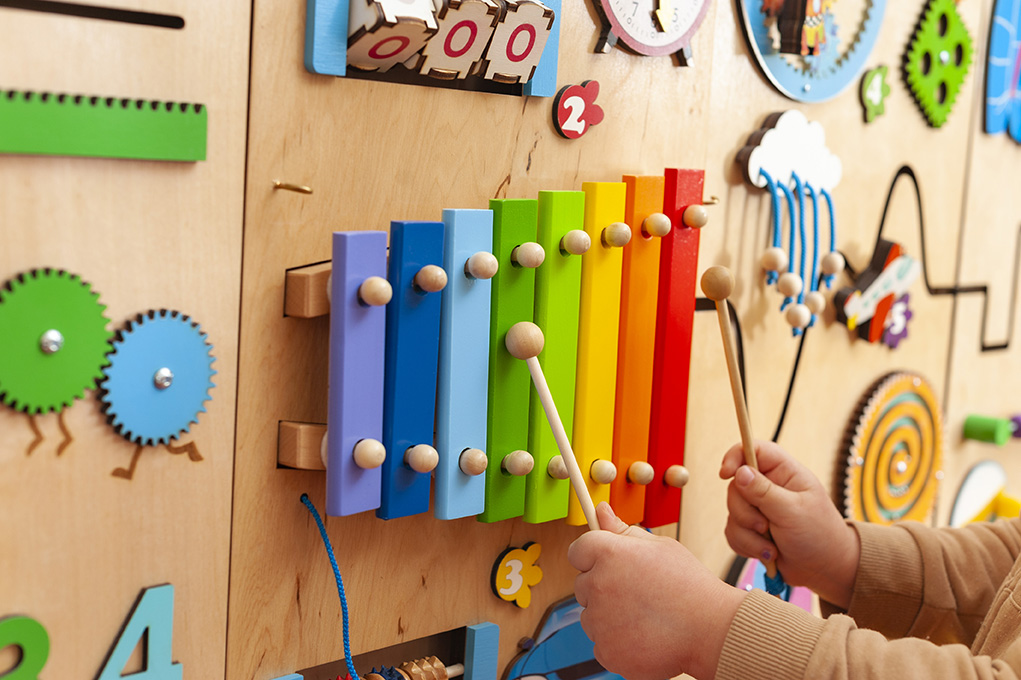
A busy board is a wall-mounted or freestanding activity panel covered in interactive elements - locks, latches, gears, zippers, spinners and switches. Children manipulate these by hand to build fine motor skills, hand-eye coordination and independent play. Unlike a single toy, it's a fixed activity station: it stays in place, holds up to daily use, and gives a child the same reliable spot to explore every day.
At BumbleBeeSmart we handcraft every board for homes, preschools, daycare centers, therapy clinics and waiting rooms. Each one is built from birch plywood and finished with non-toxic, water-based finishes - painted, printed or left as natural wood, depending on the theme. Elements are mechanically fastened rather than glued on - the difference between a board that survives years of daily use and one that doesn't.
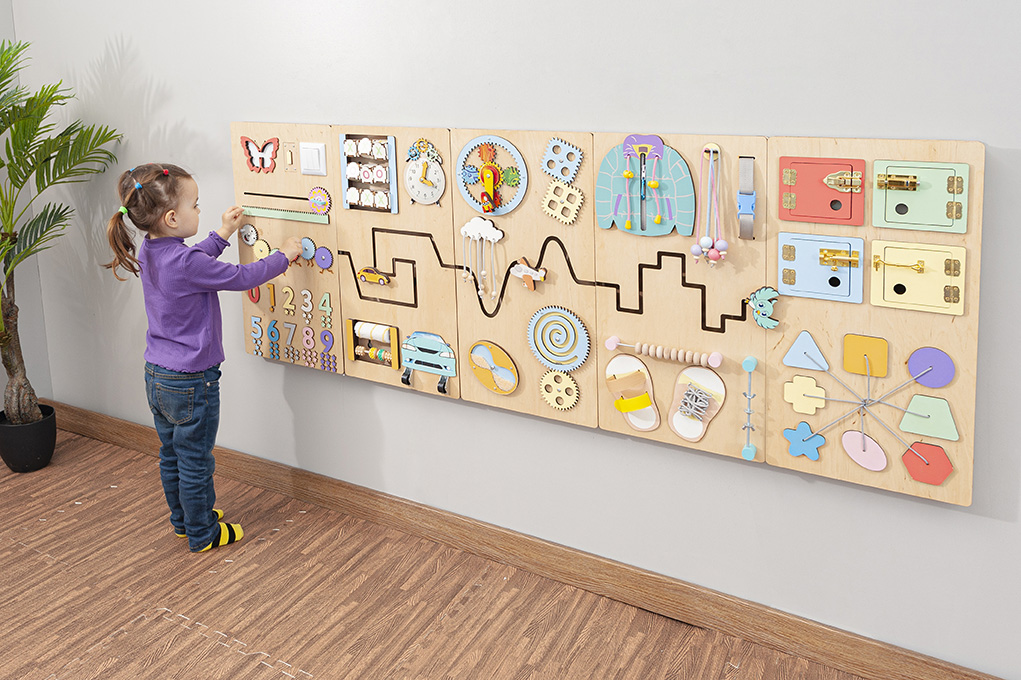
Why choose a busy board
It gives a child something purposeful to do with their hands. No screen is needed, and no adult has to set it up each time.
Builds real skills through repetition
Fine motor control, finger strength and hand-eye coordination all improve with the same kind of repeated, hands-on manipulation this format is built around - turning a latch, sliding a lock, spinning a gear.
Supports independent play
There's no single correct way to use one, so a child doesn't need an adult to start or direct the activity. That matters as much in a classroom with one teacher and many children as it does at home.
Holds attention without a screen
It gives a repeatable activity that doesn't wear out its welcome the way a single-use toy can. It's a genuine screen-free alternative, not just a marketing line - there's nothing to charge, load or restart.
Built to last, not to replace
Mechanically fastened elements and birch plywood construction mean it holds up to years of daily handling in a home, classroom or clinic, rather than needing replacement after a season.
What age is it for
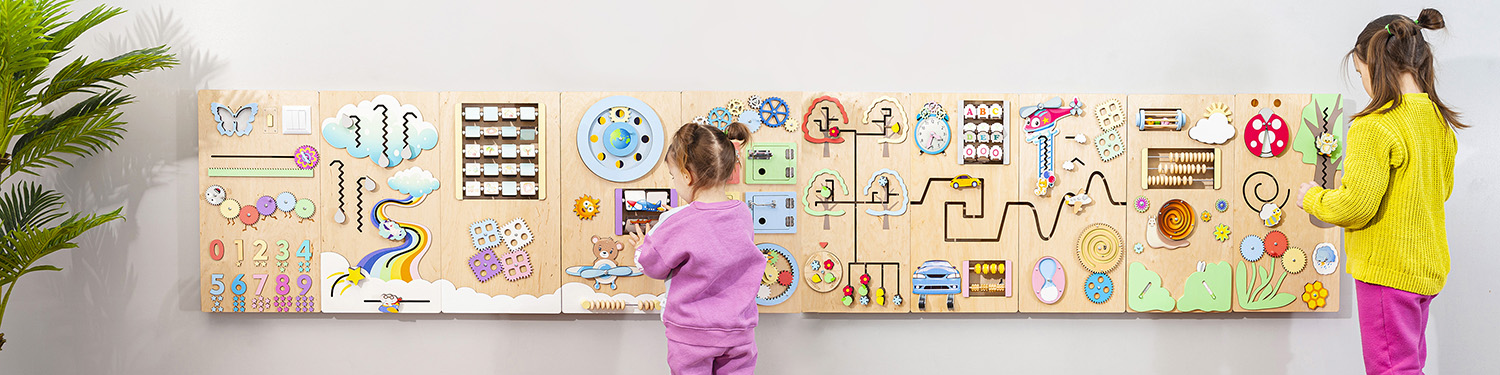
It works for children from about 1 to 8 years old. The right choice changes with age more than most toy categories.
- 1-2 years: large, simple elements - big latches, chunky switches, sliders. Close supervision around small parts.
- 2-4 years: the core age range for this format. Locks, zippers, gears and spinners match developing fine motor skills well.
- 4-8 years: boards with more elements and finer mechanisms - buckles, laces, multi-step sequences - hold attention longer and add problem-solving difficulty.
There's no single best age. It grows useful as long as its elements still challenge the child using it. For a full breakdown by developmental stage, see our guide on the best age for a busy board.
What to look for when buying one
Match the format to your space
Wall-mounted suits a fixed installation with zero floor footprint. DIY or modular suits a space where you need a specific size or want to choose your own element mix.
Match elements to age and setting
Simpler and larger elements for toddlers, more numerous and intricate ones for preschool age and up. A shared classroom or clinic setting also argues for sturdier, simpler mechanisms that hold up to more hands per day.
Check how it's built, not just how it looks
Mechanically fastened elements outlast glued ones. Ask whether locks, latches and gears are screwed or bolted in place rather than adhered - that's the detail that decides whether it survives a classroom year or a home playroom for years.
Confirm installation details up front
For a wall-mounted installation, confirm mounting hardware is included and suited to your wall type - drywall, brick or a shared partition wall each need different hardware.
Formats - which one fits your space
The term "busy board" covers several physical formats, and picking the right one matters more than picking the right theme.
For larger multi-panel installations built as a complete wall system, see our sensory wall panels collection.
Materials, base types and safety
Every BumbleBeeSmart board is handcrafted from birch plywood with non-toxic, water-based finishes. They come in three base types, which affect look and price rather than durability:
- Painted - solid color base with painted design elements
- Printed - a printed image base under mounted physical elements
- Unpainted - natural wood finish, elements mounted directly on bare birch
Every board is available for wall mounting or, on select models, portable use. Locks, latches and gears are mechanically fastened, not glued, so they hold up under repeated daily use in a classroom or clinic as well as at home. For full material and finish details, see our sensory wall safety guide.
Montessori and this format
This format follows Montessori principles of independent, self-directed activity. There's no single correct way to use one, and a child learns through their own exploration rather than instruction. The mix of practical, real-world mechanisms - latches, locks, zippers - mirrors the "practical life" activities at the center of Montessori early education. That's why it's a fixture in Montessori classrooms as much as in homes.
For a deeper walkthrough of sizing, materials and layout planning, see our guide to choosing sensory wall panels.
Busy boards by setting
- Schools and classrooms - see our sensory wall panels for schools collection
- Care homes and memory care - see our sensory wall panels for care homes collection
- Autism and special needs - see our sensory wall panels for autism collection
- Adults - see our sensory wall panels for adults collection
Need a custom one?
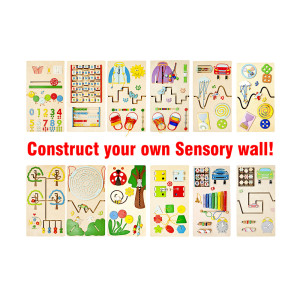
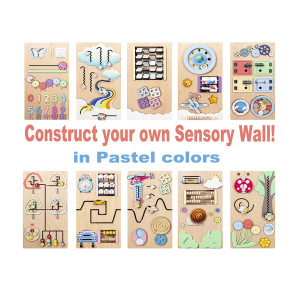
Whether it's a large wall installation for a school, a themed board for a clinic, or a specific size for a home playroom, we build to your space. You can also design your own using our DIY sensory wall builder - more than 24 modular panel designs to combine.
Frequently asked questions
What is a busy board?
It's a wall-mounted or freestanding activity panel covered in interactive elements - locks, latches, gears, zippers and switches - that children manipulate by hand. It builds fine motor skills and gives a child an independent, repeatable activity without screens or supervision. See our full guide on what is a busy board for more detail.
What age is it suitable for?
It suits children from about 1 to 8 years old. Toddlers do best with large, simple elements; older preschoolers and early elementary-age children get more from finer, multi-step mechanisms.
What's the difference between a busy board and a sensory board?
The terms overlap heavily in everyday use. It typically emphasizes mechanical fine-motor elements - locks, latches, gears. A sensory board leans more toward tactile and sensory variety - textures, sounds, visuals. Most BumbleBeeSmart boards combine both.
Wall mounted or DIY - which format should I choose?
Choose wall-mounted for a fixed installation with no floor footprint - classrooms, clinics, dedicated play walls. Choose DIY if you need an exact size or want to pick your own mix of elements.
Are busy boards good for classrooms and shared spaces?
Yes. Wall-mounted boards in particular hold up well to shared, repeated use since elements are mechanically fastened rather than glued. See our sensory wall panels for schools collection for classroom-specific options.
Is this safe for a shared or public space?
Yes, when elements are mechanically fastened rather than glued - that's the standard across every BumbleBeeSmart board. See our sensory wall safety guide for full material and construction details before ordering for a shared setting.
Related reading
- What is a busy board?
- What's the best age for a busy board?
- Busy board vs. sensory bin: an honest comparison
- How to choose sensory wall panels
- Sensory wall safety guide
See why families love BumbleBeeSmart
Our handcrafted boards bring hands-on learning, creativity and sensory play into homes, playrooms and learning spaces. See how children explore, discover and grow with BumbleBeeSmart activities every day.
Looking for a bigger wall system?
For multi-panel installations built as a complete wall rather than a single board, browse our sensory wall panels collection, or get in touch and we'll help you plan a layout, size and element mix that fits your room.