


The best toys for sensory development are not always the most expensive or the most high-tech. They are the ones that give a child something real to touch, see, hear and move, and a reason to come back to it tomorrow. This guide sorts the options by sense and by age. It covers toys we make and plenty we don't, so you can build a mix that fits your child and your space.
Sensory play simply means play that engages the senses. Children use it to learn how objects behave: what is soft, what rolls, what clicks, what happens when a latch opens. No single toy covers every sense, so the best toys for sensory development work as a small, varied set.
What Makes a Toy Good for Sensory Play
Before looking at specific toys, it helps to know what the best toys for sensory development have in common. Look for these five qualities:
- Real variety of input. Different textures, weights, sounds or colors in one toy give a child more to compare.
- Clear cause and effect. A switch that turns something, a door that opens, a bell that rings. Children repeat actions that produce a visible result.
- Open-ended use. Toys without a single correct answer keep working as a child's skills change.
- Room to grow. The same toy should offer a simple task for a younger child and a harder one later.
- Built for the setting. A toy for a busy classroom needs to survive far more handling than one used at home.
Sensory Toys by Sense
Grouping the best toys for sensory development by sense makes it easier to spot gaps. Most families already own plenty of visual toys and very few that give movement or tactile feedback.
Touch (tactile)
Tactile toys let children feel differences in texture, temperature and resistance. Good options include sensory bins filled with rice, dried beans or water, play dough, textured balls and fabric books. Many busy boards add tactile patches alongside latches and zippers, which pairs touch with hand work. If you are weighing a bin against a board, our comparison of a busy board vs a sensory bin looks at mess, supervision and setup.
Sight (visual)
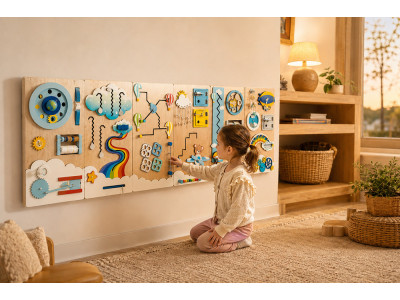
High-contrast cards suit young babies. Toddlers enjoy mirrors, color sorting, stacking cups and anything with moving parts they can track. Light-up toys belong here too, as long as they respond to what the child does rather than flashing on their own. Our interactive wall decor with touch-sensitive lights is built around that idea: the light changes only when a child touches a panel.
Sound (auditory)
Simple instruments work well: shakers, drums, xylophones and rain sticks. Toys that let a child control the volume and rhythm are better than those that play a recording. A loud electronic toy can be fun for a minute, but it gives the child very little to figure out.
Movement and body awareness
Two senses often get forgotten. The vestibular sense tracks balance and motion. Proprioception tells a child where their body is in space. Rocking toys, balance boards, tunnels, push toys and heavy objects to carry all feed these senses. Most of these toys live on the floor or outdoors and need open space.
Hands and fine motor control
Twisting, pinching, sliding and turning build the small hand movements used later for drawing, buttoning and using a spoon. Lacing cards, puzzles with knobs and large beads all help. Peg maze boards add a planning element, because the child has to steer a peg around turns without lifting it. For the wider picture, see our guide on how to develop fine motor skills.

Which Toys Suit Which Age
Age ranges are a guide, not a rule. The best toys for sensory development at each stage match what a child is already trying to do. Children move through these stages at their own pace, so watch what holds your child's attention and adjust from there.
| Age | What children are exploring | Toys that fit |
|---|---|---|
| 0 to 12 months | Looking, grasping, mouthing, listening | High-contrast cards, soft textured toys, rattles, unbreakable mirrors |
| 1 to 2 years | Cause and effect, standing play, simple hand tasks | Push toys, shakers, stacking cups, low-mounted busy boards with large parts |
| 2 to 3 years | Latches, sorting, pretend play, more precise grips | Sensory bins with supervision, play dough, shape sorters, busy boards with locks and gears |
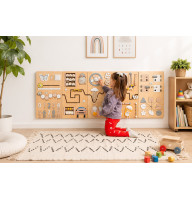
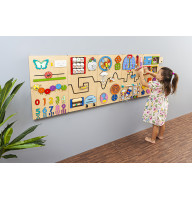
| 3 to 5 years | Planning, sequences, matching, cooperative play | Peg mazes, memory games, lacing, balance boards, larger sensory wall panels for shared play |
Busy boards in particular have a wide range, because the same board can be used simply at first and in more complex ways later. Our guide to the best age for a busy board goes into this in more detail.

Wall-Mounted Panels vs Floor Toys
Wall-mounted panels are one option among the best toys for sensory development, not a replacement for the rest. Here is an honest look at where they work well and where floor toys win.
Where wall panels do well:
- They take no floor space and cannot be tipped over or carried off.
- Parts stay attached, so nothing gets lost under the sofa.
- Several children can use a large panel at the same time, side by side.
- Standing play at a vertical surface gives a different posture from sitting at a table.
Where floor toys do better:
- Movement toys, such as balance boards and tunnels, need open floor space.
- Messy tactile play, like water and sand, belongs in a bin or outdoors.
- Portable toys can travel with a child from room to room.
Most homes and classrooms end up with a mix. Our article on a wall-mounted vs freestanding busy board compares the two formats in more depth.
Choosing for Home, Daycare or a Clinic
The setting changes what matters most.
At home, variety beats volume. The best toys for sensory development at home are a handful covering different senses. Rotate them every few weeks to keep interest high. A single mounted board can anchor a play corner in a small room.
In daycare and preschool, durability and shared use come first. Toys need to handle many children every day and be easy to wipe down. Larger panel sets suit this well, and our page on sensory wall panels for daycare covers group settings specifically.
In waiting rooms and therapy spaces, quiet, self-explanatory activities work best. Children should be able to start playing without instructions and stop without a mess to tidy. Many families of children with sensory differences also find that predictable, repeatable activities are easier to settle into. Our article on why sensory play matters for autistic children looks at this in more depth.

Safety Checklist Before You Buy
- Small parts. For children under three, avoid anything that could fit inside a toilet paper tube. That is a common home check for choking hazards.
- Attached parts. Pull firmly on knobs, beads and fittings. Nothing should come loose.
- Finishes. Look for smooth, sealed surfaces and ask the maker what the finish is.
- Cords and strings. Keep them short on toys for babies and toddlers.
- Mounting. Wall-mounted toys should be fixed securely into studs or with proper anchors.
- Supervision. Sensory bins with small fillers, water play and play dough need an adult nearby.
Our sensory wall panel safety guide covers mounting and materials for wall panels in particular.
Where to Go From Here
There is no single list of the best toys for sensory development that suits every child. Start with the senses your child uses least, then add from there.
If you already know a wall panel is right for your space, our guide to the best sensory wall panels for kids explains how to compare sizes, themes and activities. For smaller toys you can move from room to room, browse our activity toys.
Frequently Asked Questions
What are the best toys for sensory development for a toddler?
For children between one and three, look for toys with clear cause and effect and simple hand tasks: shakers, stacking cups, shape sorters, push toys and busy boards with large latches and gears. Add one tactile option, like play dough or a supervised sensory bin, to cover touch.
How many sensory toys does a child need?
Fewer than most people expect. A small set that covers touch, sight, sound, movement and hand skills is enough. Rotating toys every few weeks keeps them interesting without buying more.
Are electronic toys good for sensory development?
It depends on who is in control. Toys that respond to a child's action, such as a light that turns on when a panel is touched, give the child something to figure out. Toys that play sounds and lights on their own mostly ask the child to watch.
At what age can a child start using a wall-mounted busy board?
Most children start around 12 months, once they can stand and reach. Mounting the board lower helps younger toddlers, and the same board stays useful into the preschool years as children move on to harder activities.
Can sensory toys be used with children who have sensory processing differences?
Yes, many families and educators use them. Every child responds differently, so start with one type of input at a time and watch how your child reacts. If your child works with an occupational therapist, ask which sensory activities they recommend. Sensory toys are play materials, not a treatment.
Building a sensory play space?
Shop sensory wall panelsFurnishing a school, daycare or clinic? Ask our team about larger installations.






Write a comment